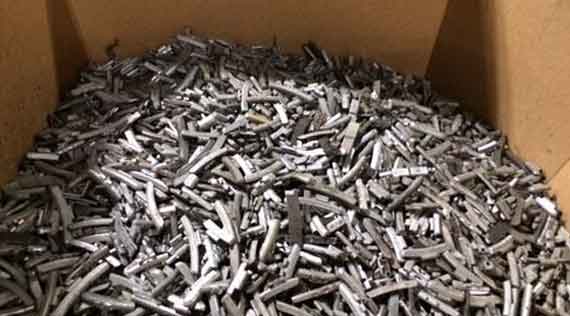
Lead Wheel Weights Scrap consists of used lead-based balancing weights recovered from vehicle wheels. These small metal weights help correct uneven mass distribution in tire and wheel assemblies, reducing vibration during operation.
Wheel weights are also manufactured from zinc and steel. Accurate identification matters because lead, zinc, steel and mixed wheel-weight scrap can have different purchasing grades, processing requirements and values. Lead-containing weights also require appropriate handling because of lead exposure and environmental concerns.
Lead Wheel Weights Scrap: Quick Facts
- Material category: Nonferrous lead scrap
- Principal material: Lead or lead-based alloy
- ReMA/ISRI trade code: Ropes (Lead Wheel Weights)
- Related mixed grade: Reels (Mixed Nonferrous Wheel Weights)
- Common sources: Tire shops, automotive service centers, vehicle dismantlers and wheel repair operations
- Common alternatives: Zinc and steel wheel-balancing weights
- Primary grading factors: Metal composition, iron clips, mixed weights and foreign material
- Potential buyers: Nonferrous scrap processors and specialized lead recyclers
What Are Lead Wheel Weights?
Wheel weights are small components attached to vehicle wheels to balance the rotating tire and wheel assembly. They compensate for uneven mass distribution that can otherwise cause vibration.
Traditional lead wheel weights use lead-based metal and may include a steel or iron attachment clip. Adhesive-backed balancing weights are another configuration and may use lead, zinc or steel, depending on their design and production period.
Lead was historically used because it is dense and relatively easy to form. However, environmental and health concerns have encouraged the use of alternative materials and led to restrictions in several jurisdictions.
Important distinction: Not all wheel-balancing weights contain lead. Modern scrap streams can include zinc, steel and mixed-material weights, which should not automatically be sold as lead scrap.
ReMA/ISRI Lead Wheel Weight Scrap Specifications
The Recycled Materials Association (ReMA) maintains the ISRI Specifications used as reference descriptions in recycled commodity trading. The January 2026 specifications identify two relevant wheel-weight grades.
Ropes: Lead Wheel Weights
Ropes is the trade code for lead wheel weights. Qualifying material can include attached iron clips. The grade is intended for lead wheel weights rather than unrelated lead products such as battery components, lugs or lead plates.
Foreign material should be excluded, and the final purchasing requirements are established between buyer and seller.
Reels: Mixed Nonferrous Wheel Weights
Reels is a separate trade classification for mixed wheel-weight scrap. Under the January 2026 specification, this material must contain at least 35% nonferrous material overall and no more than 65% iron.
The nonferrous fraction may include both lead and zinc weights. The material must also meet agreed requirements for foreign contamination.
Reels should not be presented as a clean lead-only grade. Its mixed composition affects how the material is evaluated and processed.
Lead vs. Zinc vs. Steel Wheel Weights
Different wheel-weight materials have different properties and may require separate recycling streams.
| Material | Common Characteristics | Recycling Consideration |
|---|---|---|
| Lead | Dense, relatively soft and commonly gray | Separate lead-bearing stream with exposure controls |
| Zinc | Less dense than lead; generally harder | Separate zinc-bearing stream where required |
| Steel | Ferromagnetic and typically harder than lead | Ferrous material, subject to buyer grading |
The characteristics above are identification clues, not definitive tests. Plating, coatings, steel mounting clips and product variations can make visual sorting unreliable.
How to Identify Lead Wheel Weights
Sorting wheel weights begins with identifying their composition and separating unrelated components.
- Check markings: Some weights carry material designations, such as Pb for lead, Zn for zinc or Fe for iron/steel.
- Inspect the design: Identify clip-on and adhesive-backed weights, including attached clips or adhesive residue.
- Check magnetic response: A magnet can help identify ferrous components, but the presence of an iron clip does not mean the weight itself is steel.
- Separate clearly identified materials: Keep lead, zinc and steel weights apart when required by the buyer.
- Set aside uncertain items: Do not rely on appearance or softness alone to determine composition.
- Confirm buyer specifications: Ask whether the receiving processor purchases clean Ropes material, mixed Reels material or another category.
Safety note: Do not file, grind, melt, burn or chemically test unknown wheel weights to identify the metal. Where composition cannot be established from markings or reliable records, consult a qualified materials buyer or testing service.
Common Sources of Lead Wheel Weights Scrap
Wheel-weight scrap is primarily generated through vehicle maintenance and dismantling activities.
- Tire retailers: Used weights removed during tire installation and wheel balancing
- Automotive repair shops: Weights generated during wheel and suspension service
- Wheel repair facilities: Removed clip-on and adhesive-backed balancing weights
- Vehicle dismantlers: Weights recovered during permitted vehicle and wheel processing
- Fleet service operations: Scrap generated through routine tire maintenance
- Commercial tire operations: Material accumulated during ongoing tire and wheel servicing
Because modern wheel weights may use different metals, source alone does not establish whether a collected batch qualifies as lead wheel weight scrap.
What Lowers the Value of Lead Wheel Weights?
Lead wheel weights can be downgraded or purchased under a different category when their composition does not match the buyer's lead grade.
Mixed Zinc and Steel Weights
Unsorted loads containing lead, zinc and steel may be priced as mixed wheel weights rather than clean lead wheel weight scrap.
Excess Foreign Materials
Rubber, plastic, dirt, excessive adhesive backing, packaging and unrelated debris may affect buyer acceptance or increase processing costs.
Unidentified Metal Content
Lots containing unknown metals may require additional sorting or testing. Some buyers may decline unidentified material.
Unrelated Lead Scrap
Battery plates, lead lugs, cable coverings and other lead products should not be mixed into the Ropes grade unless specifically accepted under the purchasing agreement.
Lead Wheel Weights Scrap Prices
Lead Wheel Weights Scrap prices are influenced by recoverable lead content, contamination, composition, lead-market conditions and the cost of processing the material.
The price for a clean lead wheel-weight shipment may differ from the price for mixed lead/zinc/steel weights or other lead grades.
What Determines the Buying Price?
- Lead content: The quantity of recoverable lead affects the material's metal value.
- Grade: Ropes and mixed Reels material are different commercial categories.
- Foreign metals: Zinc and excessive ferrous content can affect classification and pricing.
- Contamination: Dirt, adhesives and unrelated waste can increase handling costs.
- Quantity: Larger consistent lots may qualify for different terms.
- Location: Transportation costs and access to lead processors influence net value.
- Market conditions: Secondary lead demand and current lead-market prices affect purchasing economics.
Available Lead Wheel Weights Prices
Review RecyclingMonster's available buying-price records below. Check the reporting date, currency, unit, location and exact grade before making a comparison.
The prices listed below are country averages paid by recycling centers in the United States
| Scrap Material | National Average | High Price | Low Price | Unit | Updated |
|---|---|---|---|---|---|
| Scrap Wheel Weights Scrap | $0.12 | 0.12 | 0.12 | USD/LB | 2018-12-20 |
| Auto Batteries Scrap | $0.27 | 0.27 | 0.27 | USD/LB | 2018-11-28 |
| Lead Wheel Weights Scrap | $0.11 | 0.11 | 0.11 | USD/LB | 2018-04-20 |
| Soft Lead Scrap | $0.41 | 0.41 | 0.41 | USD/LB | 2018-04-20 |
| Lead Scrap | $30.48 | 32.64 | 28.31 | USD/LB | 2018-03-07 |
For additional records, visit Lead Wheel Weights Scrap Prices or the broader Lead Scrap Price Guide.
Historical quotations should not be interpreted as guaranteed current offers, and prices for other lead grades should not be automatically applied to wheel weights.
How to Sort and Prepare Wheel Weights for Recycling
Appropriate preparation focuses on accurate classification, contamination control and the receiving facility's requirements.
- Collect removed weights in suitable, clearly identified containers.
- Separate lead, zinc and steel weights when identification is reliable and the buyer requires it.
- Keep lead wheel weights separate from batteries and unrelated lead scrap.
- Remove loose unrelated debris without grinding or damaging the weights.
- Keep different grades labeled and record the weight of each shipment.
- Avoid activities that generate lead-containing dust, fumes or unnecessary surface contamination.
- Confirm acceptance requirements, collection arrangements and transportation procedures before shipping.
Important: Never melt wheel weights or use heat to remove clips or coatings as an informal preparation method. Lead heating and melting can create hazardous exposure conditions and may be subject to workplace and environmental controls.
Lead Wheel Weights and Environmental Regulations
Lead is a toxic metal, and releases from lost or discarded wheel weights have been an environmental concern. Regulations governing the manufacture, sale, installation and disposal of lead wheel weights differ by jurisdiction.
United States
Several U.S. states restrict the use of lead wheel-balancing weights. However, there is no equivalent nationwide TSCA rule banning all lead wheel weights.
In December 2024, the U.S. Environmental Protection Agency announced that it would not proceed with a proposed federal rulemaking on lead wheel weights. Its assessment noted that nine states had adopted restrictions at that time.
Applicable state rules may address different activities, including sale, installation or use. Businesses should check current state requirements rather than assuming that the same restrictions apply nationwide.
Canada
Canada has national restrictions on the manufacture and import of wheel weights containing lead above the applicable regulatory threshold, subject to the regulation's specific provisions.
Businesses should distinguish these restrictions on new wheel weights from the rules governing collection, handling and recycling of existing used material.
Collection and Waste Management
Requirements for collected lead wheel weights depend on the jurisdiction, material condition and whether the material is managed as recyclable scrap or waste.
Commercial handlers should verify applicable environmental, worker safety, storage and transportation rules before accumulating or shipping significant quantities.
How Are Lead Wheel Weights Recycled?
Used lead wheel weights can be directed to secondary lead processing operations, where suitable material is evaluated and prepared for metal recovery.
A commercial recycling process may include:
- Receiving and inspection: Material is weighed and checked against purchasing specifications.
- Material identification: Lead-bearing weights are distinguished from zinc, steel and other metals.
- Sorting: Ferrous components and unacceptable materials are separated as required.
- Processing: Suitable lead-bearing material is prepared for appropriate industrial metallurgical recovery.
- Refining and alloy control: Recovered metal is processed to meet downstream composition requirements.
- Residual management: Byproducts, contaminants and residues are managed according to facility procedures and regulations.
Recovered lead may become secondary raw material for lead-based industrial products, including suitable battery-related applications. Actual use depends on refining quality and the downstream manufacturer's specifications.
Where Can You Sell Lead Wheel Weights?
Lead Wheel Weights Scrap may be accepted by nonferrous scrap yards, metal processors and specialized lead recycling businesses. Not every facility purchases wheel weights, particularly when batches contain mixed metals.
Before delivery, confirm whether the buyer accepts clean lead weights, mixed wheel weights, or both. Ask about minimum quantities, grading, pricing and required preparation.
Lead Wheel Weights Scrap: Prices, Grades & Recycling - Material Specifications, How to Sell & Current Price accepting recycling centers in the United States
- AMM225 Park Avenue South, 6th Floor
New York,New York - H&H Metals Corp509 Madison Ave
Suite 1902
New York,New York - D&D Salvage Corp51 Bond Street
Manhattan,New York - Leico Industires, Inc250 West 57th Street
Suite 1118
New York,New York - Freemetaltake.com LLCPiscataway ,New Jersey
Find potential buyers through RecyclingMonster's Lead Wheel Weights Recycling Centers Directory. For a narrower related category, review Clean Lead Wheel Weight Recycling Centers.
Directory inclusion does not guarantee a facility is currently purchasing the material. Contact buyers to verify their acceptance policies and services.
Bulk Wheel Weight Recycling for Tire Shops and Auto Businesses
Tire shops, fleet maintenance facilities, automotive recyclers and vehicle service businesses may accumulate wheel weights through routine operations.
A commercial recycling arrangement should address:
- Accepted metals and wheel-weight grades
- Whether the buyer requires lead, zinc and steel separation
- Container type and labeling requirements
- Minimum collection and pickup quantities
- Weighing and grading procedures
- Price basis and material deductions
- Collection, freight and service charges
- Workplace handling and storage requirements
- Applicable local recycling and waste-management rules
- Receiving facility documentation and payment terms
Some recyclers may offer recurring collection services for qualifying commercial accounts. Free pickup should not be assumed, and larger quantities do not automatically guarantee higher net prices.
Lead Exposure and Safe Handling
Handling lead-bearing materials can create exposure risks, particularly when contaminated dust is transferred to hands, clothing, work surfaces or food-contact areas.
Businesses should establish suitable hygiene, handling and housekeeping measures, including:
- Minimizing unnecessary handling of lead-containing weights
- Avoiding dry sweeping or compressed-air cleaning of potentially contaminated dust
- Keeping lead scrap away from eating and drinking areas
- Using suitable containers to prevent loss or scattering
- Following applicable occupational exposure and protective-equipment requirements
- Training employees on the material's hazards and handling procedures
Lead wheel weights should not be placed in ordinary litter or discarded outdoors. Use an appropriate scrap or waste-management destination.
Frequently Asked Questions About Lead Wheel Weights
What is the ReMA/ISRI code for lead wheel weights?
Ropes is the trade code for lead wheel weights. Reels is a separate specification for mixed nonferrous wheel weights meeting its stated requirements.
Are all wheel weights made of lead?
No. Wheel weights can be manufactured from lead, zinc or steel. Material identification is important before grading or recycling.
Are lead wheel weights banned in the United States?
Restrictions exist in several states, but there is no nationwide TSCA ban equivalent to those state restrictions. Current requirements should be checked for the relevant jurisdiction.
Should lead and zinc wheel weights be separated?
Separation can help buyers classify material more accurately. Some processors purchase mixed wheel weights, while others specify separate lead and zinc grades.
How much are scrap lead wheel weights worth?
Prices vary by grade, metal content, contamination, location and reporting date. Compare quotations for the same wheel-weight category and confirm the buyer's terms.
Related Lead Scrap and Recycling Resources
Explore RecyclingMonster's related lead market information and recycling directories.
Material information and safety notice: Lead-bearing scrap can present environmental, occupational and transportation concerns. Material grades, recycling acceptance, prices and regulatory requirements vary by location. This guide provides educational information and does not replace applicable regulations, qualified material identification or a buyer's written specifications.