 By Carolina
Curiel | Published on November 23, 2026 12:00:00 AM
By Carolina Curiel
Published November 23, 2026
MONTREAL (RecyclingMonster): The United States now has seven comprehensive state packaging Extended Producer Responsibility laws. What it does not have is one national implementation schedule.
That distinction becomes particularly important in 2027.
Oregon and Colorado already have producer-funded programs in operation. California is approaching its first full program year. Maryland has begun producer registration but remains years away from full plan implementation. Minnesota and Washington are still building the rules, collection lists and assessments their future systems will rely on.
Maine presents a different problem altogether: the state has rules, but as of late November it still has not contracted the stewardship organization needed to operate the program.
For manufacturers, brand owners, importers, retailers, municipalities, MRF operators and other service providers, “EPR compliance” therefore means something different depending on the state.
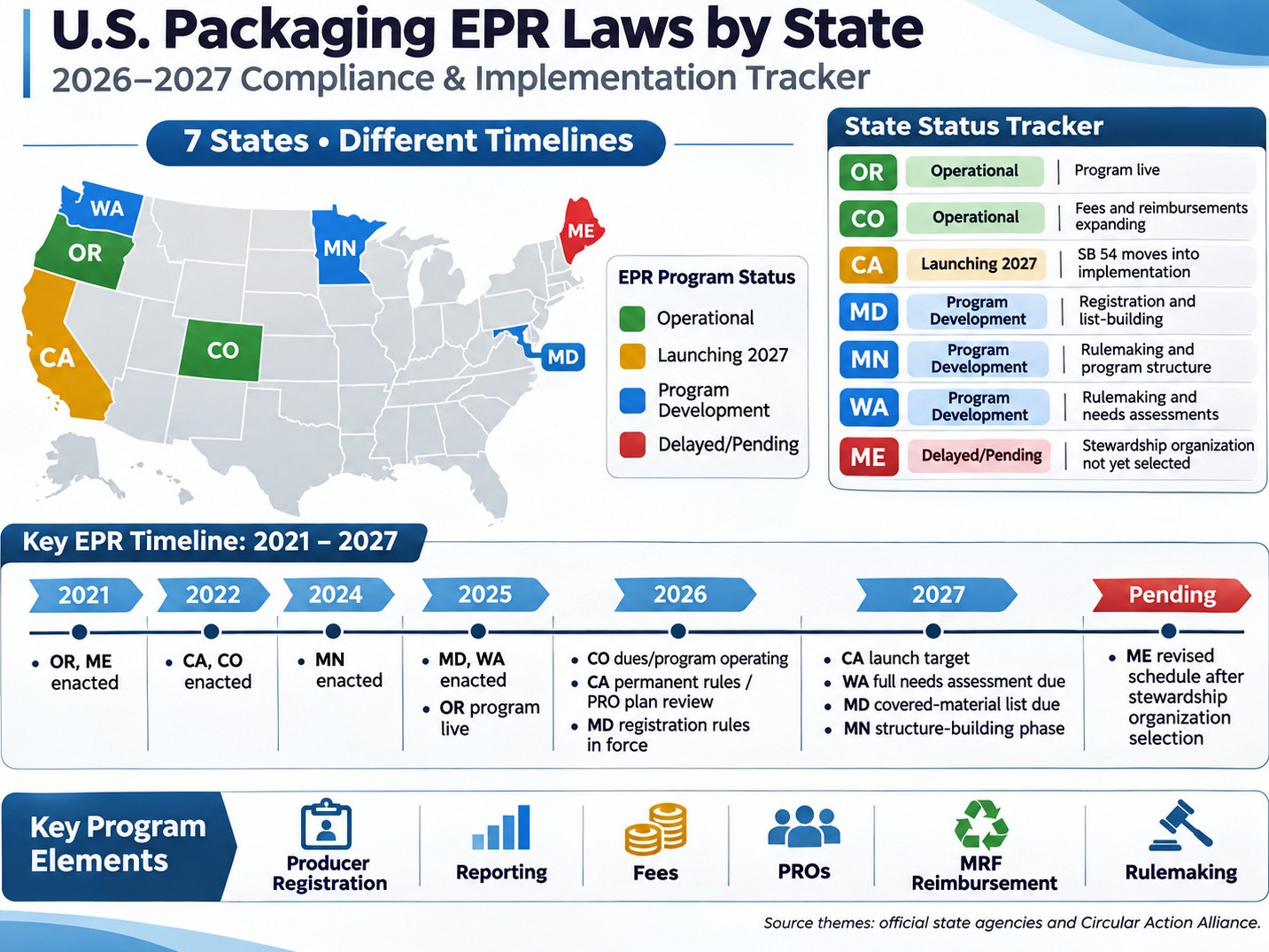
- Seven states have enacted comprehensive packaging EPR laws: California, Colorado, Maine, Maryland, Minnesota, Oregon and Washington.
- Oregon and Colorado already operate producer-funded packaging recycling programs and have published 2027 producer fee schedules.
- California is approaching a major January 1, 2027 milestone as SB 54 moves from rulemaking into implementation.
- Maryland, Minnesota and Washington remain in program-development phases with major regulatory and infrastructure work still ahead.
- Maine's implementation schedule is being reassessed after its first stewardship-organization procurement received no proposals.
U.S. Packaging EPR Laws at a Glance
| State | Law Enacted | Status Nov. 2026 | Key 2027 Development |
|---|---|---|---|
| Oregon | 2021 | Operational | 2027 producer fee schedule published; producer-funded collection, processing and system-expansion work continues. |
| Colorado | 2022 | Operational | 2027 producer dues finance expanded collection, MRF processing and education under the approved program plan. |
| California | 2022 | Launching | Program scheduled to begin on or before Jan. 1; first major source-reduction milestone and producer-funded payments begin. |
| Maryland | 2025 | Registration / Development | Statewide list of covered materials considered recyclable or compostable is due by July 1. |
| Minnesota | 2024 | Rulemaking / Development | Moves into its 2027–2028 structure-building phase, including statewide requirements and collection-list development. |
| Washington | 2025 | Rulemaking / Assessment | Statewide collection lists and full needs-assessment work continue, with final full assessment due by year-end. |
| Maine | 2021 | Delayed / Pending | Timing depends on selection of a Stewardship Organization and the revised implementation schedule that follows. |
This table should not be read as a legal-compliance calendar by itself. Producer definitions, exemptions and covered materials vary by state, and individual companies may face different obligations based on their role in the supply chain.
The Seven States Are Now Splitting Into Four Implementation Groups
The most useful way to understand the U.S. EPR landscape is no longer by enactment date.
It is by operating stage.
Producer fees are funding real collection, processing and program activities. Service providers are reporting data and, where eligible, receiving program support or reimbursement.
Permanent rules are in force, a final producer responsibility plan is under regulatory review and the first major 2027 obligations are approaching.
Producer organizations and registration frameworks exist, but regulators are still defining collection lists, performance requirements, plans, needs assessments and other operating rules.
The legal and regulatory structure exists, but the state still needs the Stewardship Organization that will run the day-to-day program before the remaining timetable can be finalized.
Oregon: The First Full U.S. Packaging EPR Program Is Now in Its Second Phase
Oregon's Plastic Pollution and Recycling Modernization Act is the most mature of the seven current state programs.
The law was enacted in 2021, and major program changes began July 1, 2025.
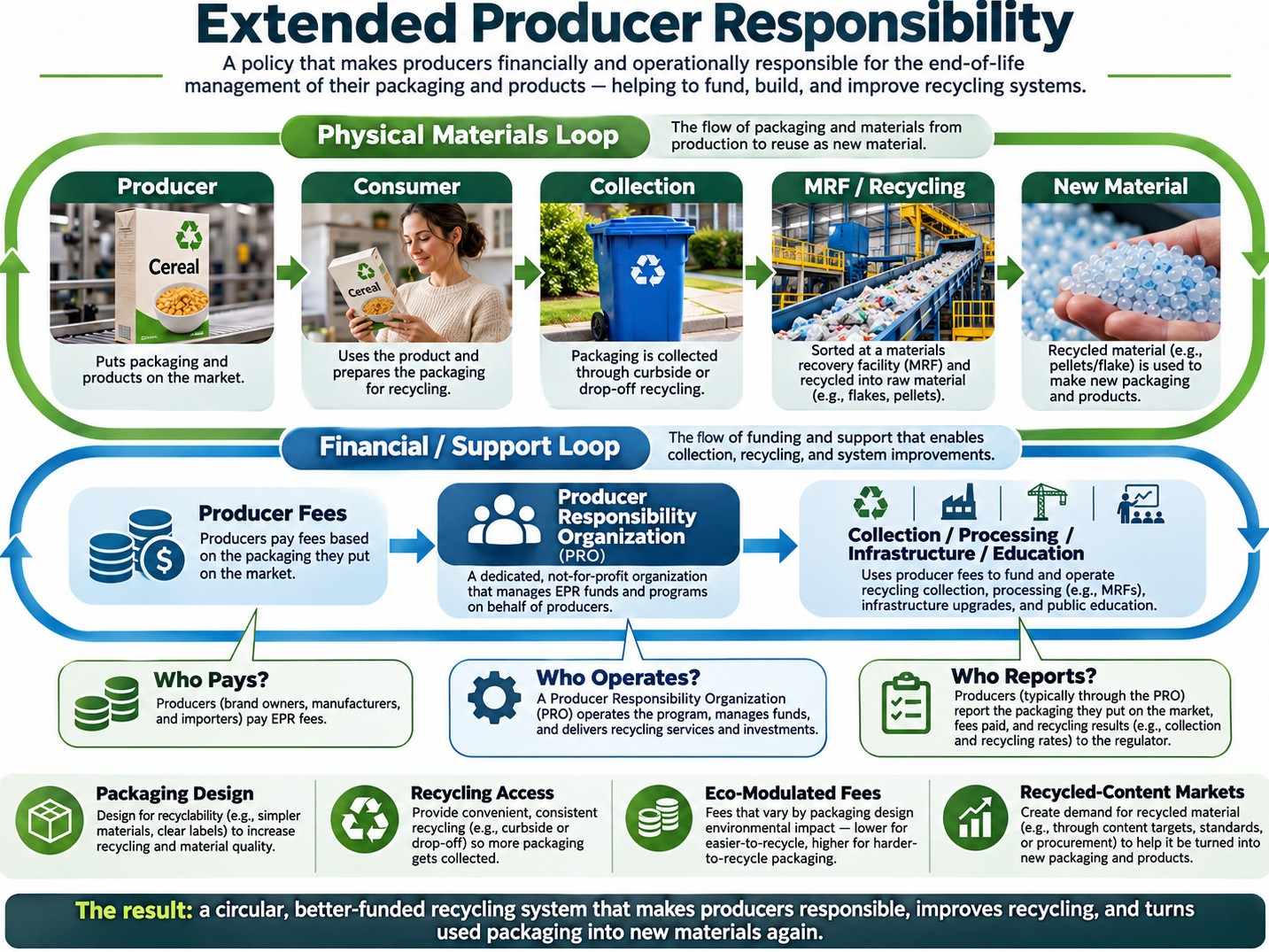
Circular Action Alliance operates the approved producer responsibility program. Covered producers report material supplied into Oregon and pay fees that support collection expansion, transportation, processing, education and recycling-system modernization.
By late 2026, Oregon was no longer testing EPR on paper. It had producer-member registries, funding agreements, annual reporting and operating programs in place.
CAA has also published its 2027 Oregon fee schedule.
Its current forecast shows that most of each producer-funded dollar is expected to flow into collection, processing and education rather than general administration.
Oregon is becoming the clearest U.S. test of what packaging EPR looks like after the launch period: recurring fees, processor payments, community funding, reporting and measurable system changes.
Colorado: EPR Funding Has Moved Into the Recycling System
Colorado's Producer Responsibility Program for Statewide Recycling is also operating.
Circular Action Alliance's final program plan was approved on December 9, 2025, and producers began paying dues in January 2026.
The implementation model is particularly relevant to recycling businesses because processors such as MRFs and transfer stations can provide operational data through the program's service-provider system to support reimbursement.
By October 2026, the Colorado program had expanded producer-funded recycling access to more than 400,000 households and added 13 recycling-processing facilities representing more than 200,000 tons of annual capacity.
The 2027 dues forecast makes the funding model unusually transparent.
CAA projects that 67 cents of each producer-fee dollar will support collection, 18 cents processing and 7 cents education and outreach. Together, those categories represent 92 cents of each projected dollar.
Colorado demonstrates why EPR reporting systems matter commercially. Facilities seeking program payments have to document throughput, qualifying services and other program information rather than simply selling recovered commodities into the market.
California: January 2027 Is the Major Transition Point
California's SB 54 is the largest and most complex packaging producer-responsibility program among the current U.S. state laws.
Permanent regulations took effect on May 1, 2026.
Circular Action Alliance submitted the final draft of its producer responsibility plan to CalRecycle on October 13, and the state is reviewing it ahead of the program's scheduled start on or before January 1, 2027.
That date also carries California's first major source-reduction milestone.
The statewide PRO must achieve a 10% reduction in covered single-use plastic by January 1, 2027 compared with the program baseline, with at least 2% coming from reuse and refill.
California's requirements then go substantially further.
By 2032, SB 54 calls for a 25% reduction in covered single-use plastic, 100% of covered packaging to be recyclable or compostable, and a 65% recycling rate for single-use plastic packaging.
The financing obligation also becomes material in 2027.
The PRO is required to contribute $500 million annually to California's Plastic Pollution Mitigation Fund from 2027 through 2037, in addition to financing the producer-responsibility system.
California is where packaging reduction, reuse, recycling finance and product-design requirements begin converging into one compliance system. Companies should not treat SB 54 simply as another state recycling fee.
Maryland: Registration Is Underway, but Full Program Operation Comes Later
Maryland enacted its Packaging and Paper Products Producer Responsibility Plans Act in 2025.
The first implementing regulations took effect May 25, 2026.
Those rules established definitions, covered-material categories, producer and PRO registration requirements, recordkeeping and other early compliance infrastructure.
Circular Action Alliance is the approved PRO.
Annual registration began July 1, 2026 for the PRO and for producers choosing to pursue an individual plan.
The next important state milestone arrives July 1, 2027, when the Maryland Department of the Environment is required to develop the statewide list of covered materials determined to be recyclable or compostable through curbside programs.
The first full producer responsibility plans do not come due until 2028.
This means Maryland's 2027 story is primarily about defining the future system, not yet operating a Colorado-style reimbursement network.
Minnesota: 2027 Begins the Structure-Building Phase
Minnesota's Packaging Waste and Cost Reduction Act was enacted in 2024.
Circular Action Alliance is the state's registered PRO, and covered producers have been required to become members since July 2025 unless an applicable exemption or alternative applies.
But Minnesota's operating system is not yet live.
The Minnesota Pollution Control Agency began formal rulemaking work in 2026. That process is expected to clarify definitions, exemptions, collection lists, measurement requirements, stewardship plans and annual reports.
Minnesota's own implementation framework describes 2025–2026 as the foundation-building period and 2027–2028 as the phase for establishing program structure.
During that second phase, regulators will develop statewide requirements and collection lists and prepare the framework for the first stewardship plan.
Actual producer reimbursement of recycling-system costs is scheduled for a later phase beginning in 2029 and increasing over time.
Minnesota already has registered producers and a PRO, but that does not mean the producer-funded reimbursement system is already functioning at its eventual scale.
Washington: 2027 Will Be an Assessment and System-Design Year
Washington became the seventh state to enact comprehensive packaging EPR when the Recycling Reform Act passed in 2025.
The law covers residential packaging and paper products and ultimately requires producers to fund the recycling system through a nonprofit PRO.
Washington is still in startup.
Ecology opened draft rule language for public comment on November 19, 2026, with comments accepted through December 17.
The state is also completing two major needs assessments intended to document existing infrastructure, evaluate capacity and support development of future performance targets.
The preliminary assessment is scheduled to be finalized by December 31, 2026.
During 2027, Ecology is expected to publish statewide collection lists and complete the full needs assessment, with the final full assessment scheduled for December 31, 2027.
Producer-funded reimbursement comes later.
Beginning in 2030, the PRO must reimburse at least 90% of qualifying residential recycling-system costs.
That makes the 2027 period important for recyclers because the state is establishing the infrastructure baseline against which future system investments and performance requirements will be judged.
Maine: The Law Exists, but the Operating Organization Does Not Yet
Maine was one of the first states to enact packaging producer responsibility, passing its law in 2021.
Its program rule was adopted in 2024 and amended in March 2026.
Yet implementation has encountered an unusual obstacle.
Maine needs a Stewardship Organization to manage day-to-day program operations.
The state's initial procurement closed in August 2026 without receiving a proposal.
DEP subsequently announced that it would revise the procurement.
As of November 23, Maine's official implementation page still places the program at Step 4: Contracting with a Stewardship Organization.
The agency says that a revised implementation schedule will be established after the organization is selected.
Maine publishes a standard annual schedule for reporting, invoicing and reimbursement, but DEP has explicitly said the implementation timetable is being reassessed. Companies should follow the revised schedule issued after the Stewardship Organization is contracted rather than assuming earlier projected startup dates still apply.
2027 Packaging EPR Compliance Calendar
| Timing | State | Milestone to Watch |
|---|---|---|
| Jan. 1, 2027 | California | Program scheduled to begin; first 10% statewide source-reduction milestone takes effect. |
| Early 2027 | Oregon / Colorado | 2027 producer fee cycles support ongoing collection and processing programs. |
| March 1, 2027 | California | PRO's first Plastic Pollution Mitigation Fund remittance milestone. |
| July 1, 2027 | Maryland | Statewide recyclable/compostable covered-material list due. |
| During 2027 | Minnesota | State moves deeper into collection-list, statewide-requirement and program-structure development. |
| During 2027 | Washington | Statewide collection lists and full needs assessment advance. |
| Dec. 31, 2027 | Washington | Final full statewide needs assessment due. |
| Pending | Maine | Revised program dates depend on successful Stewardship Organization procurement. |
2027 Is Also Becoming a Real Budget Year for Producers
EPR is moving from legal analysis into corporate budgeting.
Circular Action Alliance has already published 2027 fee schedules for California, Colorado and Oregon.
Those rates are based on producer-reported supply data, program budgets and material-specific management costs.
This means packaging decisions now have direct financial consequences in operating states.
A producer's exposure can be affected by:
- How much covered material it supplies
- Material type
- Package design
- Program-specific fee categories
- Eco-modulated incentives or penalties
- State exemptions
- Whether another entity is legally considered the producer
National brands can no longer treat packaging weight as only an engineering or procurement metric.
It is becoming a compliance and cost-allocation metric as well.
What Producers Should Have Ready Before 2027
- State sales map: Identify every EPR state where covered products are sold or distributed.
- Producer determination: Confirm which entity in the supply chain is legally obligated in each state.
- Material inventory: Map packaging components to each state's reporting categories.
- Weight data: Build defensible material-weight records rather than relying on rough packaging estimates.
- PRO status: Confirm registrations and participation agreements where required.
- Fee budgeting: Use published fee schedules where available and create contingencies for emerging states.
- Exemption records: Maintain documentation supporting any claimed exemption.
- Design review: Identify packaging that could face higher costs under eco-modulated fee systems.
- Calendar ownership: Assign one team or system to maintain state deadlines rather than allowing each business unit to track EPR independently.
What MRFs and Recycling Service Providers Should Prepare
EPR creates compliance work for producers, but it also creates operational requirements for recyclers seeking program funding.
Facilities should increasingly expect requests for data on:
- Inbound tons
- Material composition
- Commodity output
- Residue
- Contamination
- Operating and processing costs
- Transportation
- Responsible end markets
- Service areas
- Capital improvements
The commercial lesson is straightforward.
A facility that cannot document its material flows may have difficulty documenting the costs or performance that qualify it for EPR funding.
There Is Still No Federal Packaging EPR Law
The seven current programs are state laws.
The United States still does not have a federal packaging EPR system that replaces or harmonizes them.
That means national companies must manage multiple definitions of:
- Producer
- Covered material
- Exempt material
- Reporting category
- PRO participation
- Fee calculation
- Recyclability
- Program timing
For compliance teams, that fragmentation may become one of the largest costs of the emerging U.S. model.
For recyclers, however, the state-by-state rollout creates something useful: several different operating models will be tested at roughly the same time.
The industry will be able to compare what actually happens to collection access, processing investment, contamination, recycling rates and MRF economics.
Industry Edge: 2027 Will Test Whether EPR Produces Better Material, Not Just More Money
The first phase of U.S. packaging EPR has focused heavily on producer registration, fee schedules, plans and program governance. The more important recycling-industry test now begins downstream.
If producer funding expands access but the recovered stream remains highly contaminated, or if more material is collected without dependable end markets, EPR will have solved only part of the recycling problem. The strongest programs will have to connect financing with material quality, modern MRF capacity, packaging design and real manufacturing demand.
Five Questions to Ask About Any Packaging EPR Program
Brand owner, manufacturer, importer, retailer and marketplace responsibilities differ among states.
Packaging, paper and food-service ware definitions and exclusions are not identical across jurisdictions.
Registration with a PRO does not necessarily mean system reimbursements or performance requirements are already active.
Producer supply data, material categories and fee schedules increasingly determine the cost of compliance.
Program value to the recycling system depends on reimbursement formulas, contracts, eligible costs and accountability requirements.
The Bottom Line
Packaging EPR in the United States has moved beyond the legislative phase.
But it has not moved into one uniform national system.
Oregon and Colorado are already producing operating data.
California is approaching a major 2027 launch.
Maryland, Minnesota and Washington are defining the systems that will govern future collection and reimbursement.
Maine is demonstrating that even an enacted law and adopted regulations do not guarantee a smooth operational startup.
For producers, the immediate challenge is compliance across multiple state frameworks.
For recyclers and municipalities, the opportunity is new funding tied more directly to the cost of collecting and processing packaging.
For both sides, the next test is performance.
By the end of 2027, the most useful question will no longer be which states have EPR. It will be which programs are actually producing cleaner material, stronger recycling infrastructure and a more durable market for what gets recovered.
Frequently Asked Questions About U.S. Packaging EPR Laws
How many U.S. states have packaging EPR laws?
As of November 23, 2026, seven states have enacted comprehensive packaging EPR laws: California, Colorado, Maine, Maryland, Minnesota, Oregon and Washington.
Which U.S. packaging EPR programs are already operating?
Oregon's producer-funded program began in July 2025, while Colorado moved into implementation and producer dues in 2026. California is scheduled to move into its program phase on or before January 1, 2027.
Does every EPR state use the same producer definition?
No. Producer hierarchies, exemptions and covered materials differ. Companies must determine their obligations separately under each state's law and implementing rules.
Are packaging EPR fees already being charged?
Yes in some states. Oregon began producer fee obligations in 2025 and Colorado in 2026. California moves into major producer funding obligations in 2027. Other state programs remain at earlier implementation stages.
Is there a federal U.S. packaging EPR law?
No. Current comprehensive packaging EPR obligations are created through individual state laws, which is why producer definitions, reporting requirements and implementation dates differ across the country.
Primary Sources and Verification
- California Department of Resources Recycling and Recovery — SB 54 Packaging Producer Responsibility Program
- Colorado Department of Public Health and Environment / Circular Action Alliance — Producer Responsibility Program
- Oregon Department of Environmental Quality — Plastic Pollution and Recycling Modernization Act
- Maine Department of Environmental Protection — Stewardship Program for Packaging
- Maryland Department of the Environment — Packaging and Paper Products Producer Responsibility
- Minnesota Pollution Control Agency — Packaging Waste and Cost Reduction Act
- Washington Department of Ecology — Recycling Reform Act
- Circular Action Alliance — Producer Reporting and 2027 Fee Schedules
Last verified: November 23, 2026.