 By RecyclingMonster
Industry Desk | Published on November 13, 2026 12:00:00 AM
By Carolina Curiel
Published November 13, 2026
MONTREAL (RecyclingMonster): The fastest way to waste money on a recycling program is to design it around what a business assumes it throws away.
A commercial waste audit replaces that assumption with evidence.
It shows what is actually entering the trash, what is being captured for recycling, what is contaminating existing collection streams and which materials appear often enough to justify a different handling system.
Done properly, an audit can also reveal a less obvious opportunity: the business may not need more recycling service at all. It may need fewer disposable products, a separate cardboard or stretch-film stream, better employee instructions, different container placement or a hauling schedule that more closely matches actual volume.
- A commercial waste audit measures what a business is disposing, recycling, composting or otherwise managing instead of relying on assumptions.
- Start with hauling records, invoices and a site walk-through before opening bags or sorting material.
- The sampling method should match the audit objective, business operations and safety conditions; there is no single universal sample size for every facility.
- Measure material by weight whenever practical and keep recycling contamination separate from recoverable material found in trash.
- The audit is useful only when its findings lead to specific actions such as source reduction, better collection, employee training, service changes or specialty recycling.
What Is a Commercial Waste Audit?
A commercial waste audit, sometimes called a waste assessment or waste characterization study, is a systematic review of the materials generated by a business or facility.
It answers questions that hauling invoices alone cannot answer:
- What is actually in the trash?
- What recyclable material is still being discarded?
- What does the recycling stream contain?
- How much contamination is present?
- Which departments or operations generate the most material?
- Are existing containers and pickup schedules appropriate?
- Which materials could be prevented, reused, donated, recycled or composted?
EPA describes a waste assessment as a systematic review of a building and its operations to determine both the quantity and composition of its waste stream.
Those two dimensions matter.
Knowing that a business disposes of 20 tons tells you the scale of the problem.
Knowing what those 20 tons contain tells you what to do about it.
A Waste Audit Is Not the Same as Waste Tracking
The terms are related but not interchangeable.
| Activity | Primary Question | Typical Inputs |
|---|---|---|
| Waste tracking | How much material are we generating and where is it going? | Hauler weights, invoices, container fullness, pickup records |
| Waste audit | What is the material actually made of? | Representative samples, physical or visual characterization, weights by category |
| Program monitoring | Did our changes improve performance? | Repeat measurements, contamination checks, service records and costs |
A business needs all three over time.
The audit provides the diagnosis. Tracking establishes the trend. Monitoring tells management whether corrective action worked.
Start With the Business Question
Do not begin the audit by deciding how many bags to open.
Begin by deciding what management needs to know.
A company might want to determine:
- Whether cardboard is being lost to trash
- Why mixed recycling is being rejected or contaminated
- Whether a warehouse generates enough stretch film for a separate program
- Whether food waste justifies commercial organics service
- Whether trash service can be reduced
- Which facility should receive investment first
- Whether batteries and electronics are entering ordinary disposal
- Which department is generating avoidable waste
An office trying to understand break-room contamination does not need the same sampling plan as a distribution center evaluating thousands of pounds of pallet wrap or a multi-building portfolio developing a corporate baseline.
Step 1: Define the Audit Boundary
Write down exactly what is included before collecting data.
The boundary may be:
- A single office
- One warehouse
- An entire manufacturing site
- A cafeteria
- A retail store
- One waste stream, such as trash
- One recycling stream
- Several buildings within a portfolio
Also document what is excluded.
If construction debris, confidential document destruction, hazardous waste or production scrap is managed separately, say so.
This prevents management from later treating the audit result as though it represents material that was never sampled.
Step 2: Collect Existing Data Before Touching the Waste
A physical sort should not be the first source of information.
Collect:
- Waste and recycling invoices
- Hauler weight tickets where available
- Container sizes
- Pickup frequency
- Service costs
- Contamination or overage charges
- Compactor data where available
- Specialty recycling records
- Donation or reuse records
- Organics collection records
- Site occupancy or production information that helps explain unusual periods
This gives the audit context.
A dumpster collected every day but routinely one-third full tells a different story from a container overflowing before every pickup.
Likewise, a recycling stream that looks clean may still be expensive if the business is paying for poorly sized equipment or excessive collection frequency.
Step 3: Walk the Site Before Designing the Sample
Follow material from the point where it becomes waste to the point where the hauler collects it.
Look at:
- Workstations
- Break rooms
- Copy and print areas
- Kitchens and cafeterias
- Receiving docks
- Production areas
- Shipping stations
- Loading docks
- Outdoor dumpsters and compactors
Record where the material is generated and how employees currently manage it.
A walk-through can reveal issues a physical sort cannot.
For example, cardboard may be appearing in trash because the cardboard container is across the warehouse. Beverage containers may contaminate paper recycling because the break room has no container-recycling bin. Stretch film may be mixed with general trash because workers have nowhere else to put it when pallets are unwrapped.
Step 4: Choose the Right Type of Audit
Not every audit requires employees to open bags and physically sort waste.
| Approach | Best Used When |
|---|---|
| Records review | You need a quantity and cost baseline from existing hauling data. |
| Facility walk-through | You need to identify where material originates and whether the collection system matches operations. |
| Visual characterization | The stream can be meaningfully assessed without direct physical handling, or physical sorting would create unnecessary risk. |
| Physical sort | You need measured composition by material category and the stream is appropriate to handle safely. |
Large or specialized businesses may use more than one method.
A warehouse could physically audit ordinary trash while visually inspecting bulky material and separately analyzing cardboard and film using hauler weights.
Step 5: Build a Representative Sampling Plan
The sample needs to reflect normal operations closely enough to answer the business question.
There is no universal rule that every commercial audit must sort a particular number of bags or pounds.
Instead, document why the sample is representative.
Consider:
- Different departments
- Different shifts
- Weekdays versus unusual operating days
- Seasonal activity
- Production schedules
- Major deliveries or cleanouts
- Events that create abnormal waste
- Multiple buildings or tenant types
A one-day sample taken during an office move should not be presented as a normal operating baseline.
Likewise, a sample collected only from the executive floor should not be used to characterize an entire warehouse and manufacturing complex.
Record the date, source, stream, operating conditions and any known abnormalities for every sample. An audit result is much more useful when a future reviewer can understand exactly what was measured.
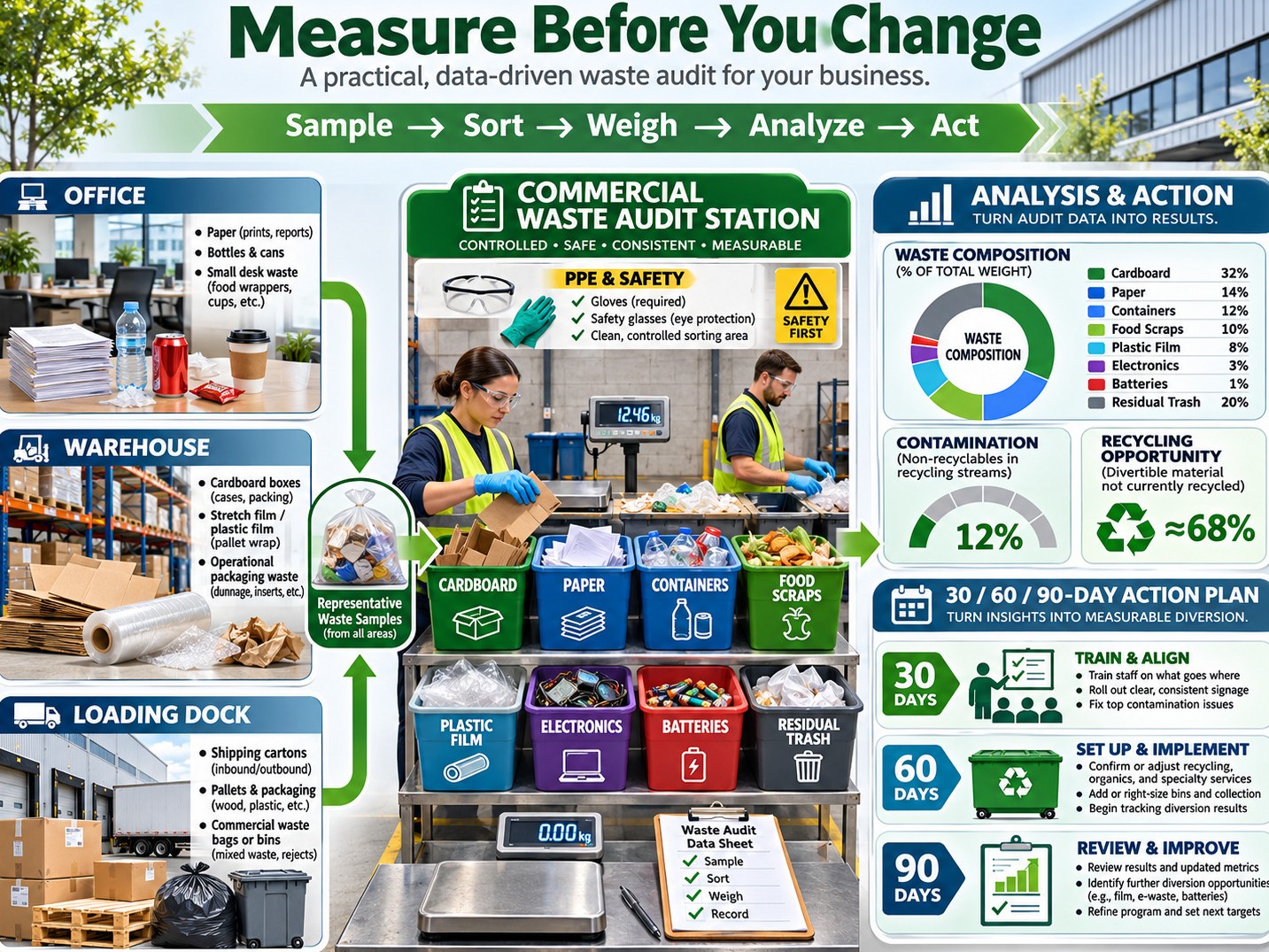
Step 6: Create the Material Categories Before Sorting
Decide what you are going to measure before the first sample is opened.
A general commercial audit might use:
| Category | Examples |
|---|---|
| Cardboard | Corrugated shipping boxes and cases |
| Mixed paper | Office paper, mail and accepted paper products |
| Plastic containers | Bottles, jugs and locally accepted rigid containers |
| Plastic film | Stretch wrap, bags and other film where relevant |
| Metal containers | Aluminum and steel cans |
| Glass | Accepted bottles and jars |
| Food scraps | Preparation scraps and uneaten food where organics are being evaluated |
| Reusable material | Usable supplies, packaging, furniture or products |
| Specialty material | Electronics, batteries, lamps or other separately managed items |
| Residual trash | Material without an identified recovery route under the current program |
Do not create fifty categories if the business only needs ten.
But do not combine materials that require different actions.
If the goal is to evaluate commercial stretch-film recycling, “plastics” is too broad. Film should have its own category.
Step 7: Set Up a Safe Audit Area
A physical waste sort is operational work, not an office exercise.
Use a controlled area away from normal pedestrian and vehicle traffic.
The audit team should establish appropriate protective equipment and procedures for the material being handled.
At minimum, consider:
- Protective gloves appropriate to the task
- Eye protection
- Protective clothing
- Closed, protective footwear
- Hand-washing facilities
- Traffic control around the sorting area
- A procedure for unexpected sharps, chemicals or hazardous material
If chemical, biological, medical, sharp or other hazardous material may be present, stop and use an appropriate visual or specialist assessment method. A waste audit should never expose employees to an unnecessary hazard.
Step 8: Weigh the Sample Before Sorting
Record the total sample weight.
Use the same calibrated or verified scale throughout the audit where practical.
If material is weighed in containers:
- Weigh or record the empty container weight.
- Weigh the container with material.
- Subtract the tare weight.
- Record the net material weight.
Keep the unit consistent.
Do not mix pounds and kilograms in the same worksheet without clearly converting them.
Step 9: Sort and Weigh Each Material Category
Place each material into its predetermined category and record the net weight.
Do not estimate visually when you have the ability to weigh it.
When an item does not fit a category, record it as miscellaneous rather than forcing it into the wrong one.
Document unusual findings separately.
A lithium-ion battery in the mixed recycling stream may weigh very little, for example, but it represents a much larger operational risk than its percentage by weight suggests.
Likewise, one oversized piece of cardboard can dominate volume while contributing relatively little weight.
This is why photographs and field notes can add context that the spreadsheet alone misses.
How to Calculate Waste Composition
For each category:
Material Weight ÷ Total Sample Weight × 100 = Composition %
Use the same denominator for every category within that sample.
When all categories are added together, the result should account for the complete sample, allowing for reasonable rounding.
How to Calculate Recycling Contamination
When auditing the recycling stream, separate acceptable recyclables from material the recycler does not accept.
Unacceptable Material Weight ÷ Total Recycling Sample Weight × 100 = Contamination %
Then identify the contaminants individually.
“18% contamination” tells management there is a problem.
“Most contamination is food waste and plastic bags from two break rooms” tells management what to fix.
Do Not Call Every Recoverable Material “Recycling”
The audit may identify several different opportunities:
- Prevent — avoid generating the material
- Reuse — use the item again internally
- Donate — transfer usable material or products
- Recycle — send material through an appropriate recycling system
- Compost — send suitable organics to an accepted processor
- Special handling — manage batteries, electronics, lamps or regulated materials separately
These outcomes should remain distinct in the final report.
A chair donated for reuse is not the same as a chair recycled for material recovery.
A battery captured for specialty recycling is not evidence that it belongs in ordinary mixed recycling.
What the Audit Results Should Tell Management
| Audit Finding | Possible Operational Response |
|---|---|
| Large amounts of cardboard in trash | Add or relocate cardboard collection and review receiving-area workflow. |
| Clean stretch film in warehouse trash | Evaluate a separate commercial film stream and buyer requirements. |
| Food dominates cafeteria trash | Evaluate prevention, donation and local organics-processing options. |
| Plastic bags dominate recycling contamination | Update signage, bin placement and employee instructions. |
| Batteries or electronics found in ordinary waste | Establish a controlled specialty collection route immediately. |
| Containers routinely collected half empty | Review container size or pickup frequency with the hauler. |
| Usable supplies or packaging repeatedly discarded | Evaluate purchasing, internal reuse or supplier-return practices. |
Look for Cost Opportunities as Well as Recycling Opportunities
A waste audit is also an operating-cost review.
Compare the findings with:
- Current monthly hauling cost
- Container rental charges
- Pickup frequency
- Overage charges
- Contamination fees
- Compactor costs
- Specialty recycling costs
- Commodity rebates or revenue where applicable
One of the most practical outcomes may be service right-sizing.
If source reduction and improved recycling reduce the trash volume, the company may eventually be able to use a smaller container or fewer pickups.
Do not change service solely on the basis of one unusual audit day. Confirm the pattern with hauling and operating data first.
Prioritize by Impact, Not by the Number of Findings
A good audit may identify twenty opportunities.
Management does not need twenty projects at once.
Rank findings by:
- Amount of material involved
- Cost impact
- Ease of implementation
- Available recycler or processor
- Contamination risk
- Worker or fire safety
- Regulatory importance
- Potential for reuse or prevention
A business may gain more from fixing one high-volume cardboard stream than from introducing five low-volume specialty bins employees struggle to understand.
Build a 30/60/90-Day Action Plan
| Timing | Action |
|---|---|
| First 30 Days | Correct immediate safety issues, obvious contamination, missing signage and clearly misplaced collection stations. |
| Days 31–60 | Confirm new material outlets, test separate collection streams and train affected employees and cleaning staff. |
| Days 61–90 | Review hauling data, contamination and participation; adjust container sizes, service frequency and program design where the evidence supports it. |
Track Performance After the Audit
The audit creates a snapshot.
The business still needs a system for following performance afterward.
EPA's ENERGY STAR Portfolio Manager can track 29 different waste and material categories, including trash, cardboard, mixed recyclables, plastic film, electronics, batteries, food scraps, pallets and textiles.
Materials can be recorded as:
- Recycled
- Composted
- Donated or reused
- Disposed
Portfolio Manager can also accommodate regular collection and intermittent events such as a one-time furniture donation.
This makes it possible to maintain a baseline beyond the audit date and monitor whether a waste-reduction project actually changes the organization's material flows.
When Should a Business Repeat the Audit?
There is no single schedule appropriate for every operation.
Repeat or targeted audits are particularly useful when:
- A new recycling program is introduced
- Contamination increases
- A hauler changes accepted materials
- The company changes buildings or operations
- Occupancy changes materially
- A new production line or product is introduced
- The business begins organics collection
- Management needs to verify progress against a prior baseline
A smaller follow-up audit can focus on the material or department that changed rather than repeating the full study unnecessarily.
Commercial Waste Audit Checklist
Before the Audit
- Define the business question.
- Define facilities and waste streams included.
- Gather invoices, weights, container sizes and pickup schedules.
- Walk the facility.
- Choose physical, visual or records-based methods.
- Define material categories.
- Choose representative sampling periods and locations.
- Prepare data sheets, scales, containers and PPE.
During the Audit
- Record sample source, date and operating conditions.
- Record total sample weight.
- Sort only material that can be handled safely.
- Weigh each material category.
- Separate recycling contamination from recyclable material found in trash.
- Photograph unusual or recurring problems.
- Document hazardous or specialty material separately.
After the Audit
- Calculate composition percentages.
- Calculate recycling contamination where applicable.
- Compare results with hauling and cost data.
- Prioritize prevention and reuse before adding new recycling streams.
- Verify real end markets before changing collection.
- Assign owners and deadlines.
- Set measurable KPIs.
- Schedule appropriate follow-up measurement.
Common Waste Audit Mistakes
Collection equipment should follow the audit, hauler requirements and actual material volumes.
Document unusual production, events, cleanouts or occupancy changes that could distort the sample.
Percentages should be tied back to actual weights or volumes and the business operation they represent.
Trash inside recycling and recyclables inside trash are two different operating failures.
Confirm an actual collection and processing route before redesigning operations.
Hazardous or unknown material should not be physically handled simply to improve data quality.
An audit has little value if nobody is responsible for implementing the findings.
The Bottom Line
A commercial waste audit should turn an invisible operating cost into measurable material flows.
Start with records.
Walk the operation.
Define the question.
Choose a representative and safe sampling method.
Sort and weigh only what needs to be measured.
Then connect the result back to the way the business actually works.
The most important finding may be a recyclable material being thrown away. It may be contamination in an existing recycling stream. It may be an oversized dumpster, excessive pickups, unnecessary packaging or a specialty waste that should never have been mixed with ordinary trash.
A good audit makes those problems visible.
The value of a waste audit is not the spreadsheet it produces. It is the operational decision the business can make because it finally knows what is in the bin.
Frequently Asked Questions About Commercial Waste Audits
What is a commercial waste audit?
A commercial waste audit is a systematic assessment of the quantity and composition of waste and recoverable materials generated by a business or facility. It is used to identify opportunities for prevention, reuse, recycling, composting, contamination reduction and service improvements.
How much waste should a business sample?
There is no single sample size appropriate for every commercial audit. The sampling plan should reflect the audit objective, facility size, operating patterns, waste streams and desired level of confidence. Document why the selected period and locations reasonably represent normal operations.
How is recycling contamination calculated?
For a weighed sample, divide the weight of material that is not accepted in the recycling program by the total recycling-sample weight and multiply by 100. Identify the major contaminants separately so the result can guide corrective action.
Can a waste audit reduce business costs?
It can identify opportunities to reduce costs, such as preventing waste, recovering materials, changing container sizes or adjusting pickup frequency. Actual savings depend on the facility's service contract, material volumes, local markets and the changes ultimately implemented.
How often should a commercial waste audit be repeated?
There is no universal schedule. Follow-up audits are useful after major operational changes, when contamination changes, when collection programs change or when management needs to verify progress against an earlier baseline.
Primary Sources and Verification
- U.S. Environmental Protection Agency — Managing and Reducing Wastes: A Guide for Commercial Buildings
- ENERGY STAR — Waste Tracking and Management in Commercial Buildings
- California Department of Resources Recycling and Recovery — Waste Characterization Physical and Visual Sorting Procedures
- CalRecycle — Uniform Waste Disposal Characterization Method
Last verified: November 13, 2026.
Explore More on RecyclingMonster