 By Carolina
Curiel | Published on October 10, 2026 12:00:00 AM
By Carolina
Curiel | Published on October 10, 2026 12:00:00 AM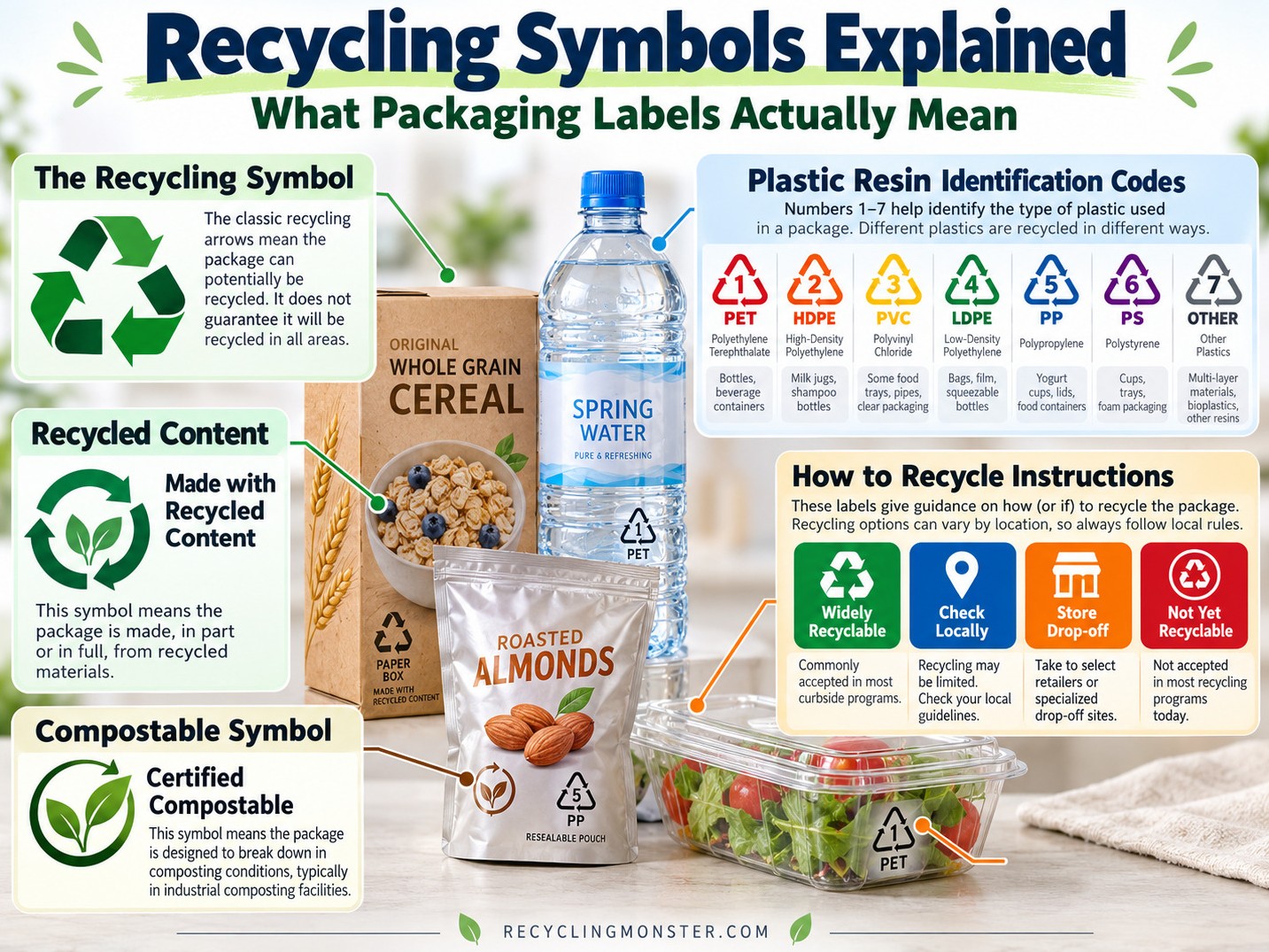
Published October 10, 2026
Recycling symbols appear on bottles, boxes, bags, cups and almost every other type of packaging, but similar-looking marks can communicate very different things. Some identify the material. Some describe recycling access. Others refer to recycled content, compostability or participation in a packaging recovery system.
- A recycling-looking symbol does not automatically mean a package belongs in your local recycling bin.
- Plastic numbers 1–7 are Resin Identification Codes that identify plastic resin, not guarantees of recyclability.
- How2Recycle labels give more specific disposal instructions such as Widely Recyclable, Check Locally, Store Drop-off and Not Yet Recyclable.
- A recycled-content claim describes what a product or package is made from; it does not necessarily describe what happens to it after use.
- Compostable packaging belongs only in an appropriate composting system that accepts it, not in conventional recycling.
Recycling Symbols at a Glance
| Symbol or Label | What It Tells You | What It Does Not Tell You | What You Should Do |
|---|---|---|---|
| Chasing arrows / recycling symbol | Usually communicates a recyclability claim or recycling message. | It does not guarantee that your local program accepts the package. | Check the package instructions and your local accepted-material list. |
| Plastic #1–#7 | Identifies the plastic resin used in the item. | It does not guarantee curbside recyclability. | Use the number as an identification aid, then check local rules. |
| How2Recycle: Widely Recyclable | The package meets the program's access criteria for broad recycling availability. | It does not override individual municipal instructions. | Follow preparation instructions and your local program. |
| How2Recycle: Check Locally | Recycling access varies significantly by location. | It does not mean the item is universally accepted or universally rejected. | Check the municipality, hauler or recycling provider serving your address. |
| How2Recycle: Store Drop-off | In the U.S., certain eligible polyethylene film packaging can use participating retail collection programs. | It does not mean the film belongs in a standard curbside recycling cart. | Follow the label and use a participating collection location. |
| How2Recycle: Not Yet Recyclable | The package does not currently meet that program's recyclability criteria. | It does not necessarily mean the underlying material could never be recycled through a specialized system. | Follow the label's disposal instruction rather than placing it in curbside recycling. |
| Recycled content | The product or package contains recovered material. | It does not automatically mean the finished item is recyclable. | Look separately for end-of-life recycling instructions. |
| Certified compostable | The item has been evaluated against applicable compostability standards by the certifier identified on the package. | It does not mean the item belongs in the recycling bin or that every composting program accepts it. | Use an organics or composting program only when that program accepts the item. |
| Green Dot | In participating markets, it relates to financial participation in a packaging recovery system. | It is not a recyclability symbol. | Look for separate local sorting or recycling instructions. |
Does the Recycling Symbol Mean Something Is Recyclable?
Not necessarily in the way consumers often assume.
A package can carry arrows or recycling-related language and still require you to check whether an appropriate recycling program exists where you live. The practical issue is not only whether a material can theoretically be processed, but whether it can be collected, sorted and sent to an appropriate end market through the system available to you.
In the United States, Federal Trade Commission guidance says marketers should qualify recyclable claims when appropriate recycling facilities are not available to at least 60% of the consumers or communities where a product is sold.
For the person standing over a recycling bin, however, the safest instruction is even simpler: local acceptance wins.
RecyclingMonster's Complete Curbside Recycling Guide explains which materials are commonly accepted and why local rules can still differ.
What Do Plastic Recycling Numbers 1–7 Actually Mean?
The numbers stamped or molded into plastic products are more accurately called Resin Identification Codes, or RICs.
ASTM International's resin identification standard is explicit: these codes are not “recycle codes.” Their job is to identify the plastic resin used to make an article.
That distinction matters because two packages made from the same resin can perform differently in a recycling system. Shape, size, color, labels, closures, adhesives and other components can affect how a package is collected, identified and processed.
| Code | Resin | What the Number Means |
|---|---|---|
| #1 | PET or PETE | The item is made primarily from polyethylene terephthalate. |
| #2 | HDPE | The item is made primarily from high-density polyethylene. |
| #3 | PVC or V | The item is made primarily from polyvinyl chloride. |
| #4 | LDPE | The item is made primarily from low-density polyethylene. |
| #5 | PP | The item is made primarily from polypropylene. |
| #6 | PS | The item is made primarily from polystyrene. |
| #7 | Other | The plastic falls outside resin categories #1 through #6 or uses another qualifying resin composition. |
EPA likewise cautions that the triangle containing a resin number can look like a recycling symbol but does not necessarily mean the item can be collected for recycling in your community.
For the complete material-by-material explanation, see RecyclingMonster's Plastic Recycling Numbers 1–7 Guide.
How2Recycle Labels Give More Specific Instructions
Some packaging carries a How2Recycle label rather than relying only on a generic recycling symbol.
The system evaluates the package and provides disposal instructions for the relevant packaging component. Current designations include Widely Recyclable, Check Locally, Store Drop-off and Not Yet Recyclable.
Widely Recyclable
For U.S. packaging, How2Recycle currently uses its Widely Recyclable designation when at least 60% of Americans have access to recycling the package through curbside or drop-off programs. Its Canadian threshold is 50%.
The label may also contain preparation instructions such as “Empty Before Recycling,” “Flatten Before Recycling” or “Empty & Replace Cap.” Those instructions matter because the label is evaluating a specific package configuration, not simply the broad material category.
Check Locally
“Check Locally” means recycling availability is not sufficiently uniform for a broad recycling instruction.
This is one of the most useful labels for consumers because it makes the uncertainty explicit: do not guess. Check the municipality, hauler or recycling provider serving your address.
Store Drop-off
In the United States, How2Recycle uses Store Drop-off for eligible polyethylene film packaging that can enter participating retail collection programs.
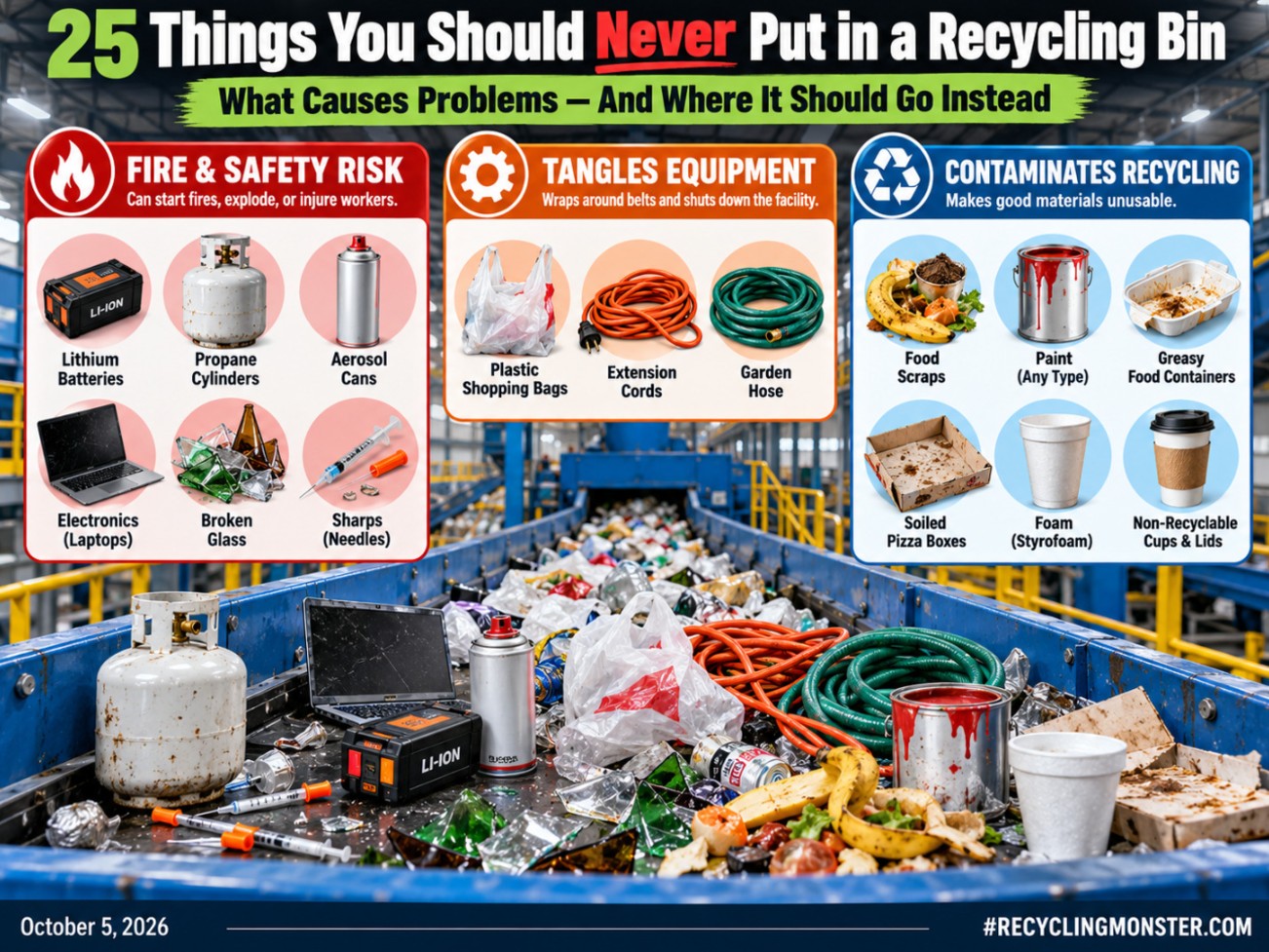
This is an important distinction from curbside recycling. Plastic bags, wraps and films generally should not be placed loose into a standard household recycling cart because flexible film can interfere with conventional sorting equipment.
A package labeled Store Drop-off should be handled according to the instructions on that package and the requirements of the participating collection location.
Not Yet Recyclable
How2Recycle applies its Not Yet Recyclable designation when recycling access is below its stated threshold or when significant challenges exist in sorting, reprocessing or end markets.
That does not mean every molecule in the package is physically incapable of being recovered. It means the package does not currently qualify for one of the program's recycling designations.
Multi-Component Packaging May Have More Than One Instruction
A box, bottle, tray, cap, pouch or sleeve does not necessarily share one end-of-life instruction simply because the pieces were sold together.
Modern package labels may therefore identify individual components separately.
A package could tell you to recycle the paper box, replace the plastic cap on a bottle, discard a pump, and take a separate film pouch to a store drop-off location.
The lesson: read the instruction for the specific component rather than treating the entire package as one material.
This is also why an item that “looks recyclable” can produce the wrong result when placed in a bin without checking the label.
What Does “Made With Recycled Content” Mean?
A recycled-content claim answers a different question from a recyclable claim.
Recyclable concerns what can happen to an item after use. Recycled content concerns material that was recovered or diverted from the waste stream and used to make the item.
Under FTC guidance, a product or package that is only partly made from recycled material should make the amount clear — for example, by stating a percentage.
A package can therefore contain recycled material without necessarily being recyclable through your local system. Conversely, a recyclable package does not necessarily contain recycled material.
What Does a Certified Compostable Symbol Mean?
Compostability is another end-of-life pathway and should not be confused with conventional recycling.
In North America, the Biodegradable Products Institute, or BPI, operates a third-party certification program for qualifying compostable products and packaging. BPI-certified products must meet applicable ASTM compostability standards and carry the organization's certification mark according to its program requirements.
That certification does not mean the item should go into a household recycling bin.
It also does not guarantee that every municipal organics program or commercial composting facility accepts the package. Composting facilities establish their own accepted-material requirements.
EPA warns that compostable plastics are not intended for conventional plastic recycling and can contaminate the recycling stream when mixed with ordinary plastics.
“Biodegradable” Is Not the Same as “Compostable”
The words are often used together in casual conversation, but they are not interchangeable disposal instructions.
“Biodegradable” broadly describes the ability of a material to be broken down by biological activity. It does not by itself tell a consumer how quickly the material will break down, under what conditions, or whether the item is accepted by a composting program.
“Compostable” claims are more specific and, under FTC guidance, need supporting evidence concerning how the material breaks down into usable compost.
When a package carries a compostable claim, follow the exact certification and disposal instructions rather than putting it into the recycling cart.
What Does the Green Dot Symbol Mean?
The Green Dot, seen primarily on packaging associated with European markets, is frequently mistaken for a recycling symbol.
It is not.
Packaging Recovery Organisation Europe states that the Green Dot indicates participation in a packaging recovery system and the payment of a financial contribution where the system applies. It does not mean the package itself is recyclable or provide a consumer sorting instruction.
If a package carries a Green Dot, look elsewhere on the package — or to your local recycling rules — for the actual disposal instruction.
Why Recycling Labels Are Changing in 2026
Packaging labels are receiving more scrutiny as governments, recyclers and brands try to reduce the gap between what consumers believe a recycling symbol means and what recycling systems can actually process.
How2Recycle Is Rolling Out New Pro Labels
How2Recycle is currently transitioning to its newer Pro label system. The updated labels retain familiar disposal categories while changing iconography and layout to improve clarity and adapt to evolving labeling requirements.
Legacy labels will remain visible on packaging during the transition, so consumers should expect to encounter both formats.
California SB 343 Targets Misleading Recyclability Claims
California's SB 343 was enacted to restrict use of the chasing-arrows symbol and other recyclability claims unless specified criteria are met.
CalRecycle published its first final material-characterization findings in April 2025. Under the statutory timetable, labeling restrictions were scheduled to apply to products and packaging manufactured after October 4, 2026.
However, the current legal situation is important: CalRecycle reports that a federal court issued a preliminary injunction on July 14, 2026 that blocks enforcement of SB 343 while litigation proceeds. The injunction does not stop CalRecycle from continuing its required material-characterization work.
Why Packaging Design Matters After Collection
A label can tell a consumer where an item is intended to go, but successful recycling still depends on what happens after collection.
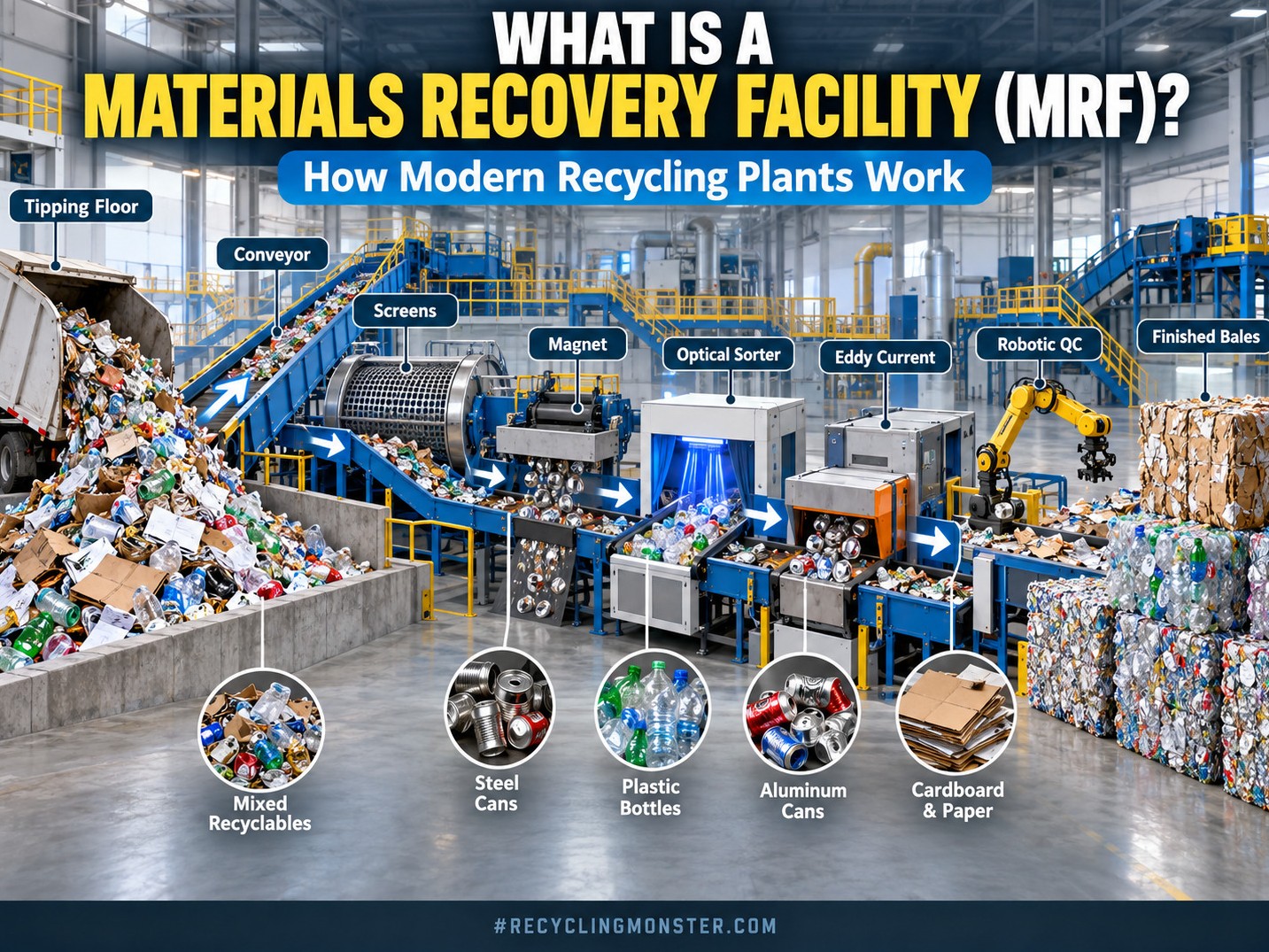
At a materials recovery facility, recyclables may be separated using screens, magnets, eddy-current systems, optical sorters, robotics and manual quality control.
Packaging shape, dimensions, material combinations, labels and attached components can affect whether an item is correctly identified and recovered.
See RecyclingMonster's guide to how modern materials recovery facilities work for the complete sorting process.
What Should You Do When the Packaging Label Is Unclear?
Use this order:
- Identify the item and all packaging components.
- Read the full disposal instruction, not simply the arrows or resin number.
- Check your local recycling program when the label says “Check Locally” or when no clear instruction is provided.
- Prepare the item as directed — for example, emptying, flattening or replacing a cap.
- Use a specialty collection route if the item is recyclable somewhere but not through curbside collection.
If you still cannot determine the correct route, RecyclingMonster's Recycle an Item tool lets you search by material and location.
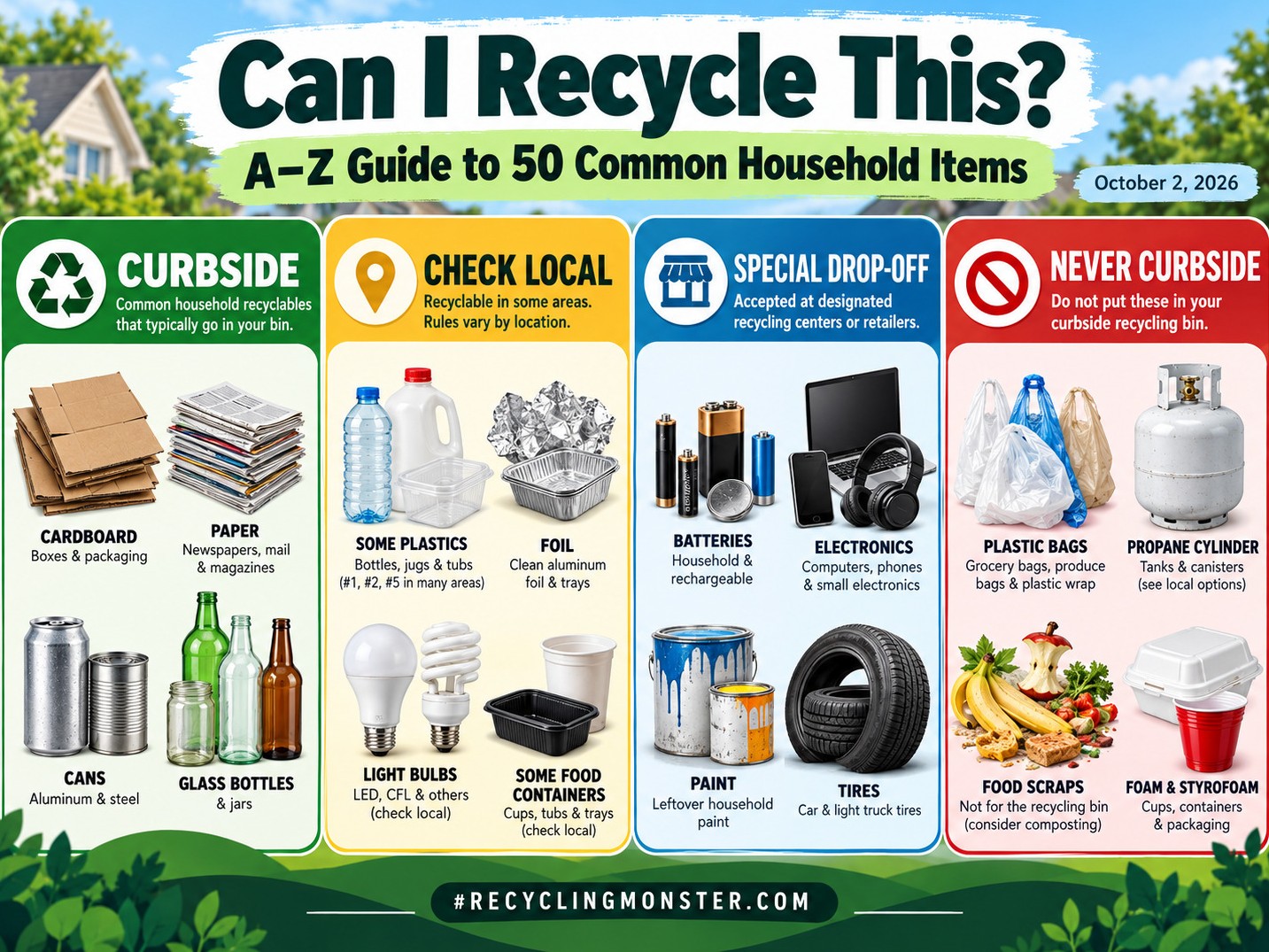
You can also use the A–Z Guide to 50 Common Household Items for practical disposal guidance on batteries, electronics, plastics, paint, glass, tires and other commonly confusing materials.
Five Packaging Label Mistakes to Avoid
| Mistake | Better Approach |
|---|---|
| Assuming arrows mean curbside recyclable | Read the complete instruction and check local acceptance. |
| Treating plastic #1–#7 as seven recycling categories | Use the number to identify the resin, then check the specific product format. |
| Putting store-drop-off film in the curbside cart | Use the collection route stated on the Store Drop-off label. |
| Assuming “made with recycled content” means recyclable | Look separately for disposal and recyclability instructions. |
| Putting certified compostable packaging into recycling | Use an accepting composting or organics program instead. |
The Simplest Rule for Reading Recycling Symbols
Do not ask only, “Does this have a recycling symbol?”
Ask:
“What exactly does this symbol tell me, and does my local system accept this particular package?”
That distinction prevents many of the mistakes that create contamination in recycling programs.
A resin number identifies material. A recycled-content statement describes manufacturing inputs. A compostability certification points toward an organics pathway. A standardized disposal label may tell you to recycle, check locally, use a store drop-off or dispose of the package.
None of those instructions should be interpreted more broadly than the label actually says.
Frequently Asked Questions About Recycling Symbols
Does the recycling symbol mean an item can go in my recycling bin?
No. A recycling-related symbol does not override local collection rules. Check the full packaging instruction and the accepted-material list for the recycling program serving your address.
Do plastic numbers 1 through 7 mean a product is recyclable?
No. Numbers 1 through 7 are Resin Identification Codes. They identify the plastic resin and do not guarantee that a community recycling program accepts the item.
What does “Check Locally” mean on packaging?
It means recycling availability varies by location and you should confirm whether the specific package is accepted by your local recycling program.
Does “made with recycled content” mean the package is recyclable?
No. Recycled content describes material used to manufacture the product or package. Recyclability is a separate end-of-life question.
Can compostable packaging go in the recycling bin?
No. Compostable packaging is not intended for the conventional recycling stream. Use a composting program that specifically accepts the item.
Primary Sources and Verification
This guide was reviewed against current U.S. recycling, packaging-labeling and compostability guidance available on October 10, 2026.
- U.S. Environmental Protection Agency — How Do I Recycle Common Recyclables?
- ASTM International — D7611/D7611M Standard Practice for Coding Plastic Manufactured Articles for Resin Identification
- Federal Trade Commission — Environmental Claims and Green Guides
- How2Recycle — Current Label Explorer and Recyclability Designations
- Biodegradable Products Institute — Compostability Certification and Labeling Guidance
- California Department of Resources Recycling and Recovery — SB 343 Accurate Recycling Labels
- Packaging Recovery Organisation Europe — Green Dot Trademark Guidance
Last verified: October 10, 2026.