 By Carolina
Curiel | Published on September 30, 2026 12:00:00 AM
By Carolina
Curiel | Published on September 30, 2026 12:00:00 AM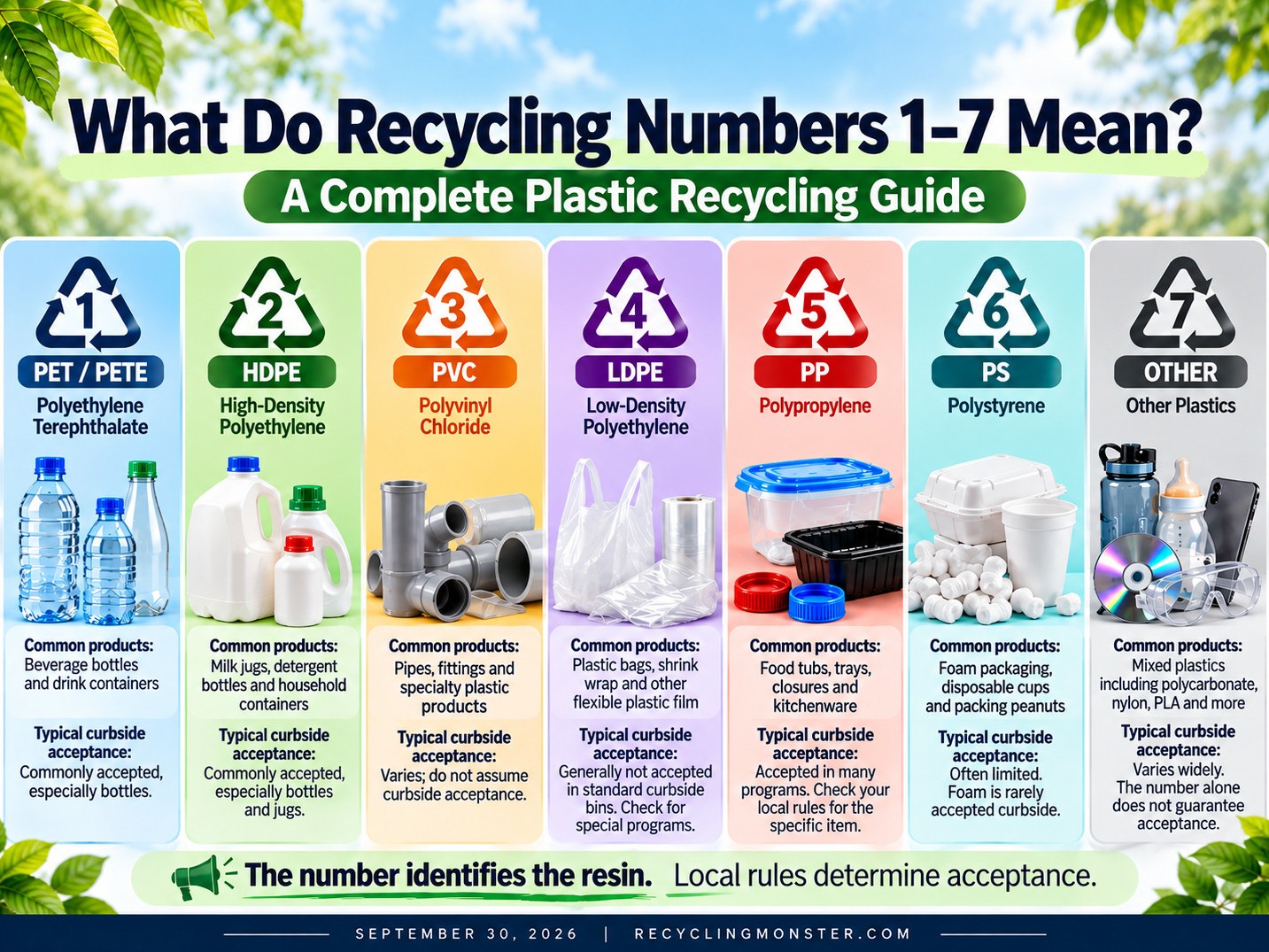
- Plastic numbers 1–7 identify the resin used to manufacture the item.
- #1 PET, #2 HDPE and #5 PP containers are accepted in many community recycling systems, but acceptance is not universal.
- #3 PVC, #4 LDPE, #6 PS and #7 Other plastics require especially careful checking because collection and processing options vary widely.
- Plastic bags and flexible film should generally stay out of household recycling bins unless the local program specifically accepts them.
- If curbside recycling does not accept a plastic item, RecyclingMonster can help locate plastic recyclers by material and location.
Turn over a plastic bottle, tub or container and you may see a number from 1 through 7 inside a triangular symbol. That number is commonly called a plastic recycling number, but its more precise name is a Resin Identification Code, or RIC.
The code identifies the type of plastic resin used in the product. The U.S. Environmental Protection Agency cautions that the symbol can look very similar to a recycling symbol, but its presence does not necessarily mean that the item is accepted for recycling in a particular community.
That distinction is increasingly important as packaging becomes more complex and local recycling programs differ in what they collect. The number is useful information. The local recycling program still makes the final decision.
Plastic Recycling Numbers 1–7 at a Glance
| Number | Resin | Common Examples | Typical Curbside Situation | What to Remember |
|---|---|---|---|---|
| #1 | PET or PETE Polyethylene Terephthalate | Beverage bottles and other PET rigid packaging | Commonly accepted, especially bottles | Acceptance still depends on the local program and package design. |
| #2 | HDPE High-Density Polyethylene | Milk jugs, detergent bottles, bottles and rigid containers | Commonly accepted, especially bottles and jugs | Natural and colored HDPE may be separated during processing. |
| #3 | PVC or V Polyvinyl Chloride | Pipes and some specialty plastic products | Varies; do not assume curbside acceptance | Check the exact item with the local program or a specialty recycler. |
| #4 | LDPE Low-Density Polyethylene | Shrink wrap, bags and other flexible plastic packaging | Flexible film is generally not accepted in standard curbside bins | Some stores and specialty programs collect clean film separately. |
| #5 | PP Polypropylene | Tubs, containers, trays, closures and some food-service items | Accepted in many programs | Confirm whether your program accepts the specific shape and package type. |
| #6 | PS Polystyrene | Foam packaging, packing peanuts and some rigid food-service items | Often limited; foam is rarely accepted curbside | Specialty recycling may be available even when curbside collection is not. |
| #7 | Other | Miscellaneous resins and products that do not fit codes 1–6 | Varies widely | The number alone gives too little information to assume local acceptance. |
These are practical U.S. guidelines, not universal curbside rules. Always verify accepted materials with the municipality, hauler or recycling program serving your address.
#1 PET or PETE: Polyethylene Terephthalate
PET is widely used for beverage bottles and other rigid plastic packaging. It is one of the plastics most familiar to curbside recycling programs.
The Association of Plastic Recyclers states that #1 PET bottles can be recycled in most communities. At a material recovery facility, or MRF, PET containers may be identified by optical sorting equipment and separated into a PET stream before being baled for shipment to a plastics recycler.
Once at the recycler, the material can be sorted again, ground into flake, washed and separated from other materials. The cleaned PET can then be further processed into recycled plastic feedstock.
Even with PET, however, the resin code is only one part of the recycling decision. Color, labels, closures, dimensions and other package features can affect how well a package sorts and processes.
#2 HDPE: High-Density Polyethylene
HDPE is commonly used for milk jugs, laundry detergent bottles and other durable rigid containers. It is another resin with a well-established presence in many curbside recycling programs.
APR notes that both natural and colored HDPE packaging are part of the plastics recycling system. Natural HDPE typically has a milky white appearance, while recycling facilities may use optical technology to separate natural material from colored HDPE.
As with PET, the safest consumer instruction is to check the local accepted-material list rather than relying only on the #2 mark.
#3 PVC: Polyvinyl Chloride
PVC, also identified by the letter V in some resin-code references, is code #3. EPA identifies pipes as a typical use for this resin.
PVC should not automatically be placed in a curbside bin simply because it carries a resin code. Local collection varies, and many PVC products are not the bottle-and-container formats that conventional residential recycling systems are designed to handle.
If a PVC item is not accepted locally, use the RecyclingMonster Recycle an Item finder or browse the plastic recycling directory for facilities that list the material.
#4 LDPE: Low-Density Polyethylene
LDPE is commonly used in flexible packaging, including film, shrink wrap and bags.
This is where consumers need to separate the idea of recyclable somewhere from accepted in the curbside bin. EPA says plastic bags, wraps and films should not be placed in the household recycling bin. Those materials may instead be collected through retail or specialty drop-off programs.
APR similarly advises that flexible films should stay out of curbside bins unless a recycling program specifically asks residents to include them.
Rigid #4 products may be handled differently, so the material form matters just as much as the resin number.
#5 PP: Polypropylene
Polypropylene is used in a wide range of rigid packaging, including bottles, tubs, trays, pails and closures. It is also used in some food-service products.
APR states that #5 PP containers can be recycled in most communities. Modern MRFs increasingly sort PP alongside PET and HDPE using optical sorting equipment.
That does not mean every #5 object belongs in every curbside cart. Size, shape, labels, attached components and local collection rules can still affect acceptance.
#6 PS: Polystyrene
Polystyrene carries resin code #6. Familiar examples include foam packaging and packing peanuts, although PS also appears in rigid products.
EPA says very few localities accept polystyrene foam in curbside recycling. Specialty collection may exist in some areas, so a rejected curbside item is not necessarily unrecyclable everywhere.
The correct approach is to identify the exact product and find a program that specifically lists it as accepted.
#7 Other: The Catch-All Category
Code #7 is different from the first six numbers because it is a broad “Other” category rather than one single resin.
It can include miscellaneous plastics that do not fit the #1 through #6 categories. Because the category is broad, a #7 code provides even less information about curbside acceptance than the other resin numbers.
Do not assume all #7 products behave the same way in a recycling system. Check the exact material and product with the local program or an appropriate recycler.
Why the Number Does Not Automatically Mean “Recyclable”
The triangle surrounding a resin number is one of the biggest sources of confusion in household recycling.
EPA explains that the symbol identifies the type of plastic and can help consumers determine whether a local program accepts it. EPA also explicitly notes that the symbol does not necessarily mean the container can be collected for recycling in that community.
The Federal Trade Commission takes a similar approach when addressing environmental marketing claims. Its Green Guides state that recyclable claims should be qualified when appropriate recycling facilities are not available to a substantial majority of consumers or communities.
APR goes a step further by defining recyclability through several separate conditions. In its current guidance, a plastic package must have appropriate design characteristics, consumer access to collection, acceptance within the collection system and a viable market for the recovered resin.
In practical terms, resin identity is only the starting point.
How Plastic Is Sorted After It Reaches a Recycling Facility
The number stamped on a package is useful for identification, but a modern recycling facility does not depend on residents manually separating every plastic by number.
After recyclables reach a MRF, the materials move through several sorting stages. Paper, metals, glass and plastics are separated using equipment designed around physical characteristics and material type.
APR describes PET, HDPE and PP as the most common plastic types sorted with optical equipment. Near-infrared sensors can identify targeted plastic resins as containers move along a conveyor. Air jets then direct identified items into the appropriate material stream.
The separated plastics are compressed into bales and sold to plastics recyclers, sometimes called reclaimers.
What Happens to Plastic at the Recycler?
Plastic bales arriving at a recycler still contain material that needs further separation and cleaning.
APR describes a typical mechanical recycling sequence that includes additional sorting, grinding the material into flake, washing it, separating different plastics by density, rinsing and drying the flake, and then melting and filtering appropriate material into recycled plastic feedstock such as pellets.
For example, a PET bottle and its cap may travel through collection together but separate later in processing because different plastics behave differently in a float-sink tank.
This is also why package design matters. Labels, colors, adhesives, closures and other components can affect whether an otherwise desirable resin can be correctly identified, separated and converted into high-quality recycled material.
Which Plastic Numbers Are Most Commonly Recycled Curbside?
APR currently identifies #1 PET bottles, #2 HDPE bottles and #5 PP containers as recyclable in most communities.
That is a useful national rule of thumb, but it is not permission to place every #1, #2 or #5 item in every curbside cart. Local programs can differ by product shape, material form, equipment, contracts and available markets.
The right question is therefore not simply, “What number is this?” It is:
“Does my local program accept this specific type of plastic product?”
What Should You Do When Curbside Recycling Does Not Accept the Plastic?
A curbside rejection does not always mean the material has no recycling option.
Start with the local municipality or hauler. If the item is not accepted, search by material through RecyclingMonster’s Recycle an Item finder. You can also browse plastic recycling centers and review the materials individual facilities report accepting.
Always contact the recycler before making a trip. Accepted forms, quantities and customer requirements can differ even among facilities that process the same resin.
Frequently Asked Questions
Does a number inside a triangle mean the plastic is recyclable?
No. The number identifies the plastic resin. EPA states that the symbol does not necessarily mean the item can be collected for recycling in your community.
What does plastic #5 mean?
#5 identifies polypropylene, or PP. It is used for products such as rigid containers, tubs, trays and closures. APR says #5 PP containers can be recycled in most communities, but local acceptance still applies.
Which plastic numbers are most commonly accepted?
APR identifies #1 PET bottles, #2 HDPE bottles and #5 PP containers as recyclable in most communities. Specific acceptance still depends on the local recycling program.
Can #4 plastic bags go in the curbside recycling bin?
Generally, no. EPA says plastic bags, wraps and films should not go in the household recycling bin. Specialty or retail collection may be available separately.
What does plastic #7 mean?
#7 is the “Other” category for miscellaneous plastics that do not fit resin codes #1 through #6. Because it is a broad category, local acceptance varies significantly.
Primary Sources and Verification
This guide was checked against current primary and plastics-industry guidance on September 30, 2026:
- U.S. EPA: How Do I Recycle Common Recyclables?
- U.S. EPA: Assessment of the U.S. Recycling System
- Federal Trade Commission: Environmental Claims and Green Guides
- Association of Plastic Recyclers: APR Design Guide Overview
- Association of Plastic Recyclers: The Plastic Recycling Process
Verification date: September 30, 2026. Recycling acceptance can change by municipality, hauler, facility and product type. Readers should confirm current requirements with the program serving their location.