 By Carolina
Curiel | Published on November 09, 2026 12:00:00 AM
By Carolina Curiel
Published November 9, 2026
MONTREAL (RecyclingMonster): A clear water bottle, a peanut-butter jar and a strawberry clamshell can all carry the number 1. That does not mean every one of them follows exactly the same recycling route.
The number identifies the plastic: polyethylene terephthalate, or PET.
PET has one of the most established recycling systems of any plastic in North America. Bottles are accepted in the overwhelming majority of U.S. recycling programs, millions of pounds move through reclaimers every day, and recycled PET is routinely used to make new bottles and other products.
But the familiar #1 symbol is still not a universal recycling instruction.
A bottle, jar, tray and clamshell can all be made from PET while differing in shape, color, labels, coatings and how easily recycling equipment can identify and process them.
- PET, or polyethylene terephthalate, is the plastic identified by Resin Identification Code #1.
- PET bottles and jars have broad U.S. recycling access, while PET trays, clamshells and other thermoforms still require local confirmation.
- Caps and labels can generally remain on PET bottles because reclaimers can separate common polypropylene and polyethylene closures from denser PET during processing.
- PET reclaimers sort, grind, wash and purify the material into clean flake or recycled PET resin for new packaging and other products.
- Package color, labels, adhesives, coatings and other design choices can determine how much usable recycled PET survives the process.
What Is PET #1 Plastic?
PET stands for polyethylene terephthalate. PETE is another abbreviation for the same polymer.
It belongs to the polyester family and is commonly used where manufacturers need a package that is lightweight, strong, clear and resistant to breakage.
Common PET packaging includes:
- Water bottles
- Soft-drink bottles
- Juice and beverage bottles
- Some cooking-oil bottles
- Peanut-butter and food jars
- Produce clamshells
- Deli and bakery containers
- Clear cups, trays, tubs and lids
The #1 is the Resin Identification Code associated with PET.
It tells a recycler what resin family the package belongs to. It does not, by itself, tell the consumer that every #1 item belongs in every curbside recycling program.
For the full distinction between resin codes and recycling instructions, see RecyclingMonster's Plastic Recycling Numbers 1–7 Guide.
Which PET #1 Items Are Commonly Accepted?
PET bottles are the strongest part of the #1 recycling stream.
NAPCOR reports that PET bottles are accepted in virtually all U.S. recycling programs, and its current consumer data indicate that roughly 88% of U.S. households have access to PET bottle recycling.
Non-bottle PET is more complicated.
| PET Item | Typical Situation | What to Do |
|---|---|---|
| Clear PET beverage bottles | Widely accepted | Empty the bottle and follow the local program. |
| PET food jars | Commonly accepted where PET bottles and jars are collected | Remove significant food residue and follow local rules. |
| Clear PET produce clamshells | Accepted in many, but not all, programs | Check specifically for trays, tubs or thermoforms. |
| PET bakery or deli trays | Varies by market and processor | Confirm the local accepted-material list. |
| Dark or heavily colored PET | Can have limited recycling markets | Do not assume #1 alone makes it locally acceptable. |
| Multimaterial PET packages | Compatibility depends on labels, coatings, seals and attachments | Follow the package and local recycling instructions. |
PET Bottles and PET Thermoforms Are the Same Resin, but Not the Same Package
This distinction is becoming increasingly important.
A PET bottle is blow-molded into a three-dimensional container, usually with a screw-neck opening.
A PET thermoform begins as PET sheet that is heated and shaped into packaging such as a tray, clamshell, tub, lid or cup.
Both may carry the #1 code.
But sorting systems do not see only chemistry. They also encounter shape, thickness, labels, colors and other packaging components.
NAPCOR says PET thermoforms are technically recyclable with PET bottles, and most recovered thermoforms continue to be processed through established PET bottle recycling infrastructure.
However, not every PET reclaimer accepts unlimited quantities of thermoforms in bottle bales. Buyer specifications can limit how much thermoform material may be included, and auto-sorting is often preferred to reduce contamination from look-alike packages made from other resins.
If your local recycling program says “bottles and jars,” do not assume that every #1 clamshell or tray is included. Look specifically for language covering tubs, trays, clamshells or PET thermoforms.
Do PET Bottle Caps Need to Come Off?
Usually, no.
EPA says plastic caps and labels can typically remain on bottles. NAPCOR likewise says common plastic caps, closures and neck rings are not considered contaminants in PET recycling.
This seems counterintuitive because the cap is often not made from PET.
That is exactly why the recycling process can separate it.
Most bottle caps are made from polypropylene or polyethylene, which are less dense than water. PET is denser than water.
When ground bottle material enters a float-sink separation process:
PET flake sinks.
Many polyethylene and polypropylene cap components float.
That physical difference allows reclaimers to separate the materials after grinding.
Metal closures are different and can be undesirable in the PET stream.
How Should PET Containers Be Prepared for Recycling?
You do not need to turn your kitchen into a plastics reclamation plant.
The useful steps are straightforward:
- Empty the container. Remove liquids and significant food residue.
- Follow local instructions for rinsing. A quick rinse may be appropriate when residue remains.
- Leave ordinary plastic caps on when your program allows it.
- Do not assume every #1 thermoform is accepted. Check the program.
- Keep non-recyclable material out. A PET package does not make everything attached to it compatible with PET recycling.
There is little benefit in using large amounts of hot water and detergent simply to make a bottle cosmetically perfect. The objective is to keep significant food and liquid contamination out of the recycling stream.
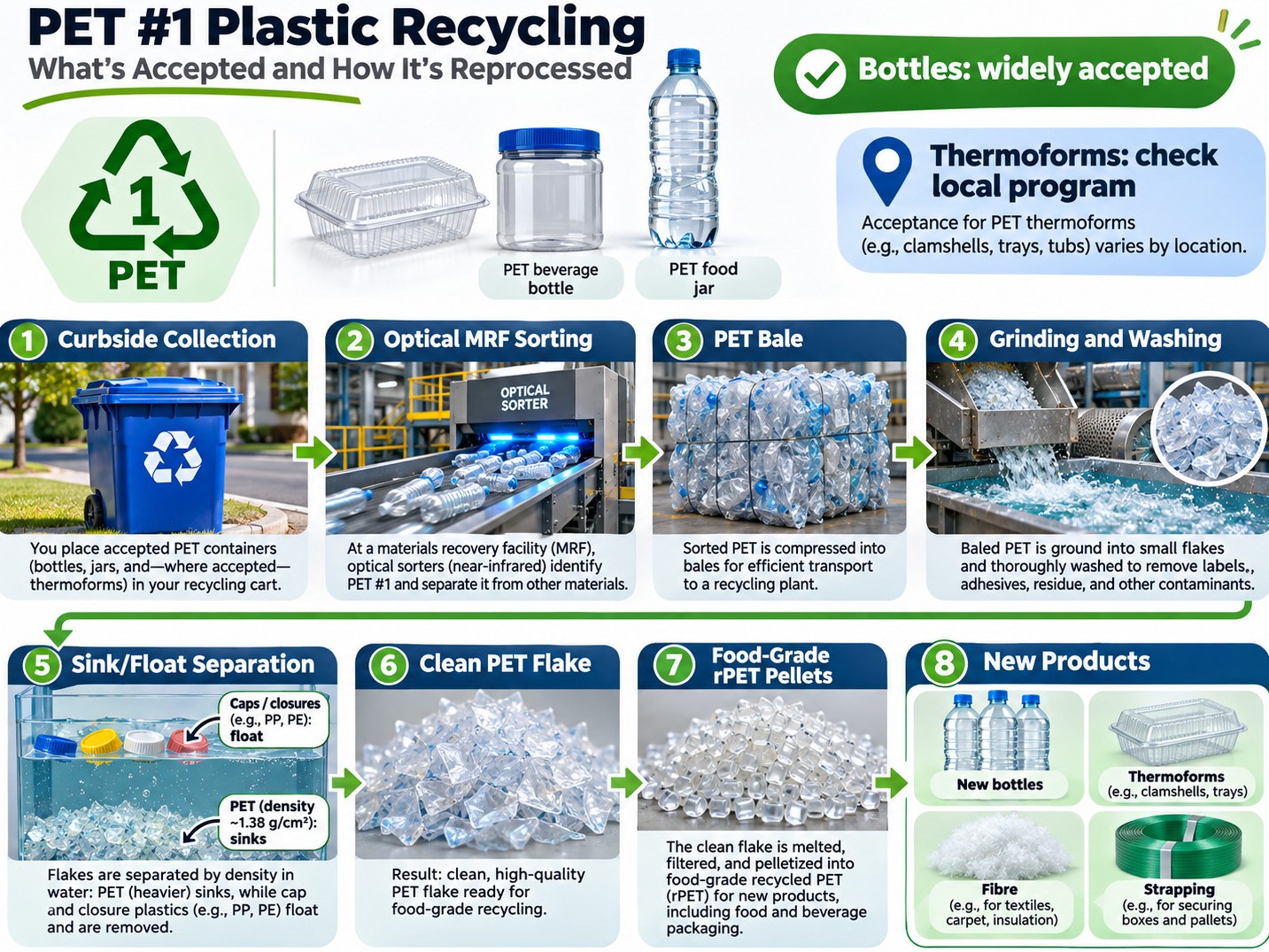
Step 1: PET Is Collected With Other Recyclables
In most curbside programs, the PET bottle does not travel to a PET recycling plant by itself.
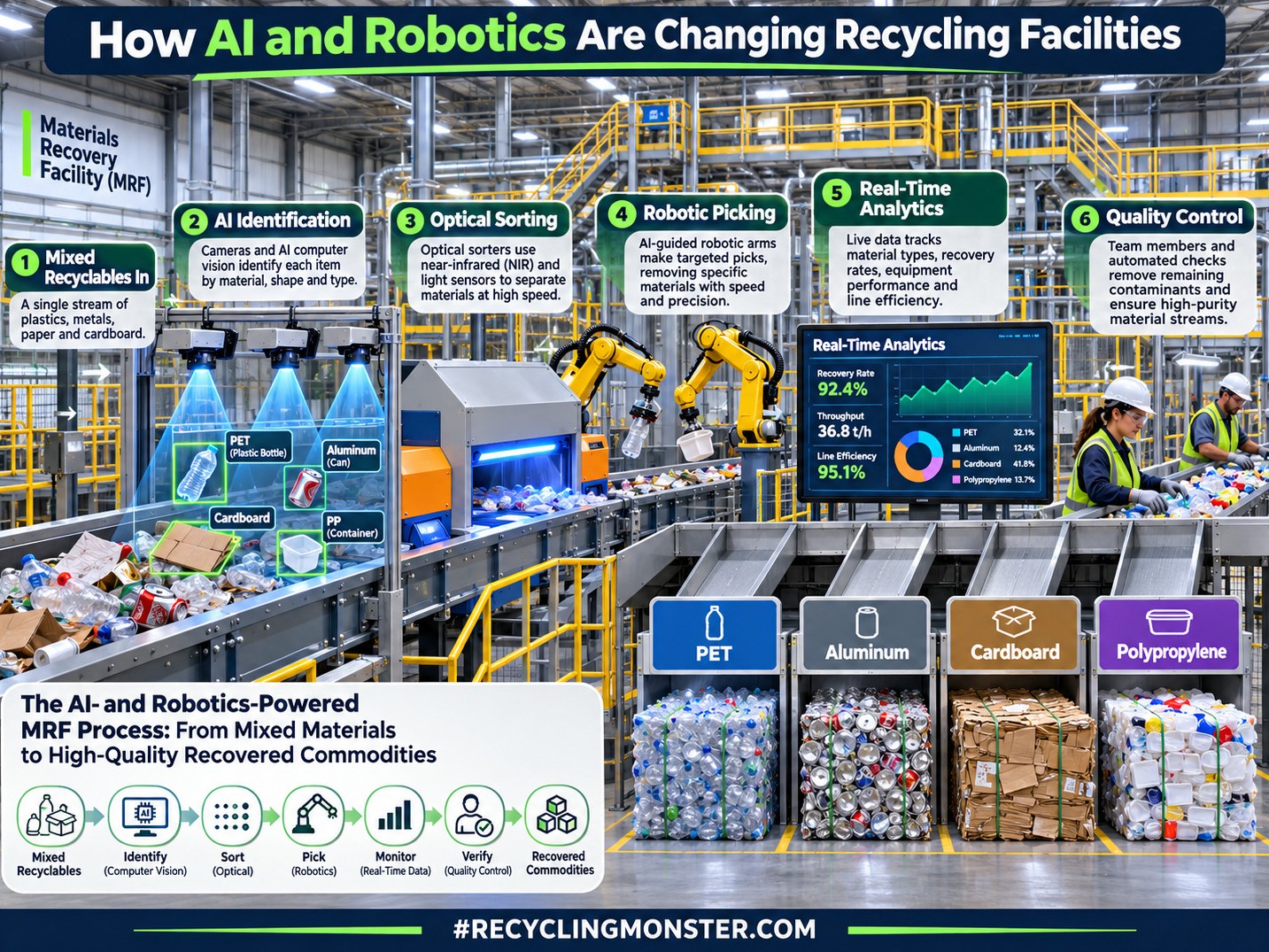
It arrives at a materials recovery facility, or MRF, mixed with paper, cardboard, cans, glass and other accepted containers.
The MRF's job is to separate those mixed recyclables into marketable commodity streams.
PET is one of those streams.
Step 2: Optical Sorters Identify PET
Modern MRFs commonly use optical sorting equipment to identify plastic resin.
Near-infrared sensors examine packages moving rapidly across a conveyor. When the equipment identifies the target PET stream, precisely timed air jets can redirect selected containers into another chute.
Shape matters as well.
A clear bottle generally presents differently to sorting equipment than a flat lid, dark tray or small fragment.
This is one reason package dimensions and design affect whether technically recyclable PET is actually recovered.
RecyclingMonster's MRF guide explains the full sorting system in more detail.
Step 3: The MRF Makes a PET Bale
Once enough PET has been accumulated, the MRF compresses the containers into a dense bale for storage and transportation.
NAPCOR says a typical PET bale can weigh approximately 1,000 pounds.
The bale is not finished recycled resin.
It still contains complete packages, caps, labels and some unwanted material.
This is why PET bale specifications matter.
Industry model specifications distinguish between PET bottle bales, bottle bales containing agreed quantities of thermoforms, and dedicated PET thermoform bales.
Individual buyers can set tighter contractual specifications.
The MRF creates a sorted commodity. The PET reclaimer performs the deeper cleaning and processing that turns that commodity into recycled PET feedstock.
Step 4: PET Bales Reach the Reclaimer
A PET reclaimer purchases or receives baled PET and converts it into usable recycled material.
The first thing the reclaimer does is not melt everything together.
The material is inspected and sorted again.
Additional optical sorting, color sorting and quality-control systems may remove:
- Non-PET plastics
- Problematic colors
- Metals
- Paper
- Unacceptable packaging
- Other contaminants
The cleaner the incoming bale, the more efficiently the reclaimer can produce useful recycled PET.
Step 5: Bottles Are Ground Into PET Flake
After sorting, PET containers are reduced to smaller pieces.
Grinding creates flakes that are easier to wash and separate than intact bottles and packages.
At this point, a single ground stream may contain PET alongside pieces of labels, closures, adhesives and residual contamination.
The next stages are designed to separate them.
Step 6: Washing Removes Labels, Adhesives and Residue
Washing is one of the most important steps in PET reclamation.
Wash systems remove product residue, dirt, label material and adhesives.
Package design matters enormously here.
The Association of Plastic Recyclers recommends label systems and adhesives that separate cleanly during PET washing. Compatible film labels are designed to float away from the PET, while adhesives should release rather than remain attached to the flake or redeposit onto it.
A package can therefore be made from PET while still creating avoidable recycling problems if the label or adhesive is poorly designed for the reclamation process.
Step 7: Density Separation Splits PET From Caps
Ground PET then benefits from one of the polymer's useful physical properties: density.
PET → sinks
while
many PE and PP caps → float
The materials can then be separated physically.
The cap material does not necessarily become waste. Polyethylene and polypropylene recovered from the process can have recycling outlets of their own.
Step 8: Clean PET Flake Is Purified
After washing and separation, clean PET flake can undergo further processing.
Depending on the intended market, reclaimers may use additional optical sorting, filtration, metal detection and other purification steps.
Some customers buy clean PET flake directly.
Other applications require the PET to be melted, filtered, extruded and pelletized into a more uniform recycled resin.
The specifications become tighter when the material is intended for demanding packaging applications.
Can Recycled PET Be Used in New Food and Beverage Bottles?
Yes, when the recycled material is produced through a process suitable for food-contact use.
This is where the phrase food-grade rPET matters.
The U.S. Food and Drug Administration evaluates recycled-plastic processes intended for food-contact applications with particular attention to possible contamination in post-consumer feedstock and the ability of the recycling process to remove that contamination.
FDA's favorable opinions apply to specific recycling processes and conditions of use.
That means a bag of generic PET flake does not automatically become food-contact material simply because the base resin is PET.
Feedstock control, cleaning, decontamination and process validation matter.
“Made from PET” and “suitable for food-contact recycled PET” are not the same claim. Food-contact applications depend on the recycling process and intended use, not resin identity alone.
What Does Recycled PET Become?
Recycled PET, commonly abbreviated rPET, has several major end markets.
- New beverage and food bottles
- New PET thermoform packaging
- Polyester fibre used in textiles and other products
- Strapping
- Sheet
- Non-food containers and other plastic products
Bottle manufacturing has become an increasingly important rPET end market.
NAPCOR's current 2026 materials report that approximately 62% of the recycled PET used in the United States and Canada in 2024 went into new PET bottles.
That is significant because bottle-to-bottle use keeps recovered PET within the packaging system rather than moving it immediately into a product with a very different recycling pathway.
How Much PET Is Actually Being Collected?
The latest comprehensive NAPCOR report covers 2024 activity.
| 2024 PET Indicator | Result |
|---|---|
| U.S. PET bottle collection rate | 30.2% |
| North American PET bottle collection rate | 39.2% |
| Average recycled content in U.S. PET bottles | 15.9% |
| U.S./Canadian PET reclamation output-to-input ratio | 85.2% |
| PET thermoforms recovered in U.S. and Canada | 264 million lb |
The U.S. bottle collection rate fell from 32.5% in 2023 to 30.2% in 2024.
That is an important reminder that a technically mature recycling system does not guarantee that every available bottle reaches it.
The material still has to be captured from households and businesses.
PET Thermoforms Are the Fast-Growing Part of the Story
The most interesting recent development is outside the bottle stream.
NAPCOR's June 2026 thermoform analysis found that 264 million pounds of PET thermoforms were recovered in the United States and Canada during 2024.
That was a 52% increase from the prior year and the highest recovery volume NAPCOR has recorded.
But recovery alone does not equal circularity.
Thermoform converters purchased more than 2.05 billion pounds of PET feedstock during 2024. Virgin PET accounted for approximately 79% of those purchases, while post-consumer recycled PET represented about 12%, down from the prior year.
Most recovered thermoforms are still processed alongside PET bottles rather than through dedicated thermoform-to-thermoform systems.
The recycling industry is capturing substantially more PET trays and clamshells, but expanding collection is only one part of the problem. Sorting compatibility, reclaimer yield, food-contact requirements and demand for recycled thermoform feedstock all have to grow with it.
Why Clear PET Is Easier to Keep in Circulation
Color affects what a reclaimer can make from recovered PET.
The Association of Plastic Recyclers identifies clear, unpigmented PET as preferred for recycling, along with limited light-color exceptions.
Highly colored PET can have much narrower end markets because pigment cannot simply be removed during washing.
Once dark color enters the flake, it limits the range of colors and products manufacturers can make from that recycled resin.
This is why a clear package can have more end-market flexibility than a heavily pigmented version made from the same base polymer.
Labels Can Determine Whether a PET Package Recycles Well
A PET bottle can be made from a highly recyclable base resin while wearing a label that makes the recycling process harder.
Recyclers care about:
- How much of the bottle the label covers
- Whether optical sorters can still identify the PET
- What polymer the label is made from
- Whether the label separates during washing
- Whether inks bleed into the wash water or PET flake
- Whether adhesive releases cleanly
APR's design guidance recommends labels, inks and adhesives that are compatible with the existing PET reclamation process.
This is a useful example of why “PET is recyclable” is not the end of the packaging-design discussion.
The recycler has to process the whole package.
The #1 Symbol Does Not Guarantee a Market
Recycling ultimately depends on a buyer.
A MRF can correctly identify PET. A reclaimer can clean it. But recovered PET still needs to meet the quality and price requirements of a manufacturer.
That is why PET bale quality, domestic reclaimer capacity and demand for recycled content all matter.
NAPCOR reported that imports represented 23% of total rPET supply to U.S. and Canadian end markets in 2024, even as domestic recyclers worked with locally collected material.
This creates another industry tension: North American manufacturers can demand more recycled PET while domestic reclaimers compete with imported recycled resin.
Industry Edge: Collection Is Now a Manufacturing Issue
PET recycling is increasingly tied to domestic manufacturing strategy. NAPCOR's 2026 decarbonization roadmap identifies stronger collection, sorting, recycling capacity and higher recycled-content use among the levers that could reduce PET bottle-system emissions over time. Sister publication ScrapMonster reported on the roadmap and its implications for the U.S. PET supply chain.
Seven Common PET Recycling Mistakes
PET identifies the resin. Local programs determine acceptance.
Both can be PET, but MRF and reclaimer acceptance can differ by package format.
Common plastic caps can generally remain on PET bottles and are separated during reclamation.
Emptying containers reduces contamination and makes downstream processing easier.
Pigment can narrow the possible end markets for recycled PET.
The whole package has to survive sorting, washing and separation, not just the bottle body.
Collection is only the beginning. PET still has to be sorted, reclaimed, purified and sold into a manufacturing market.
How to Find a PET Recycler or Drop-Off Option
For most households, the first place to check is the curbside or municipal recycling program serving the address.
If the item is not accepted there, specialty recycling may be available.
- Check the local accepted-material list.
- Confirm whether it accepts PET bottles only or also tubs, trays and clamshells.
- Use RecyclingMonster's Recycle an Item tool to search for #1 PETE Plastic, #1 PETE Plastic Bottles or related PET materials.
- Browse the Plastic Recycling Centers directory.
- Confirm acceptance directly before traveling.
The Bottom Line
PET #1 has one of the most developed recycling systems in the plastics industry.
That does not make every #1 package automatically recyclable everywhere.
Bottles remain the strongest and most widely collected part of the system. Thermoforms are becoming a much larger part of the recovered PET stream, but acceptance and downstream compatibility still vary.
Once PET reaches a reclaimer, the process becomes much more sophisticated than simply melting bottles together. Material is sorted again, ground, washed, separated by density and purified into clean recycled feedstock.
Package design determines how efficiently that process works.
Color matters. Labels matter. Adhesives matter. Closures matter. Bale quality matters.
And ultimately, end-market demand matters.
The #1 code tells you what the plastic is. The recycling system determines what happens to it next.
Frequently Asked Questions About PET #1 Recycling
Is PET #1 recyclable?
Yes. PET is widely recycled, particularly bottles and jars. Acceptance of trays, clamshells and other PET thermoforms varies by local program and downstream market.
Should I remove the cap from a PET bottle?
Usually not. EPA and NAPCOR say ordinary plastic caps and closures can generally remain on PET bottles. During reclamation, common polypropylene and polyethylene cap material can be separated from denser PET using float-sink separation.
Can PET clamshells go in curbside recycling?
In some communities, yes. PET thermoform acceptance has expanded, but it is not universal. Check specifically whether your local program accepts PET trays, tubs or clamshells rather than relying only on the #1 code.
What does recycled PET become?
Recycled PET can be used in new bottles, thermoform packaging, polyester fibre, strapping, sheet and other products. Bottle manufacturing is currently the largest North American end market for rPET.
Is PET bottle-to-bottle recycling possible?
Yes. PET can be mechanically recycled and processed back to food-grade quality when the reclamation process meets the requirements for the intended application. Recycled PET is already widely used in new food and beverage bottles.
Primary Sources and Verification
- National Association for PET Container Resources — 2024 PET Recycling Report
- National Association for PET Container Resources — 2024 PET Thermoform Market Analysis
- National Association for PET Container Resources — PET Recycling and Reclaimer Guidance
- Association of Plastic Recyclers — PET Packaging Design Guidance
- U.S. Environmental Protection Agency — How Do I Recycle Common Recyclables?
- U.S. Food and Drug Administration — Recycled Plastics in Food Packaging
Last verified: November 9, 2026.