 By Carolina
Curiel | Published on November 02, 2026 12:00:00 AM
By Carolina Curiel
Published November 2, 2026
Plastic film is everywhere: grocery bags, shipping mailers, pallet wrap, case wrap, bread bags, produce bags and the clear stretch film used around warehouse loads.
Yet film does not behave like a bottle or jug in the recycling system.
Its lightweight, flexible structure is useful in packaging but difficult for conventional sorting plants. Loose film can wrap around screens and rotating equipment, contaminate paper streams and force processing lines to stop for cleaning.
- Most plastic bags, wraps and films should stay out of standard U.S. curbside recycling unless the local program specifically accepts them.
- Qualifying polyethylene film may use participating Store Drop-off or specialty collection programs.
- Commercial stretch wrap can be a valuable recycling stream when it is kept clean, dry and separate from incompatible materials.
- Not every flexible package belongs in the polyethylene film stream; multilayer pouches, compostable film and other structures may require different routes.
- Film recycling works best when collection, bale quality, processing capacity and end markets are all aligned.
What Is Plastic Film?
Plastic film is a broad term for thin, flexible plastic material rather than rigid containers.
Common examples include:
- Grocery and retail bags
- Produce bags
- Bread bags
- Newspaper bags
- Case wrap
- Stretch wrap
- Pallet wrap
- Some shipping mailers
- Wrap around paper towels and other household products
- Air pillows and certain protective packaging
Much of the film collected through established film-recycling programs is made from polyethylene, including high-density polyethylene, low-density polyethylene and linear low-density polyethylene.
But flexible packaging is not one material family.
Snack pouches, frozen-food bags, pet-food bags, metallized wrappers and other flexible packages may contain several polymer layers, coatings or barrier materials. They can look similar to recyclable polyethylene film while behaving very differently during reprocessing.
Why Plastic Film Usually Does Not Belong in Curbside Recycling
EPA advises that plastic bags, wraps and films can have recycling options but generally should not be placed in household recycling bins.
The main problem is physical rather than simply chemical.
A rigid bottle travels predictably through conveyors and sorting equipment. Flexible film folds, flutters and stretches.
At a conventional materials recovery facility, or MRF, film can:
- Wrap around rotating shafts and screens
- Become tangled in mechanical equipment
- Travel with paper and cardboard
- Reduce the quality of other commodity streams
- Require manual removal
- Force equipment shutdowns for cleaning
This is why a polyethylene bag may be recyclable in a dedicated film system but still be unacceptable in a household recycling cart.
For the sorting-plant perspective, see RecyclingMonster's guide to how materials recovery facilities work.
Household Plastic Film vs. Commercial Stretch Film
| Stream | Typical Examples | Common Collection Route |
|---|---|---|
| Household Film | Grocery bags, bread bags, produce bags, compatible mailers and product overwrap | Store Drop-off or specialty collection where accepted |
| Retail Back-of-House Film | Case wrap, pallet wrap and shipping film generated during stocking | Commercial film consolidation or baling |
| Warehouse Stretch Wrap | Clear pallet stretch film from distribution and logistics operations | Source-separated commercial recycling |
| Industrial Film | Packaging film, bags and wrap generated in manufacturing | Processor-specific commercial recycling program |
| Multilayer Flexible Packaging | Snack pouches, metallized bags and some barrier packaging | Specialty route only where specifically accepted |
How Household Store Drop-Off Recycling Works
In the United States, How2Recycle uses its Store Drop-off designation for qualifying polyethylene film packaging.
Participating retail stores and other collection sites may accept eligible bags and wraps in dedicated bins, usually near the entrance.
Common candidates can include:
- Grocery bags
- Produce bags
- Bread bags
- Newspaper bags
- Compatible shipping mailers
- Plastic stretch wrap
- Wrap around paper towels and similar products
- Certain cereal bags
But the category name is not enough.
How2Recycle specifically cautions that not every film package in those categories is compatible with the Store Drop-off stream. Consumers should look for the disposal label or verify the material before adding it.
Do not assume that a bag is accepted because it is flexible, clear, marked #2 or marked #4. Follow the package instructions and the collection program's current accepted-material list.
How Should Plastic Film Be Prepared for Drop-Off?
Film recycling relies on keeping the collection stream usable.
- Empty the package. Remove the product or contents.
- Keep it clean. Remove significant residue.
- Keep it dry. Wet film can contaminate the collected material.
- Remove incompatible components when instructed. Some labels, zippers or attachments can affect acceptance.
- Verify the item. Check the film-recycling program rather than relying on appearance alone.
- Verify the location. Retail participation and accepted materials can change.
The Flexible Film Recycling Alliance describes consumer film drop-off as a clean-and-dry stream and advises users to verify eligible items before bringing material to a collection point.
Why Commercial Stretch Wrap Can Be a Better Recycling Stream
Commercial film can have an advantage over household film: it can often be captured before it becomes mixed with other waste.
A warehouse receiving hundreds of palletized loads may generate large quantities of relatively uniform clear stretch film in one location.
If employees remove the film and place it into a dedicated collection container, the business can create a cleaner and more concentrated stream than one assembled from thousands of household drop-offs.
This can reduce sorting costs and improve the usefulness of the material to a recycler.
Commercial programs may collect:
- Clear pallet stretch film
- Case wrap
- Polyethylene bags
- Retail overwrap
- Selected manufacturing film
Acceptance depends on the buyer, and businesses should not mix every flexible plastic into the same bale.
What Makes Commercial Film Valuable?
Film recyclers care about consistency.
A load of clean, clear polyethylene stretch wrap can be easier to process than a mixed stream containing colored bags, paper labels, nylon straps, food residue, PVC, PET, multilayer flexibles and trash.
Factors that affect value and acceptance include:
- Polymer type
- Color
- Clarity
- Contamination
- Moisture
- Labels and attachments
- Quantity
- Bale density
- Freight distance
- End-market demand
APR's plastics-recycling terminology distinguishes several film bale categories, including retail bags and film and clear polyethylene film. Commercial agreements may impose tighter specifications, so the recycler's contract always matters.
How Businesses Can Set Up a Stretch-Wrap Recycling Program
A business does not need a complicated program to start, but it does need contamination control.
1. Identify the Film
Confirm that the material generated is compatible with the recycler's polyethylene film stream.
2. Separate It at the Point of Generation
Put dedicated collection containers where workers actually remove stretch wrap — receiving docks, shipping areas and warehouse aisles.
3. Keep Other Materials Out
Common contaminants include:
- Strapping
- Cardboard
- Paper labels
- Wood
- Food waste
- Gloves and other trash
- Non-PE flexible packaging
4. Keep Film Dry
Do not store collected film where rain or liquids can saturate it.
5. Build Enough Volume
Loose film has extremely low bulk density. A business generating meaningful quantities may need to compact or bale the material to control storage and freight costs.
6. Confirm the Buyer's Specification
Ask the recycler about allowable colors, labels, contamination, bale dimensions, minimum quantities and transportation arrangements.
7. Train Employees
A simple photo-based sign showing “YES” and “NO” materials can prevent a clean film stream from becoming a mixed-plastic waste stream.
Why Baling Matters
Plastic film is light but bulky.
Shipping a trailer filled with loose stretch wrap is inefficient because much of the trailer's volume is air.
Baling compresses the film into dense units that are easier to store, handle and transport.
For large commercial generators, this can determine whether film recycling is economically practical.
Smaller businesses may instead consolidate film through a recycler, distribution center or other collection partner that combines material from several generators.
What Happens to Plastic Film After Collection?
Collection is only the first step.
After household or commercial film is consolidated, the material can be baled and shipped to a film processor or reclaimer.
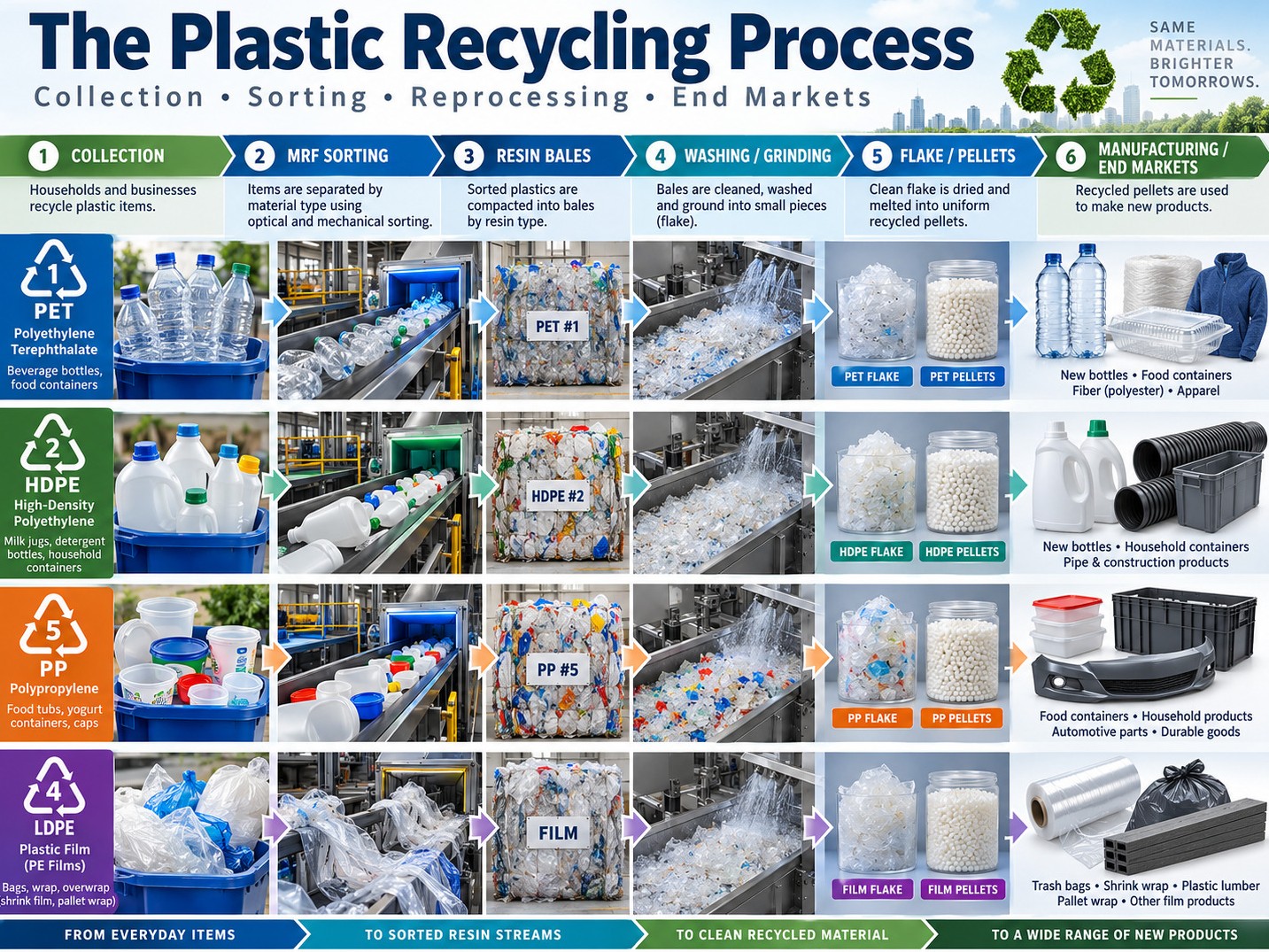
A typical polyethylene film-recycling process may include:
- Bale inspection. Incoming material is checked for incompatible plastics and contamination.
- Sorting. Film may be separated by color, polymer or quality.
- Size reduction. Material is shredded or granulated.
- Washing. Dirt, labels and residue are removed where required.
- Drying. Moisture is removed.
- Extrusion and filtration. The polymer is melted and screened to remove remaining contamination.
- Pelletizing. Recovered polyethylene may be converted into recycled resin pellets.
Those pellets or other processed outputs become feedstock for new products.
What Is Recycled Plastic Film Made Into?
End markets depend on resin quality and the capabilities of the processor.
Current U.S. film-recycling guidance identifies applications including:
- Composite and plastic lumber
- Decking
- Drainage products
- Construction products
- Trash bags
- Shrink wrap
- New film and flexible packaging
- Other durable plastic products
The recycling loop works only when manufacturers actually purchase and use the recovered material.
Why Multilayer Flexible Packaging Is Different
Not everything that bends is polyethylene film.
Modern flexible packaging often combines several materials to provide oxygen barriers, moisture protection, strength, heat resistance or shelf life.
A pouch may contain polyethylene plus nylon, polypropylene, EVOH, metalized layers or other materials.
Those structures can be difficult to separate through conventional polyethylene-film recycling.
This is why How2Recycle evaluates certain barrier layers, coatings, metallic components and attachments before determining whether a film package qualifies for Store Drop-off.
Consumers should therefore avoid using a “stretch test” as their only recycling rule.
Which Flexible Plastics Commonly Do Not Belong in Store Drop-Off?
Current film-recycling guidance commonly excludes or requires additional verification for items such as:
- Chip bags
- Candy wrappers
- Frozen-food bags
- Some salad bags
- Metallized pouches
- Compostable plastic bags
- Paper-padded mailers
- Soil and mulch bags
- Other multilayer flexible packaging
Some specialty recyclers are developing outlets for difficult flexible materials, but those programs should not be confused with the conventional polyethylene Store Drop-off stream.
Can Compostable Film Go With Polyethylene Film?
No, unless the specific recycler explicitly accepts it.
Compostable plastics are designed for a different end-of-life pathway and can interfere with conventional plastic recycling.
A compostable bag that looks and feels like polyethylene should not be added to a film-recycling bale simply because it is flexible.
Use a composting system that specifically accepts the certified compostable product.
Is Plastic Film Recycling Changing?
Yes.
The longstanding rule that film does not belong in curbside recycling is still appropriate for most U.S. households, but new systems are being tested.
The Recycling Partnership is currently investing in film and flexible packaging infrastructure, including projects in California, Texas and other markets.
One 2026 project is expanding Valemi's film and flexible packaging processing capacity by 200% as California prepares for expanded producer-responsibility requirements.
In Houston, a major MRF retrofit is designed to test whether film and flexible packaging can eventually be captured from curbside material at much greater scale.
Those developments are important, but they do not create a new national bin rule.
Emerging pilots do not mean households everywhere should start putting film in curbside recycling. Follow the program serving your address until it explicitly changes its accepted-material list.
Why Film Recycling Is an End-Market Problem Too
Collecting more material does not automatically create successful recycling.
Film processors need markets willing to buy recycled polyethylene. Manufacturers then need the recovered resin to meet price, quality and performance requirements.
The Recycling Partnership identifies limited end-market demand alongside collection and processing constraints as one of the central barriers facing film and flexible packaging.
This is especially important when virgin polyethylene prices are low. Recycled resin must compete commercially while also absorbing the additional cost of collection, sorting, washing and reprocessing.
Homes and Businesses Have Different Advantages
Households have scale — millions of people generate film — but each home produces a small, mixed quantity.
Businesses often generate much larger volumes of similar film in one place.
That makes commercial source separation particularly important.
A distribution center generating clean pallet wrap can potentially create a uniform commodity directly. Household collection requires a network that aggregates thousands of smaller quantities before the same economics begin to work.
How to Find a Plastic Film Recycler
For households:
- Check the package for a Store Drop-off or other disposal instruction.
- Confirm that the film is clean and dry.
- Use a current film-recycling locator.
- Verify the specific collection site before visiting.
For businesses:
- Identify the resin and film types generated.
- Estimate monthly volume.
- Determine whether the material can be kept source-separated.
- Contact film recyclers or plastics processors regarding specifications.
- Compare baling, storage and freight requirements.
- Ask where the material is processed and what end markets are used.
RecyclingMonster's Plastic Recycling Centers directory and Recycle an Item finder can be used to identify potential specialty outlets.
Plastic Film Recycling Checklist
| Do | Don't |
|---|---|
| Verify the exact film type | Assume every flexible package is polyethylene |
| Keep accepted film clean and dry | Add wet or heavily contaminated film |
| Use Store Drop-off or specialty programs where applicable | Put loose film into curbside recycling unless explicitly accepted |
| Separate commercial stretch wrap at the source | Mix strapping, cardboard and trash into the film stream |
| Confirm buyer specifications | Assume all recyclers accept the same bale |
| Verify drop-off locations before traveling | Leave material beside a collection bin that does not accept it |
The Bottom Line
Plastic film is recyclable in the right system.
The challenge is getting it into that system without first sending it through equipment designed for rigid containers.
For households, that usually means keeping bags and wraps out of the curbside cart and using a verified Store Drop-off or specialty collection route when one is available.
For businesses, the opportunity can be considerably larger. Clean stretch wrap and other source-separated polyethylene film can become a valuable commercial stream when it is kept dry, free of contamination and prepared to a recycler's specification.
The important distinction is not simply whether something is plastic.
It is whether the material, collection route, processor and end market are compatible with one another.
Frequently Asked Questions About Plastic Film Recycling
Usually not in the United States. Most municipal curbside programs do not accept loose plastic bags, wraps and film because these materials can tangle sorting equipment. Follow the instructions of the program serving your address. Qualifying polyethylene film can include certain grocery bags, produce bags, bread bags, compatible shipping mailers, stretch wrap and product overwrap. Look for the Store Drop-off label and confirm the local collection program. Yes. Household film collection programs and commercial recyclers generally require accepted film to be clean and dry enough to avoid contaminating the recycling stream. Often yes. Clean, source-separated polyethylene stretch wrap can be a strong commercial recycling stream when a local recycler or processor accepts it. Buyer specifications, volume and freight economics still matter. Not automatically. Many flexible pouches contain multiple polymers, barrier layers or metallized materials that are incompatible with conventional polyethylene film recycling. Use the package label or a specialty program that specifically accepts the item.Can plastic film go in curbside recycling?
What plastic film can be recycled at Store Drop-off?
Does plastic film need to be clean and dry?
Can businesses recycle pallet stretch wrap?
Can multilayer pouches go with plastic bags and stretch wrap?
Primary Sources and Verification
- U.S. Environmental Protection Agency — How Do I Recycle Common Recyclables?
- How2Recycle — Store Drop-off Guidance and Label Explorer
- Flexible Film Recycling Alliance — Plastic Film Recycling Guide and Locator
- Association of Plastic Recyclers — Plastic Film and Bale Terminology
- The Recycling Partnership — Film & Flexibles Recycling Coalition
- The Recycling Partnership — 2026 Film and Flexible Packaging Processing Case Studies
Last verified: November 2, 2026.