 By Carolina
Curiel | Published on November 05, 2026 12:00:00 AM
By Carolina Curiel
Published November 5, 2026
The newest recycling plants do not simply sort faster. Increasingly, they can see what is moving across a conveyor, classify it, measure it and use that information to change how the facility operates.
Artificial intelligence is moving deeper into materials recovery facilities, or MRFs, through computer vision, robotic picking, sensor-based sorting and real-time material analytics. The technology is being used to recover containers that manual sorters may miss, measure contamination, monitor bale quality and identify valuable material still escaping into residue.
But “AI recycling” is an easy phrase to oversimplify.
An optical sorter is not necessarily an AI robot. A robotic arm is not the same thing as a computer-vision system. And even the most sophisticated sorting line cannot create a market for a material nobody wants to buy.
Short answer: AI is giving recycling facilities better ways to identify, sort and measure material. Cameras and machine-learning models can classify objects on conveyors; optical systems can eject targeted materials with compressed air; robots can physically pick selected items; and analytics platforms can continuously monitor what is being recovered or lost. The strongest facilities combine these technologies with mechanical separation, trained operators, maintenance, quality control and real end markets.
Key Points
- AI in recycling is broader than robotic picking. It also includes computer vision, deep-learning classification, process monitoring and real-time facility analytics.
- Optical sorters can separate materials at high speed, while robots are typically used where physical picking or targeted quality control adds value.
- AI systems can help operators see contamination, missed recyclables and changes in material composition that periodic manual sampling may not capture quickly.
- Automation can move employees away from repetitive manual sorting, but people remain essential for maintenance, quality control, safety and unusual material.
- AI cannot fix poor inbound material, missing end markets, incompatible packaging or a recycling program that does not collect the targeted commodity.
What Does AI Actually Mean in a Recycling Facility?
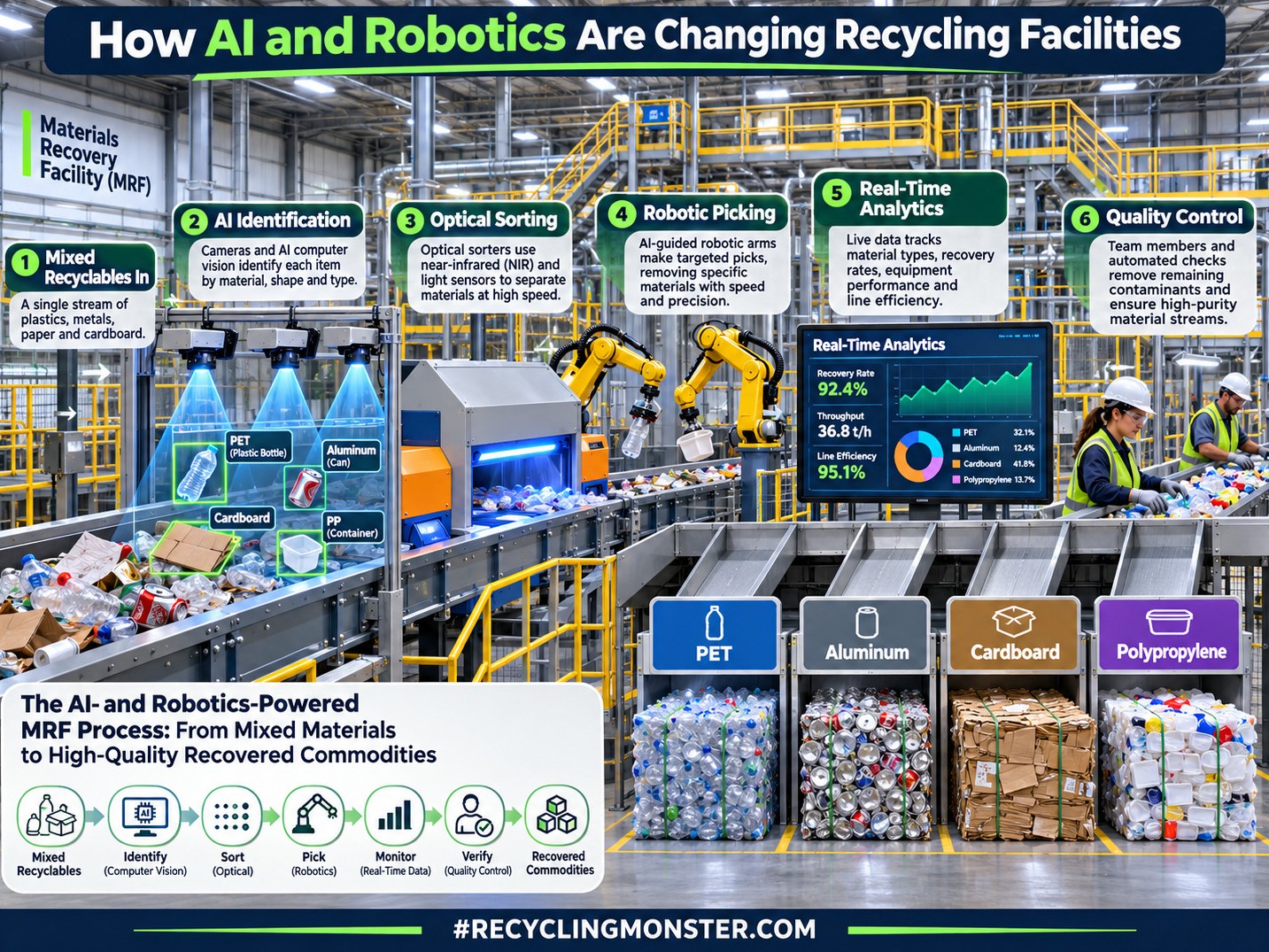
In a modern recycling plant, artificial intelligence usually means software trained to recognize patterns in material moving through the facility.
A camera captures images of objects on a conveyor. A machine-learning model analyzes characteristics such as shape, color, texture, size and visible packaging features. The system then classifies the object into a known category.
What happens next depends on the equipment connected to that information.
The AI system might:
- Tell a robotic arm which object to pick
- Trigger an air jet to redirect a targeted container
- Measure how much PET, aluminum or cardboard is passing through the line
- Detect contamination in a commodity stream
- Alert an operator when bale purity begins to deteriorate
- Measure valuable recyclable material still going into residue
- Compare different equipment settings or shifts
That is an important shift.
The first generation of recycling automation was largely about making a physical separation. The emerging generation is also about measuring the stream and using that information to operate the plant differently.
AI, Optical Sorters and Robots Are Not the Same Thing
These terms are often used together, but they describe different parts of the sorting system.
| Technology | What It Does | Typical Role |
|---|---|---|
| Mechanical separation | Uses size, shape, weight or physical behavior to divide the stream. | Screens, ballistic separators and other equipment create cleaner material fractions before sensor sorting. |
| Magnetic separation | Pulls ferrous metals from the stream. | Steel and other magnetic material recovery. |
| Eddy-current separation | Uses an electromagnetic field to eject conductive nonferrous metals. | Commonly used to recover aluminum. |
| Traditional optical sorting | Uses sensors such as near-infrared spectroscopy to identify selected materials. | Separating PET, HDPE, polypropylene, cartons and other targeted commodities. |
| AI computer vision | Uses cameras and trained models to recognize objects and packaging characteristics. | Material identification, contamination measurement, analytics and sorting instructions. |
| Deep-learning sorting | Uses trained neural-network models to distinguish more complex visual categories. | Tasks where shape, appearance or contextual features matter in addition to polymer chemistry. |
| Robotic sorting | Uses a mechanical arm or other device to physically remove selected objects. | Positive sorting, quality control and recovery from targeted streams. |
| AI waste analytics | Continuously measures the composition and performance of material streams. | Process optimization, recovery analysis, reporting and quality control. |
A modern MRF may use several of these systems at the same time.
The result is not one giant “AI machine.” It is a sequence of technologies, each performing a specific job.
How Computer Vision Sees a Recycling Conveyor
Human sorters understand objects intuitively. They see a beverage can, detergent bottle or cardboard box and recognize it almost instantly.
Computer vision attempts to convert that judgment into a repeatable digital process.
Cameras mounted above a conveyor capture a continuous stream of images. Software analyzes those images and compares what it sees with categories learned during training.
The model may be trained to recognize:
- Aluminum beverage cans
- PET bottles
- HDPE containers
- Polypropylene tubs
- Cardboard
- Paper
- Cartons
- Film
- Non-target plastics
- Contaminants
Some systems can go further, distinguishing objects by product format, color or other visible characteristics.
The advantage is not simply speed.
A camera can observe material continuously, giving operators data about what passed across the belt during an entire shift rather than relying only on occasional manual samples.
Optical Sorting Remains the Workhorse of Automated MRFs
Artificial intelligence receives much of the attention, but conventional sensor-based optical sorting remains one of the most important technologies in modern materials recovery.
Optical sorters commonly use near-infrared, visible-light or other sensors to identify material moving rapidly across a conveyor.
When the system recognizes a target, precisely timed compressed-air jets can eject the item into a separate chute.
That makes optical systems well suited to high-volume separation where thousands of objects pass a detection point every minute.
Current facility upgrades show how important these systems remain.
Pro Disposal's new Pennsylvania MRF, for example, includes four optical sorters and is designed to process up to 20 tons per hour, compared with five tons per hour at the company's previous system. The project is intended to improve material separation and produce higher-quality PET feedstock for domestic recycling markets.
Likewise, Mecklenburg County's major MRF modernization includes 16 optical sorters, with dedicated equipment expected to recover millions of additional pounds of PET annually and separate bottle PET from other PET formats.
AI increasingly sits on top of, beside or downstream from that sensor infrastructure rather than replacing it outright.
Where Robotic Arms Add Value
A robot solves a different problem from an air jet.
Instead of blowing an object from one conveyor path to another, a robotic system physically reaches into the moving stream, grips or suctions a selected item and places it into another chute or bunker.
That makes robotics useful for jobs such as:
- Recovering a valuable item from residue
- Removing contaminants from a commodity stream
- Performing repetitive quality-control picks
- Separating targeted packages
- Reducing exposure to unpleasant manual sorting positions
Robots do have limitations.
The arm can only pick what the vision system identifies and what is physically accessible. Material can overlap. Objects can move. Bags can hide containers. Conveyor loading can become too dense. Oddly shaped items may be difficult to grasp.
That is why headline “picks per minute” figures do not tell the whole story.
Facilities also need to know what percentage of the target material the robot actually sees, how often it makes the correct pick and whether those picks improve the final commodity.
2026 Facility Investments Show How Fast the Technology Is Moving
Recent North American MRF projects illustrate the different ways automation is being deployed.
Mid Valley Disposal: Three AI-Powered Robots in Fresno
Mid Valley Disposal's $12 million Fresno expansion combines optical sorting with three AI-powered robotic units.
The company said the upgraded system increased processing capacity from approximately 35 tons per hour to 60 tons per hour while improving recovery and reducing contamination.
The important point is not simply that robots were installed.
They operate within a larger redesigned line that includes optical and mechanical equipment. The performance gain belongs to the system, not one isolated machine.
Centre County: AI Sorting Replaces More Manual Separation
The Centre County Recycling & Refuse Authority in Pennsylvania installed an AI-enabled sorting system in 2026 as part of an approximately $1.5 million project.
High-speed cameras and AI software identify targeted recyclables on the conveyor, with the system directing materials into separate chutes.
The authority said existing jobs were retained while employees moved toward other operational tasks.
That is one example of automation changing job design rather than simply eliminating every manual role.
Montreal-Est: AI Combined With Hyperspectral Detection
Quebec's Montreal-Est MRF provides another model.
The facility, operational since January 2025, was designed for Quebec's modernized curbside recycling system and has a reported processing rate of 52 tons per hour with annual capacity of approximately 200,000 tons.
Its sorting system combines hyperspectral detection with Machinex's artificial-intelligence technology and is capable of thousands of targeted ejections per minute.
It also uses mechanical screens, glass cleaning, film extraction and baling equipment.
That combination illustrates the direction the industry is moving: AI is becoming one layer in a much larger integrated processing plant.
Also Read
The Bigger Change May Be AI Analytics, Not the Robot
The most consequential development may be happening above the conveyor rather than on it.
AI-based monitoring systems can watch material continuously and build a running picture of what is entering and leaving different stages of a facility.
That changes what an operator can know.
Traditional material audits often involve pulling a sample, manually separating it into categories and calculating composition afterward.
That method remains valuable, but it captures only a small period of operation.
A camera-based analytics platform can potentially observe the stream continuously and tell operators that:
- More PET is entering today than yesterday
- Aluminum is appearing in the residue stream
- A paper line is becoming contaminated with plastic
- An optical sorter may be underperforming
- A supplier's inbound contamination has changed
- A bale-quality problem began at a specific time
Greyparrot, for example, is deploying camera-based analytics specifically for MRF and plastics-recovery operations. Its platform is designed to monitor material across sorting lines and turn those observations into operational data.
In a 2026 pilot at Circular Services' Sunset Park MRF in Brooklyn, the system was used to study aluminum recovery opportunities. Greyparrot reported that its analysis identified a substantial volume of recoverable aluminum still moving through the facility.
AI Is Moving From Reporting Toward Process Control
The next step is connecting what the AI sees directly with what the plant does.
TOMRA's 2026 technology releases illustrate that shift.
The company expanded its deep-learning sorting applications while also introducing an AI-native platform developed with PolyPerception that can analyze material-flow data, generate quality reports and create operational alerts.
“What just passed across this conveyor?”
moving toward
“What changed, why does it matter, and should the operator adjust the process?”
That distinction could matter considerably for large plants where dozens of conveyors, sensors, optical sorters and bunkers interact.
AI Can Help Find Valuable Material Hiding in Residue
Residue is one of the most revealing places to measure a recycling plant.
A MRF's residue stream contains material not recovered into saleable commodity streams.
Some of that material truly does not belong in recycling.
But some can be recyclable material that escaped capture.
If cameras identify PET bottles, aluminum cans or polypropylene leaving through residue, operators can work backward through the system and ask why.
The cause might be:
- A sorter setting
- Too much belt loading
- A damaged or dirty sensor
- Poor material presentation
- A screen sending items to the wrong line
- A change in the incoming packaging mix
This turns residue from a disposal cost into a diagnostic signal.
AI Can Also Measure Bale Quality
Capturing more material is only useful if the finished commodity remains clean enough for its buyer.
A PET bale filled with incompatible material can lose value even if the facility technically “recovered more plastic.”
Computer vision can help monitor final quality-control belts and measure unwanted material entering a commodity stream.
This matters because MRFs ultimately sell commodities, not recycling percentages.
The mill or plastics reclaimer receiving the bale has specifications of its own.
The Changing Packaging Stream Makes Smarter Sorting More Valuable
The material arriving at U.S. MRFs is changing.
The Recycling Partnership's 2026 State of Recycling work found that the residential stream has become lighter and more varied since 2020.
Per-household generation of non-bottle PET increased sharply, as did polypropylene, cartons and several other packaging formats, while traditional materials such as mixed paper declined.
That creates a challenge for plants designed years ago around a different material mix.
A facility may suddenly need to distinguish more tubs, trays, opaque PET containers and lightweight packages without sacrificing throughput.
Programmable optical equipment and trainable vision systems give operators more flexibility than a processing line designed around a small number of fixed objects.
For the broader material shift, see U.S. Recycling Systems Struggle to Keep Pace With Changing Packaging Mix.
Does AI Replace Recycling Workers?
The answer is more complicated than either “yes” or “no.”
Automation can reduce the number of workers required for certain repetitive sorting positions.
At the same time, modern MRFs still need people to:
- Inspect incoming material
- Remove hazardous objects
- Perform quality control
- Operate loaders and mobile equipment
- Maintain robots and optical sorters
- Clean sensors and conveyors
- Manage balers
- Interpret process data
- Respond to jams and unusual material
- Supervise safety and fire prevention
Some facilities have explicitly used automation to move workers from repetitive picking positions into quality control and technical roles.
Scott County, Iowa, reported doing exactly that after adding optical sorting for polypropylene.
But it would be inaccurate to claim that automation can never reduce labor requirements.
The more useful industry question is how job content changes when the facility moves from manual identification toward automated sorting and process management.
Automation Can Improve Worker Safety — If the System Is Designed Well
Manual sorting can expose employees to broken glass, sharps, repetitive motion and unpredictable contaminants.
Removing workers from certain high-speed picking positions can reduce direct contact with incoming material.
Automation also creates new safety requirements.
Robotic arms, conveyors, compressed-air systems and automated equipment need guarding, lockout/tagout procedures, maintenance controls and trained technicians.
Technology therefore changes the risk profile rather than eliminating risk altogether.
What AI Cannot Fix
The technology is powerful, but some of the industry's most important problems remain outside the machine.
AI Cannot Create an End Market
A robot can recover a container perfectly. If no downstream processor wants that commodity, recovery alone does not create a sustainable recycling system.
AI Cannot Make Every Package Recyclable
Multilayer construction, incompatible labels, problematic adhesives and certain product formats can remain difficult downstream even if a vision system successfully identifies them.
AI Cannot Fix Poor Collection
If a community does not collect polypropylene, the most sophisticated PP sorter in the world will have little material to recover.
AI Cannot Make Hazardous Items Safe
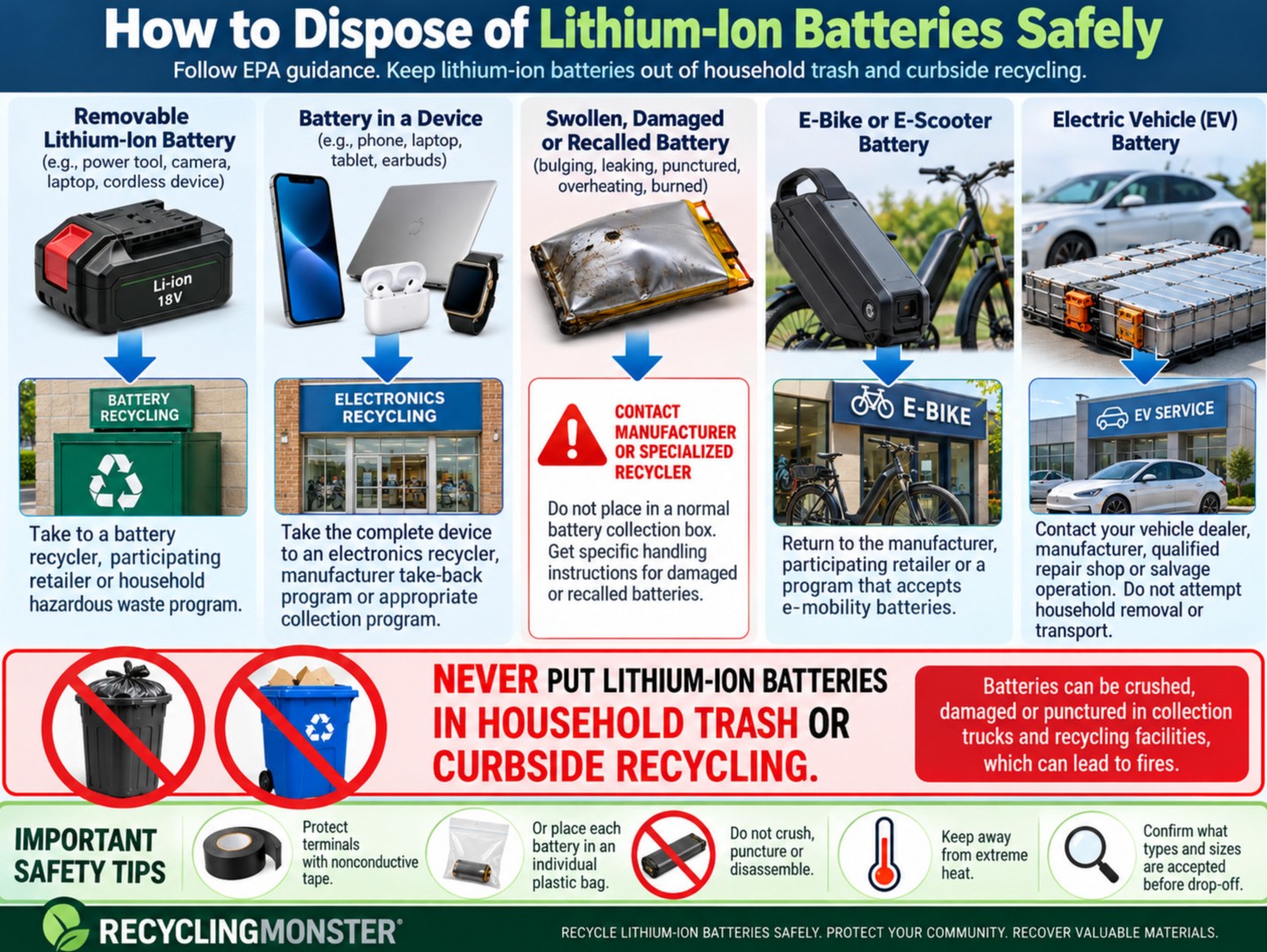
Lithium batteries, pressurized cylinders and other dangerous contaminants still need to be kept out of ordinary recycling streams.
AI Cannot Eliminate Maintenance
Dirty lenses, misaligned belts, worn components, compressed-air problems and poor material presentation can degrade sophisticated equipment just as they affect conventional machinery.
AI Cannot Replace Good Plant Design
If upstream screens send material to the wrong line or conveyors are overloaded, a downstream robot may never get a fair opportunity to perform.
The Question Operators Should Ask Is Not “How Smart Is the Robot?”
A technology purchase should begin with the operational problem.
Is the facility losing aluminum?
Is PET purity too low?
Is polypropylene being sent to residue?
Is staffing unreliable on a particular quality-control station?
Is the plant unable to measure contamination quickly enough?
Once that problem is defined, the operator can decide whether the answer is a robot, optical sorter, camera analytics, mechanical upgrade, additional bunker, belt redesign — or simply better maintenance.
What MRF Operators Should Measure Before Buying AI or Robotics
| Metric | Why It Matters |
|---|---|
| Target material volume | There must be enough recoverable material to justify the investment. |
| Baseline capture rate | Shows how much target material the existing system currently recovers. |
| Purity | More recovery is not useful if contamination makes the output harder to sell. |
| Residue composition | Shows what valuable material is currently being lost. |
| Throughput | The technology must operate at the actual belt speed and tonnage of the facility. |
| Object presentation | Overlapping, buried or densely packed material can reduce identification and picking performance. |
| Uptime | A machine that performs well only when running does not help if maintenance downtime is excessive. |
| Labor impact | Operators should understand which tasks disappear, which remain and which new technical roles are created. |
| Commodity value | Recovered material needs an end market capable of supporting the economics. |
| Disposal savings | Recovering material from residue may reduce landfill or disposal costs. |
Pick Rate Is Not Enough
Robotics vendors often discuss how many picks a machine can make per minute.
That is useful, but it is only one measure.
Imagine a robot makes 80 picks per minute but half of the targeted material is buried under other objects.
Or imagine it successfully removes polypropylene but the resulting bale contains too much PET.
Or the robot recovers an additional ton per shift but the commodity has no buyer within an economical freight radius.
In each case, the headline pick rate says very little about financial performance.
Facilities should evaluate the entire material balance.
Recovery, Purity and Yield Need to Be Measured Separately
Three concepts are particularly important.
Recovery asks how much of the target material the facility captured.
Purity asks how much of the finished commodity is actually the material the buyer wants.
Yield asks how much useful product results from the material entering a process.
AI can help measure all three, but improving one does not automatically improve the others.
A plant could recover more PET while lowering PET bale purity. A plastics reclaimer could receive more bales while producing less usable resin because contamination increased.
The best automation projects understand those tradeoffs before equipment is installed.
Real-Time Data Could Change MRF Contracts
Continuous material data may eventually affect more than operations.
Municipal recycling contracts frequently depend on assumptions about composition, contamination and processing cost.
Historically, those measurements have relied heavily on periodic audits.
If facilities can measure material continuously, operators may eventually be able to provide more detailed evidence about:
- Inbound contamination by supplier
- Commodity recovery
- Residue losses
- Material composition changes
- Bale-quality trends
- Performance during specific periods
That could become increasingly important as extended producer responsibility programs demand more detailed reporting on what materials are collected, sorted and recycled.
AI Can Help Operators Test Changes Instead of Guessing
One of the more practical uses of continuous monitoring is comparing operational changes.
An operator can adjust an optical sorter, conveyor speed or material split and then measure what happened before and after.
Did PET recovery improve?
Did residue fall?
Did bale contamination increase?
Did changing one machine simply move the loss farther downstream?
This turns process optimization into a measurable experiment rather than a visual impression.
Machine Learning Still Depends on Good Data
AI systems learn from examples.
If the system has been trained on thousands of examples of clear PET bottles, it may recognize them reliably.
New packaging can create new problems.
A redesigned bottle, unusual sleeve, black container or novel flexible package may not look like the examples the system has already learned.
Models therefore need monitoring, retraining and updated classifications as the material stream changes.
The technology does not remove the need for recycling expertise. It embeds that expertise into another operating system that still needs to be maintained.
Packaging Producers Now Have Another Audience: The Machine
Historically, packaging design focused on consumers, shelf performance and manufacturing.
Modern recycling adds another question:
A human may immediately understand that an item is a PET bottle. A machine may see the label covering it, the color, shape and reflection differently.
This makes design-for-recycling testing increasingly important.
Packaging producers need to consider not only whether a resin is technically recyclable but how the complete package behaves in real optical and automated sorting systems.
Where AI and Robotics Go Next
The next phase is likely to involve less separation between “sorting equipment” and “plant intelligence.”
Cameras can already identify material. Robots and optical sorters can act on those classifications. Analytics systems can monitor recovery and quality.
The logical next step is deeper integration.
- Measure the incoming stream.
- Detect a change in material composition.
- Identify where recovery is falling.
- Recommend or apply equipment adjustments.
- Measure whether the adjustment worked.
- Document the resulting commodity quality.
TOMRA's 2026 move toward an AI-native plant-data interface and Greyparrot's facility-wide material analytics point in that direction.
But the industry is not at a point where every MRF can simply switch on an autonomous control room and walk away.
Facilities differ enormously in age, design, material mix, equipment and markets.
Integration remains the real challenge.
The Bottom Line
Artificial intelligence is not replacing the basic physics of recycling.
Magnets still pull steel. Eddy currents still recover aluminum. Screens still separate material by size and shape. Optical sensors still identify polymers.
What AI adds is another layer of recognition and information.
It can help a plant identify objects that are difficult to distinguish with fixed rules, direct robots toward valuable material, measure what is being lost and give operators a much clearer picture of what is happening inside the facility.
That can improve recovery, quality and operating decisions.
But successful recycling still depends on the entire chain.
The material has to be collected. The facility has to be designed correctly. Equipment has to remain clean and maintained. Workers have to manage exceptions and hazards. The recovered commodity has to meet specification.
And somebody downstream still has to want to buy it.
The real promise of AI in recycling is not a plant without people. It is a plant that understands its material stream well enough to recover more value from it.
Frequently Asked Questions About AI and Robotics in Recycling
How is artificial intelligence used in recycling facilities?
AI is used for computer-vision material identification, robotic picking, contamination detection, material-flow analytics, quality control and process optimization. Some systems also connect their data to optical sorters or other automated equipment.
Are recycling robots the same as optical sorters?
No. Optical sorters typically use sensors and compressed-air ejection to separate targeted materials at high speed. Robotic systems physically pick objects using an arm or other mechanism. AI can be used with either technology.
Will robots replace all recycling workers?
No. Automation can reduce some repetitive manual sorting work, but recycling facilities still require employees for quality control, maintenance, safety, equipment operation, hazardous-material removal and process management. Labor impacts vary by facility.
Can AI make more plastics recyclable?
AI can help facilities identify and recover some materials more effectively, but it cannot create downstream processing capacity or end markets. Packaging design, collection access, reclamation capability and buyer demand still determine whether a material is actually recycled.
What should a recycling facility measure before investing in AI?
Operators should establish baseline recovery, purity, residue composition, throughput, labor requirements, equipment uptime and commodity value. The technology should be evaluated against a specific operational problem rather than purchased based only on advertised speed or pick rate.
Primary Sources and Verification
- Recycled Materials Association — Recycling Technology and AI in Material Recovery
- The Recycling Partnership — MRF Modernization and Polypropylene/PET Recovery Case Studies
- TOMRA Recycling — 2026 AI Platform and GAINnext Deep-Learning Applications
- Greyparrot — AI Waste Analytics for Material Recovery Facilities
- Circular Services — Modern MRF Operations and 2026 AI Pilot
- Closed Loop Partners — 2026 Pro Disposal MRF Infrastructure Investment
- Machinex / Éco Entreprises Québec — Montreal-Est MRF Technology
Last verified: November 5, 2026.