 By Carolina
Curiel | Published on October 28, 2026 12:00:00 AM
By Carolina Curiel
Published October 28, 2026
A lithium-ion battery that no longer powers a phone, laptop or cordless tool is not ordinary household waste. It may look spent, but it can still contain enough stored energy to spark, overheat or start a fire if its terminals short circuit or the battery is crushed or punctured.
That is why the U.S. Environmental Protection Agency gives consumers a clear instruction: lithium-ion batteries and products containing them should not go in household garbage or municipal recycling bins.
They need a separate collection route.
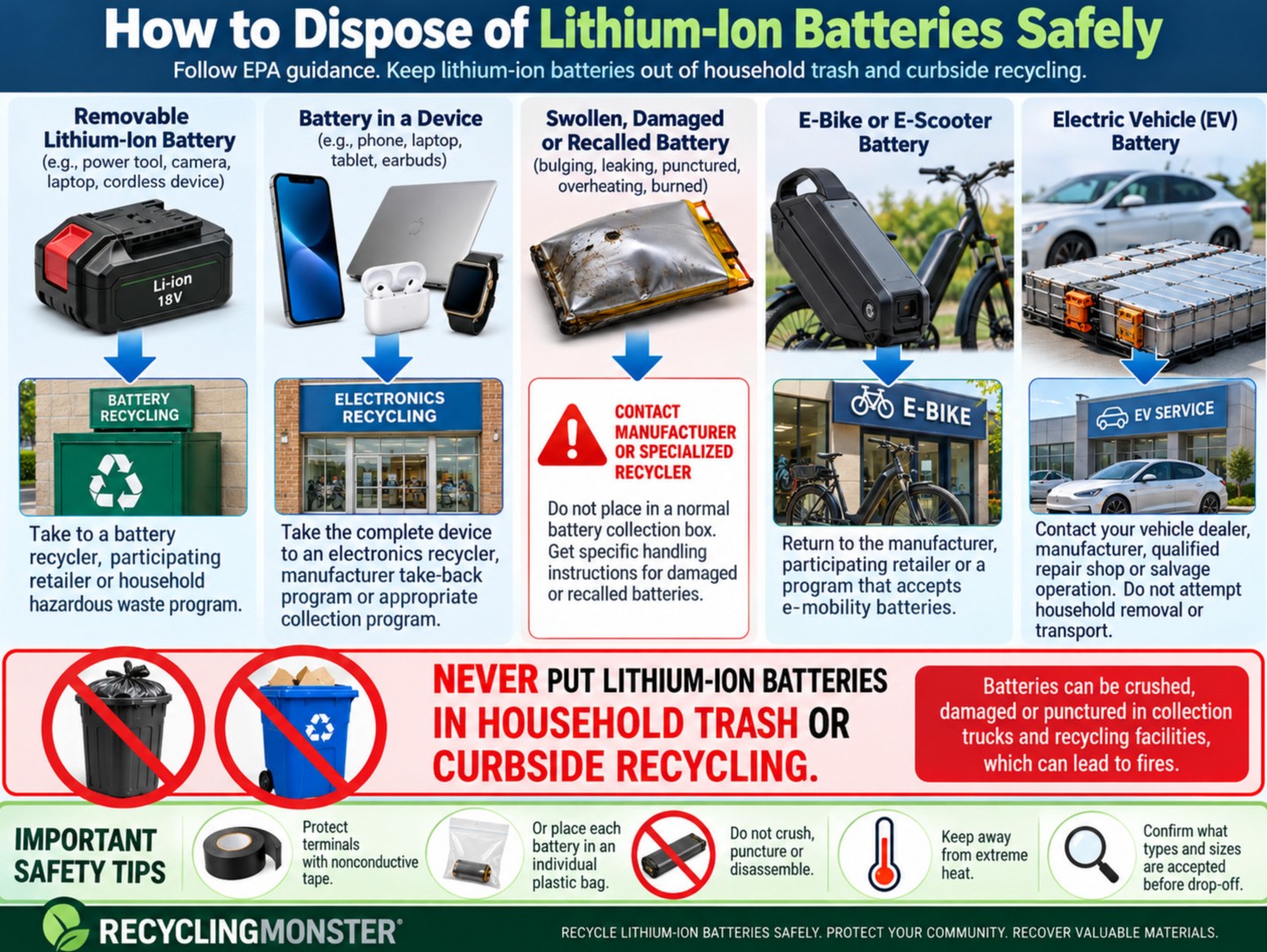
- Lithium-ion batteries should never be placed in household trash or ordinary curbside recycling.
- Even a battery that appears discharged can retain enough energy to cause a short circuit, injury or fire.
- EPA recommends protecting battery terminals with nonconductive tape or individually bagging batteries before routine recycling.
- Devices with batteries that are not intended for consumer removal can usually be taken intact to an electronics recycler or take-back program.
- Swollen, leaking, punctured, overheating, burned or recalled batteries need special handling and should not go into a standard battery drop-off box.
How Should You Dispose of a Lithium-Ion Battery?
The safest route depends on three things:
- Is the battery loose or still inside a device?
- Is it undamaged or damaged?
- How large is it?
A small removable power-tool battery can follow a different collection route from a battery sealed inside a laptop. A swollen cellphone battery needs different handling from either one. An e-bike pack, electric-vehicle battery or home energy-storage system requires another level of management entirely.
The first rule, however, is the same for all of them:
Keep lithium-ion batteries out of household trash and municipal recycling.
Lithium-Ion Battery Disposal at a Glance
| Battery Situation | Recommended Route | What to Do First |
|---|---|---|
| Undamaged removable lithium-ion battery | Battery recycler, participating retailer or household hazardous waste program | Protect exposed terminals with nonconductive tape or individually bag the battery |
| Battery built into a phone, laptop or other electronic device | Electronics recycler, manufacturer/retailer take-back program or appropriate HHW program | Keep the device intact unless the battery is designed for safe consumer removal |
| Swollen, leaking, punctured or overheating battery | Manufacturer or specialized program capable of managing damaged batteries | Isolate it and obtain specific handling instructions before transport |
| Recalled lithium-ion battery | Follow the manufacturer's recall and disposal instructions | Do not place it in an ordinary public battery collection box |
| E-bike or e-scooter battery | Manufacturer, participating bicycle retailer or program specifically accepting e-mobility batteries | Confirm the program accepts that brand, size and battery condition |
| Electric-vehicle battery | Vehicle dealer, manufacturer, qualified repair shop or salvage operation | Do not attempt household removal or transport as a portable battery |
| Home or commercial energy-storage battery | Manufacturer or company that installed the storage system | Follow system-specific service and removal instructions |
| Commercial quantity of used lithium-ion batteries | Qualified battery recycler or hazardous/universal-waste service provider | Determine applicable federal, state and transportation requirements before accumulation or shipment |
Why Can't Lithium-Ion Batteries Go in the Trash?
Lithium-ion batteries store a considerable amount of energy in a relatively small package. That high energy density is one reason they work so well in portable electronics, power tools, appliances and electric vehicles.
It also creates a problem at end of life.
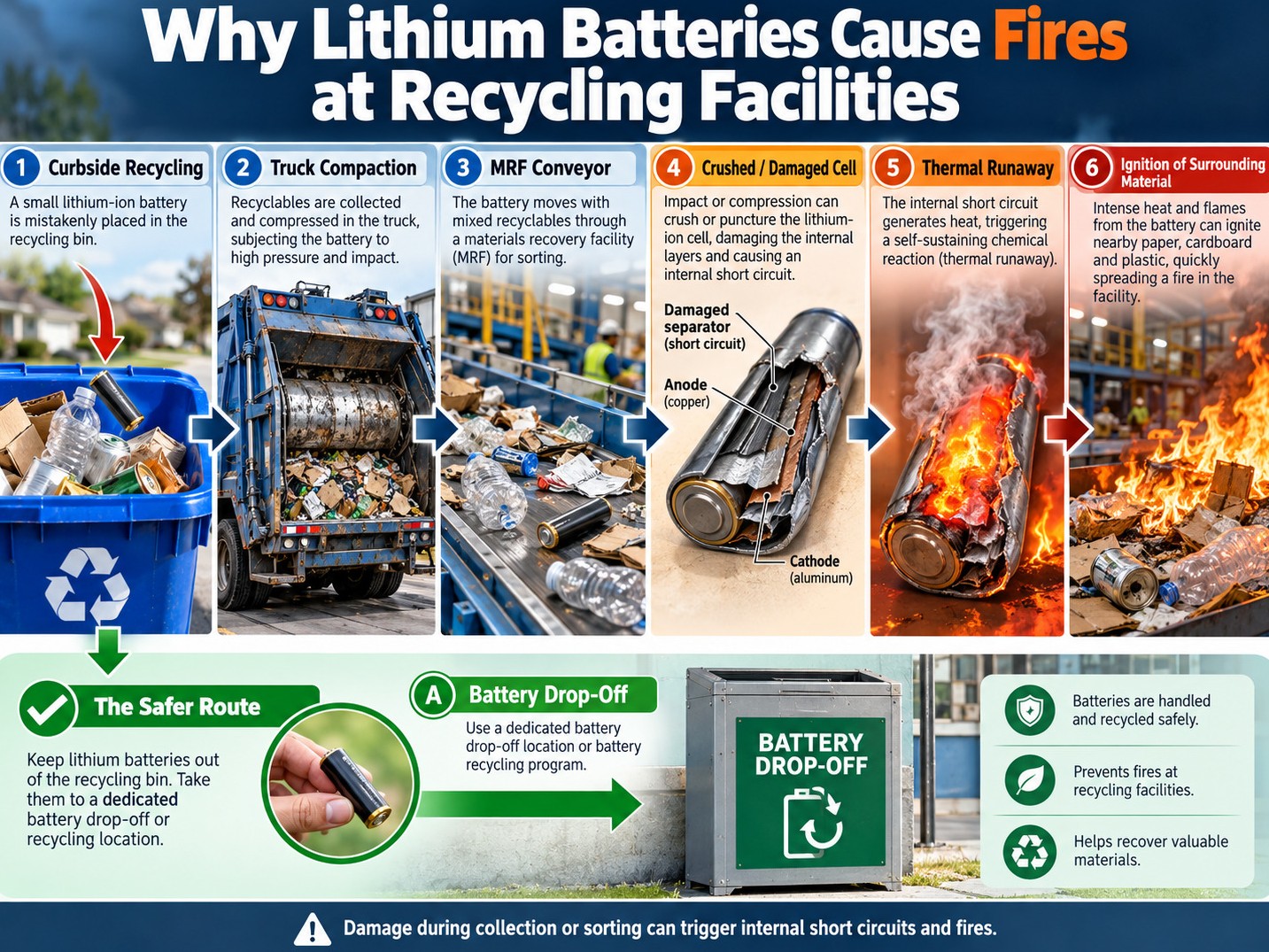
A battery placed in household garbage can be compacted inside a collection truck or damaged later at a transfer station or landfill.
A battery placed in curbside recycling can travel through equipment built to sort paper, cardboard, glass, cans and plastic containers. It may be dropped, pinched, crushed or punctured before workers even know it is there.
If the battery develops an internal short circuit, it can heat rapidly and potentially enter thermal runaway.
For the full explanation of that failure process, see RecyclingMonster's Why Lithium Batteries Cause Fires at Recycling Facilities.
A Battery Can Look Dead and Still Be Dangerous
One of the most important misconceptions is that a battery that no longer operates a device must be electrically empty.
It is not necessarily empty.
EPA warns that used batteries can retain enough energy to cause injury or start a fire.
The battery does not have to recharge a laptop or operate a cordless drill to have enough remaining energy to spark when its terminals contact metal or to react when the cell is physically damaged.
This is why terminal protection remains important even when a battery appears fully discharged.
How to Prepare an Undamaged Lithium-Ion Battery for Recycling
For a normal removable battery that is not swollen, leaking, punctured, overheated, burned or otherwise damaged, EPA recommends a straightforward preparation process.
1. Identify the Battery
Look at the battery label or product documentation.
Common markings include:
- Li-ion
- Lithium-ion
- Lithium polymer or Li-poly
- Rechargeable lithium-ion
Do not identify a battery only by its shape. Different chemistries can use similar cases.
2. Protect the Terminals
Battery terminals can create a short circuit if they contact another battery, metal object or conductive surface.
EPA recommends covering exposed terminals with nonconductive tape.
Electrical tape is appropriate. Clear packing tape and other securely attached non-metallic tape may also be used where appropriate.
Keep the battery's chemistry and identification markings visible whenever possible.
3. Or Bag the Battery Individually
EPA also recommends placing each battery in its own plastic bag as an alternative way to prevent terminals from contacting other batteries or conductive objects.
The Battery Network identifies individual clear bags as its preferred terminal-protection method for many battery types.
The objective is simple: keep battery terminals isolated during storage and transport.
4. Protect the Battery From Physical Damage
Do not crush, bend, puncture or disassemble the battery.
Keep it away from loose metal objects that could bridge the terminals.
Do not leave used batteries exposed to prolonged extreme heat, such as inside a vehicle sitting in direct summer sunlight.
5. Take It to an Appropriate Collection Point
Possible routes include:
- Dedicated battery recycling facilities
- Participating retailers
- Household hazardous waste programs
- Municipal battery collection sites
- Manufacturer take-back programs
Not every collection point accepts every battery type or size, so confirm acceptance before visiting.
What If the Battery Is Built Into the Device?
Many modern lithium-ion batteries are not designed for routine consumer removal.
Examples include batteries inside:
- Smartphones
- Tablets
- Thin laptops
- Wireless earbuds
- Smartwatches
- Portable speakers
- Electric toothbrushes
- Electronic cigarettes
- Rechargeable toys
- Small appliances
Do not pry open a device merely because you believe the recycler needs the battery removed.
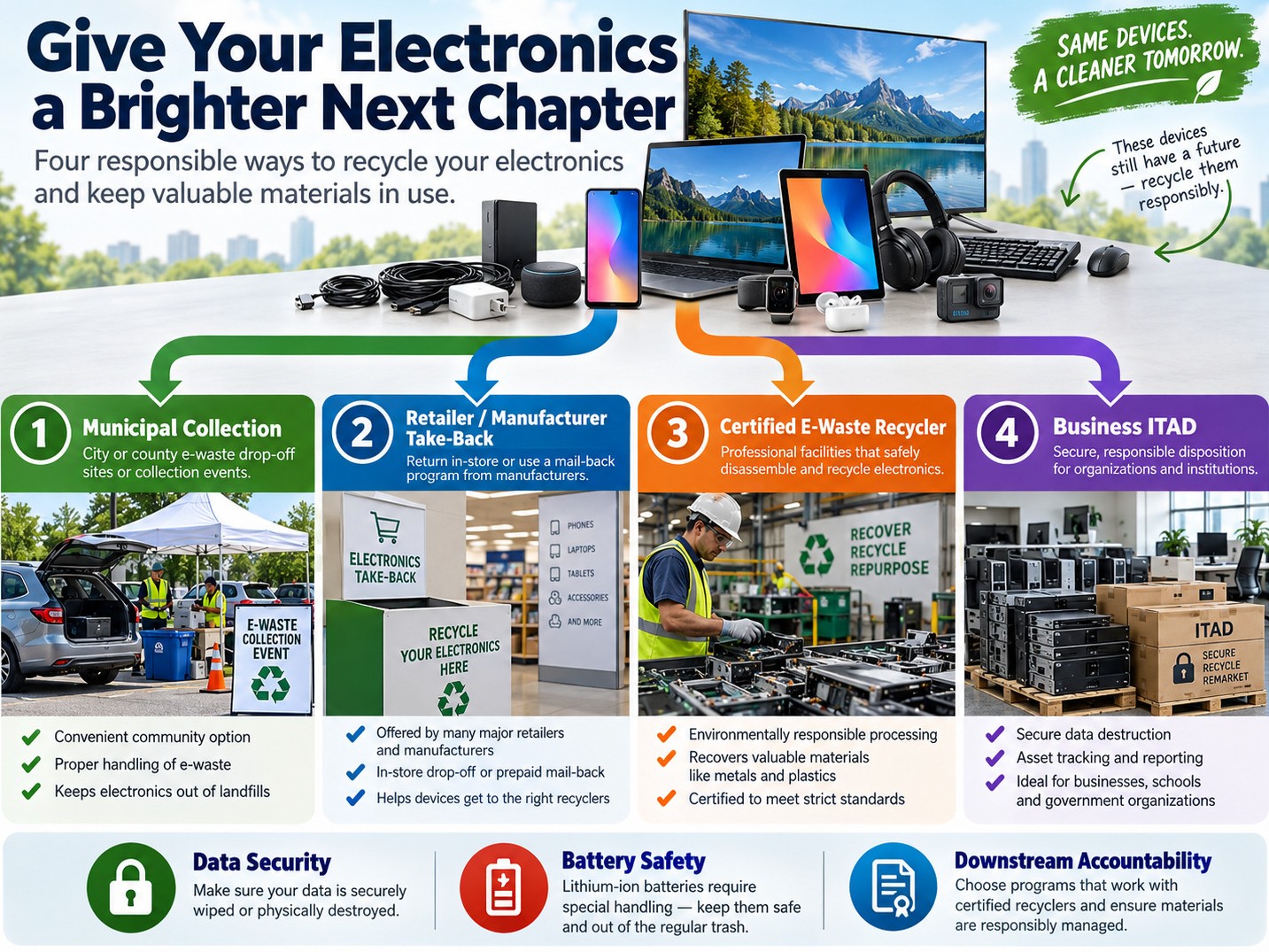
EPA advises that electronics containing non-removable lithium-ion batteries can be taken to certified electronics recyclers, participating retailer take-back programs, electronics collection programs or appropriate household hazardous waste programs.
A qualified recycler can separate the battery using procedures designed for the product.
For a broader electronics guide, see The Complete Guide to Electronics Recycling.
What Should You Do With a Swollen Lithium-Ion Battery?
Swelling is a sign that the battery has been damaged or has begun to fail.
A swollen battery should not be treated like a normal spent battery.
Do not:
- Continue charging it
- Puncture it
- Crush it to reduce its size
- Place it into household garbage
- Place it into curbside recycling
- Put it into an ordinary public battery collection box
EPA advises consumers to assess whether there is an immediate fire threat and contact the device or battery manufacturer, retailer, state waste-management agency or local household hazardous waste program for appropriate instructions.
If there appears to be an imminent fire danger, treat it as an emergency rather than attempting routine transport.
A swollen, leaking, punctured, overheated, burned or otherwise defective lithium battery requires a collection route specifically capable of handling damaged batteries. Do not assume that a retailer's ordinary battery box accepts it.
What Counts as a Damaged or Defective Lithium Battery?
Warning signs can include:
- Swelling or bulging
- Punctures or crushed areas
- Leaking
- Corrosion
- Unusual discoloration
- Damaged or loose wires
- Unexpected heat
- Unusual odor
- Smoke
- Signs of prior fire exposure
A battery that has been abused, involved in a crash or otherwise physically compromised may also require special treatment even if the damage is not obvious.
The U.S. Department of Transportation uses the term damaged, defective or recalled — DDR — batteries for batteries presenting elevated transportation risks.
Damaged Batteries Should Not Be Shipped Like Ordinary Batteries
This distinction becomes especially important when a battery needs to be transported commercially.
Lithium batteries are regulated as hazardous materials under U.S. Department of Transportation Hazardous Materials Regulations.
Damaged, defective and recalled lithium batteries face additional packaging and transportation requirements because they have a greater potential to short circuit, release heat or catch fire.
PHMSA states that damaged or defective batteries with the potential to produce dangerous heat, fire or short circuit must be transported under the specialized requirements in federal hazardous-material rules.
They are also prohibited from commercial air transportation under the applicable damaged-battery provisions.
For consumers, the practical lesson is:
Do not improvise a mail shipment for a swollen or damaged lithium battery.
Contact the manufacturer, recycler or collection program and follow the shipping or drop-off instructions it provides.
Can I Mail a Lithium-Ion Battery to a Recycler?
Sometimes, but only through a program that provides instructions compliant with applicable transportation rules.
PHMSA notes that lithium batteries offered for commercial transportation are regulated hazardous materials. Requirements depend on the battery's configuration, size, condition and mode of transport.
A manufacturer or mail-back recycling program should provide the packaging, labeling and shipping instructions needed for its program.
Do not put a battery into a box and mail it simply because you found a recycler online.
Where Can I Recycle a Power-Tool Battery?
Rechargeable cordless-tool batteries are commonly lithium-ion, although older tools may use nickel-cadmium or nickel-metal-hydride batteries.
If the lithium-ion battery pack is removable and undamaged:
- Remove it according to the tool manufacturer's instructions.
- Protect the terminals or individually bag the battery.
- Take it to a participating battery recycler, retailer or household hazardous waste program that accepts that battery type.
If the pack is swollen, cracked, leaking or otherwise damaged, do not place it in a normal collection box.
Where Can I Recycle a Cellphone or Laptop Battery?
If the battery is easily removable and undamaged, it may be accepted by a participating battery collection program.
If it is built into the device, EPA recommends taking the complete phone, laptop or other electronic product to an electronics recycler, retailer take-back program or appropriate local collection program.
Do not force apart a sealed phone or laptop simply to reach the battery.
RecyclingMonster's guide to finding a responsible electronics recycler explains how to evaluate e-waste collection and processing options.
What About E-Bike and E-Scooter Batteries?
E-bike and e-scooter batteries require more care than a small cellphone or power-tool cell.
They are larger, contain substantially more stored energy and may exceed the acceptance limits of ordinary retail battery boxes.
Use a program specifically approved for e-mobility batteries.
Good starting points include:
- The bicycle or scooter manufacturer
- The retailer that sold the product
- An authorized dealer
- A specialized e-mobility battery recycling program
- A qualified household hazardous waste program that explicitly accepts the pack
Do not leave an e-bike battery beside an ordinary battery collection bin when the site does not accept it.
How Do You Dispose of an Electric-Vehicle Battery?
An electric-vehicle traction battery is not a household drop-off item.
EPA recommends contacting the vehicle dealer, repair shop, salvage yard or manufacturer for management options.
These battery systems are large, high-voltage assemblies and require trained handling, specialized equipment and regulated transportation.
Consumers should not attempt to dismantle an EV traction battery or transport the pack as if it were a portable rechargeable battery.
What About Home Energy-Storage Batteries?
The same principle applies to stationary energy-storage systems.
Contact the manufacturer or company that installed the system.
These batteries may be integrated into electrical equipment, contain significant stored energy and require specialist removal and transport.
EPA specifically recommends using the manufacturer or installer for end-of-life management rather than treating the system as ordinary household battery waste.
Why Recycling Lithium-Ion Batteries Matters
Keeping lithium-ion batteries out of municipal trash and recycling does not mean they should be discarded.
They are valuable recycling feedstock.
Lithium-ion batteries can contain materials including:
- Lithium
- Cobalt
- Nickel
- Manganese
- Graphite
- Copper
- Aluminum
Several of those materials are considered strategically important or critical to battery and clean-energy supply chains.
EPA notes that recycling end-of-life batteries allows materials to be recovered instead of losing them through disposal while also keeping high-energy batteries out of garbage trucks, MRFs and landfills.
What Happens to Lithium-Ion Batteries After Recycling?
The recycling process varies by battery chemistry and recycler.
A typical industrial pathway can include:
- Receiving and inspection. Batteries are identified and evaluated before processing.
- Sorting. Batteries can be separated by chemistry, format and condition.
- Discharge or other safety preparation. Process requirements vary by facility.
- Dismantling or size reduction. Battery modules or cells may be mechanically processed.
- Physical separation. Steel, aluminum, copper, plastics and concentrated battery materials can be separated.
- Metallurgical recovery. Additional processes recover usable battery materials.
- Refining and material preparation. Recovered materials may undergo further processing before they can return to manufacturing.
The exact combination of mechanical, hydrometallurgical or other recovery processes depends on the recycler and battery chemistry.
What Should Businesses Do With Used Lithium-Ion Batteries?
Businesses face a different regulatory situation from households.
Under federal hazardous-waste law, household hazardous waste is generally exempt from federal RCRA hazardous-waste requirements.
Businesses, by contrast, are responsible for determining whether the wastes they generate are hazardous.
EPA says most discarded lithium-ion batteries on the market are likely to meet the federal definition of hazardous waste because of ignitability and reactivity concerns.
EPA currently recommends that businesses consider managing used lithium batteries under the federal universal waste regulations.
- Identify and segregate battery waste.
- Determine applicable federal and state hazardous-waste requirements.
- Protect batteries from damage and short circuits.
- Use appropriate labeling and accumulation procedures.
- Use qualified recycling and transportation providers.
- Maintain required records.
- Review state requirements, which can be more stringent than federal rules.
EPA Is Considering More Specific Lithium-Battery Rules
EPA announced a rulemaking effort in 2023 to develop tailored universal-waste standards specifically for lithium batteries.
The agency's current lithium-battery guidance still describes that effort as being developed.
That distinction matters for businesses: the planned tailored lithium-battery standards should not be treated as though they are already a finalized replacement for existing rules.
Current federal universal-waste, hazardous-waste and Department of Transportation requirements remain relevant, together with applicable state rules.
How to Find a Lithium-Ion Battery Recycler Near You
Start by identifying the battery, its size and its condition.
Then use one or more of these routes:
- Search RecyclingMonster's Battery Recycling Centers directory.
- Use Recycle an Item to search by battery or battery-powered product.
- Check your municipal or county household hazardous waste program.
- Check participating electronics, hardware and battery retailers.
- Contact the product or battery manufacturer.
- Use The Battery Network's U.S. battery locator where appropriate.
Always confirm:
- The exact battery type
- Battery size
- Whether it is loose or installed in a device
- Whether it is damaged
- Whether there is a fee
- Quantity limits
- Residential versus commercial eligibility
U.S. and Canadian Battery Programs Are Not Identical
EPA guidance and federal hazardous-material rules discussed in this article apply to the United States.
Canadian battery collection is organized through provincial stewardship systems and national collection networks.
Call2Recycle Canada operates the Recycle Your Batteries, Canada! program and reports a network of more than 15,000 battery drop-off locations nationwide.
The organization reported collecting more than 8 million kilograms of batteries in 2025, its highest annual volume to date.
Canada also has specialized programs for e-mobility and electric-vehicle batteries, and accepted products vary by province and program.
Canadian readers should therefore use their provincial or national locator and verify the specific battery before visiting a site.
Seven Lithium-Ion Battery Disposal Mistakes to Avoid
| Mistake | Better Approach |
|---|---|
| Putting a lithium battery in curbside recycling | Use a dedicated battery or electronics recycling program. |
| Throwing a rechargeable battery in household trash | Keep it separate and find an appropriate collection point. |
| Leaving terminals exposed | Protect them with nonconductive tape or individually bag the battery where appropriate. |
| Putting a swollen battery in a normal collection box | Contact the manufacturer or a program equipped for damaged batteries. |
| Forcing a built-in battery out of a device | Take the complete product to an electronics recycler when the battery is not intended for consumer removal. |
| Mailing a battery without checking shipping rules | Use the packaging and shipping procedure supplied by the approved recycling or take-back program. |
| Treating an e-bike or EV pack like a small household battery | Use a program designed for the size and energy level of that battery system. |
A Simple Lithium-Ion Battery Disposal Checklist
- Do not put it in household trash.
- Do not put it in curbside recycling.
- Identify whether the battery is removable.
- Inspect it for swelling, leaking, overheating or other damage.
- If undamaged and removable, protect its terminals or individually bag it.
- If embedded, keep the device intact unless removal is designed to be performed safely by the user.
- If damaged, obtain specific handling instructions before transport.
- Use a collection site that accepts that exact battery type.
- Do not improvise mail or commercial shipping.
- Confirm local and state requirements.
The Bottom Line
Lithium-ion batteries are recyclable, but they are not ordinary recyclables.
The safest disposal decision begins by keeping them out of household garbage and curbside recycling.
An undamaged removable battery can usually move through a dedicated battery collection program once its terminals are protected. A device with an embedded battery can generally go intact to an appropriate electronics recycler. A swollen or otherwise damaged battery needs a specialized route. E-bike, EV and stationary-storage batteries require programs designed for their size and stored energy.
The distinction matters because even a battery that looks dead may still contain enough energy to spark or start a fire.
Recycling it correctly does two things at once: it keeps a concentrated energy source out of waste systems that are not designed to manage it, and it gives valuable battery materials another opportunity to return to the manufacturing supply chain.
The rule to remember is simple: recycle lithium-ion batteries — just never through the ordinary recycling bin.
Frequently Asked Questions About Lithium-Ion Battery Disposal
No. EPA advises that lithium-ion batteries and devices containing them should not go into household garbage because batteries can be damaged during collection or disposal and create a fire hazard. No. Municipal recycling facilities are generally designed for commodities such as paper, cardboard, glass, metal containers and plastics, not loose lithium-ion batteries. Use a separate battery or electronics collection program. EPA recommends protecting exposed battery terminals with nonconductive tape or placing each battery in a separate plastic bag to reduce the chance of a short circuit. Stop using or charging it. Do not puncture, crush or place it into an ordinary battery collection box. Contact the battery or device manufacturer, qualified recycler or household hazardous waste program for specific handling instructions. If there appears to be an imminent fire risk, treat the situation as an emergency. Options can include dedicated battery recyclers, participating retailers, electronics recyclers and household hazardous waste programs. RecyclingMonster's Battery Recycling Centers directory and Recycle an Item finder can be used to identify potential nearby facilities. Always confirm acceptance before visiting.Can lithium-ion batteries go in the trash?
Can lithium-ion batteries go in curbside recycling?
Should I tape lithium battery terminals before recycling?
What should I do with a swollen lithium-ion battery?
Where can I recycle lithium-ion batteries?
Primary Sources and Verification
This guide was reviewed against current battery-management and transportation guidance available on October 28, 2026.
- U.S. Environmental Protection Agency — Used Lithium-Ion Batteries
- U.S. Environmental Protection Agency — Frequent Questions on Lithium-Ion Batteries
- U.S. Environmental Protection Agency — Used Household Batteries
- U.S. Environmental Protection Agency — Lithium-Ion Battery Recycling Frequently Asked Questions
- U.S. Department of Transportation / PHMSA — Transporting Lithium Batteries
- U.S. Department of Transportation / PHMSA — Damaged, Defective or Recalled Lithium Battery Guidance
- The Battery Network — Battery Preparation, Safety and Damaged Battery Guidance
- Call2Recycle Canada — Recycle Your Batteries, Canada! Programs
Last verified: October 28, 2026.