 By Carolina
Curiel | Published on October 14, 2026 12:00:00 AM
By Carolina
Curiel | Published on October 14, 2026 12:00:00 AM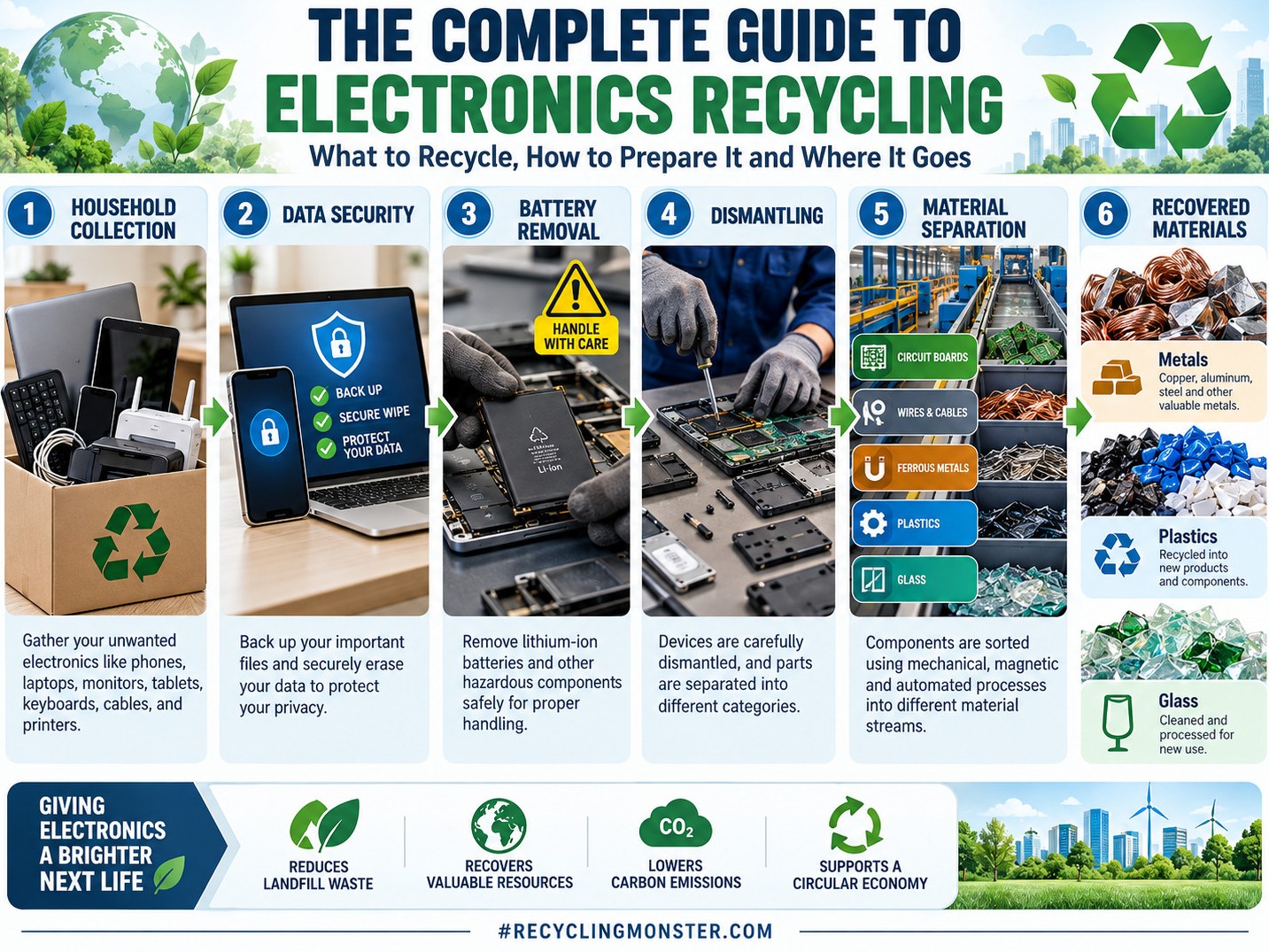
Published October 14, 2026
Old phones, laptops, tablets, televisions and other electronic devices do not belong in an ordinary recycling cart. Electronics contain a complex mix of reusable components, valuable metals, plastics, glass, batteries and other materials that require specialized collection and processing.
- Phones, computers, tablets, televisions and other electronics should use a dedicated electronics recycling, take-back or reuse program rather than standard curbside recycling.
- Before recycling a device, back up needed files, remove accounts and activation locks, and properly erase or sanitize personal data.
- Lithium-ion batteries require separate attention because damaged or crushed batteries can create serious fire hazards.
- Working electronics may be suitable for reuse, repair or refurbishment before material recycling is considered.
- Responsible electronics recyclers test reusable equipment, protect data, remove hazardous components and recover materials such as steel, aluminum, copper, plastics, glass and circuit-board metals.
What Is Electronics Recycling?
Electronics recycling is the collection, testing, dismantling and processing of unwanted electrical and electronic equipment so reusable products and components can be recovered and recyclable materials can return to manufacturing supply chains.
The term e-waste, or electronic waste, is commonly used for electronics that their owners no longer want. A device does not necessarily become material for shredding the moment it is discarded. Some equipment can be tested, repaired, refurbished and reused before reaching the material-recovery stage.
For devices that cannot be reused economically or safely, specialized recyclers can separate batteries, circuit boards, metal frames, wiring, plastics, glass and other components for further processing.
This is a different system from residential curbside recycling. Conventional materials recovery facilities are generally designed for materials such as bottles, cans, paper and cardboard — not laptops, phones, televisions or battery-powered devices.
Why Electronics Recycling Matters
Modern electronics concentrate substantial amounts of material into relatively small products.
Depending on the device, electronics can contain steel, aluminum, copper, glass, plastics, circuit boards and smaller quantities of valuable metals. Recycling allows some of those resources to re-enter supply chains instead of being lost through disposal.
The scale of the challenge is significant. The Global E-waste Monitor reported that the world generated approximately 62 million metric tonnes of e-waste in 2022. Only 22.3% was documented as formally collected and recycled through environmentally sound systems.
The same report estimates that global e-waste generation could reach approximately 82 million tonnes by 2030 if current trends continue.
For individual households, the practical implication is simple: an obsolete phone or laptop may be small, but it belongs in a specialized recovery system rather than an ordinary garbage or recycling stream.
What Electronics Can Be Recycled?
Acceptance varies by recycler, collection event and local program, but dedicated electronics programs commonly handle many of the following items.
Computers & Mobile Devices
- Desktop computers
- Laptops
- Tablets and e-readers
- Smartphones and cellphones
- Computer towers
- Keyboards and mice
- Computer accessories
Screens & Entertainment Equipment
- Computer monitors
- Televisions
- DVD and media players
- Gaming consoles
- Stereo equipment
- Streaming devices
Office & Networking Electronics
- Printers
- Scanners
- Routers and modems
- Servers
- Network equipment
- External drives
- Uninterruptible power supplies
Small Consumer Electronics
- Digital cameras
- Headphones
- Smartwatches
- Portable speakers
- Chargers and cables
- Electronic toys
- Other small electronic devices
This list is a starting point, not a universal acceptance list. Some programs charge fees for televisions or monitors, limit quantities, exclude commercial equipment or accept only residents from a specific jurisdiction.
Always confirm acceptance before transporting equipment.
Electronics Should Not Go in Curbside Recycling
A phone, laptop or tablet may contain recyclable metals and plastics, but that does not mean it belongs in a household recycling cart.
Electronics can contain batteries and components that standard materials recovery facilities are not designed to handle. Devices can be crushed by collection vehicles or sorting equipment, creating hazards and potentially damaging valuable components that could otherwise have been reused or recovered.
Use a dedicated electronics recycling or take-back route instead.
For other materials that require special handling, see RecyclingMonster's 25 Things You Should Never Put in a Recycling Bin.
Step 1: Decide Whether the Device Should Be Reused or Recycled
Before recycling an electronic device, ask whether it still functions and whether another user could reasonably use it.
A working computer may need only a new battery, additional memory or a software reset. A functioning phone may have resale, trade-in or donation value. Some electronics recyclers also operate refurbishment and resale programs.
Reuse is not automatically appropriate for every device. Very old, damaged or unsupported electronics may have little practical reuse value, and equipment with safety problems should not simply be passed to another user.
The objective is to make an informed decision between continued use, repair, refurbishment and material recycling.
Step 2: Back Up Anything You Want to Keep
Before resetting or sanitizing a phone, computer or storage device, copy any files you still need.
That may include:
- Photos and videos
- Documents
- Contacts
- Email archives
- Authentication information
- Software license information
- Business records
Confirm that the backup actually works before deleting the original data.
Step 3: Remove Accounts, Locks and Personal Information
Electronics often remain connected to online accounts even after a user stops using the physical device.
Before recycling, selling or donating a device, follow the manufacturer's current instructions to remove personal information and disconnect the device from associated accounts.
For a phone or tablet, this can include removing or deactivating accounts, removing a physical SIM card when present, disabling device-tracking or activation-lock features and completing the appropriate reset procedure.
Computers and external storage devices require appropriate data sanitization rather than simply deleting visible files.
How Should Businesses Protect Data on Retired Electronics?
Businesses usually need a more formal process than a household performing a basic device reset.
The National Institute of Standards and Technology's current SP 800-88 Revision 2, Guidelines for Media Sanitization, published in September 2025, provides a framework for organizations to establish a media-sanitization program based on information sensitivity and the type of storage media involved.
Organizations disposing of computers, servers, hard drives and other data-bearing equipment should establish procedures covering inventory control, chain of custody, sanitization, verification and documentation.
- Asset serial numbers and inventory
- Custody transfers
- Data-sanitization method
- Validation or verification of sanitization
- Reuse or disposition route
- Downstream recycling destination where appropriate
- Certificates or records supplied by the service provider
A business should select its sanitization procedure according to its security requirements rather than assuming one method fits every storage technology.
Step 4: Check the Battery Before Recycling the Device
This is one of the most important safety steps.
Phones, tablets, laptops, wireless headphones, power tools, gaming devices and many other electronics use rechargeable lithium-ion batteries.
Lithium-ion batteries and devices containing them should not be placed in household garbage or ordinary municipal recycling bins. A battery that is crushed, punctured, bent or otherwise damaged can short circuit and create a fire.
- Do not place lithium-ion batteries in household trash or curbside recycling.
- Do not intentionally crush, puncture or bend a battery.
- If a removable battery is being transported separately, follow current recycler and transportation instructions.
- EPA recommends insulating exposed terminals with nonconductive tape or individually bagging loose lithium batteries to reduce short-circuit risk.
- If a battery is swollen, damaged, leaking or unusually hot, do not attempt routine removal unless it can be done safely. Contact the manufacturer, recycler or local hazardous-waste program for instructions.
If the battery is built permanently into a phone, laptop or tablet, do not dismantle the device simply to remove it unless the recycler specifically instructs you to do so and the removal can be performed safely.
Many electronics recyclers accept complete battery-containing devices and manage the battery under their own trained procedures.
What About Swollen Lithium-Ion Batteries?
A swollen battery is a damaged battery and should be treated differently from routine electronics recycling.
Do not puncture, flatten or squeeze it. Avoid charging or using the device.
Contact the device manufacturer, a qualified electronics or battery recycler, or the local household hazardous waste authority for specific instructions. If the device appears to present an immediate fire threat, follow emergency guidance rather than transporting it casually.
Step 5: Find the Correct Electronics Recycling Program
There is no single collection method that applies everywhere.
Depending on the device and location, options can include:
Municipal Collection
Local governments may operate permanent e-waste drop-off sites or periodic electronics collection events.
Manufacturer Take-Back
Some electronics manufacturers accept products through mail-back, trade-in or designated collection programs.
Retailer Programs
Some retailers accept selected electronics, batteries or devices for recycling. Product restrictions and fees can apply.
Dedicated Electronics Recyclers
Specialized e-waste facilities can handle larger device ranges and may offer data destruction, refurbishment and business IT asset services.
RecyclingMonster's Electronics Recycling Centers directory can be used to search electronics recyclers and accepted materials.
You can also use Recycle an Item to search for a recycling option by material and location.
Call Before You Visit an Electronics Recycler
Acceptance policies change, and electronics are not interchangeable from a processing standpoint.
Before making a trip, ask:
- Do you accept this exact device?
- Do you accept equipment from households, businesses or both?
- Is there a quantity limit?
- Are televisions or CRT monitors accepted?
- Is there a recycling fee?
- Can devices with embedded lithium batteries be accepted intact?
- How is data-bearing equipment handled?
- Is an appointment or proof of residency required?
For business quantities, also ask about pickup, pallet requirements, asset inventories and data-destruction documentation.
What Are R2 and e-Stewards Certified Electronics Recyclers?
The U.S. Environmental Protection Agency recognizes two accredited third-party electronics recycling certification standards: R2 and e-Stewards.
Certification does not mean every certified company offers identical services. It indicates that a facility has been independently audited against the requirements of the applicable standard.
R2
The current R2v3 framework is administered by Sustainable Electronics Recycling International, or SERI. Its requirements address areas including environmental, health and safety management, data security, reuse, equipment processing and management of downstream material flows.
e-Stewards
The e-Stewards Standard covers responsible reuse, recycling and disposition of electronic equipment and includes requirements related to data security, downstream due diligence, reuse and refurbishment, environmental management and transboundary movement of electronic waste.
For organizations choosing an electronics recycling or IT asset disposition provider, certification can be one part of the due-diligence process.
What Happens to Electronics After You Recycle Them?
Electronics recycling is not one single mechanical process. What happens next depends on the condition of the equipment, the recycler, the device type and whether components have reuse value.
Electronics are received, recorded and sorted by product type. Business assets may also be tracked by serial number or asset tag.
Working or repairable equipment may be tested for potential reuse, refurbishment, parts harvesting or resale.
Data-bearing devices intended for reuse or recycling are processed according to the recycler's approved security procedures and customer requirements.
Batteries and other components requiring specialized management are separated before further mechanical processing where appropriate.
Technicians may remove circuit boards, drives, power supplies, cables, metal housings and other components that benefit from separate processing.
Non-reusable electronics may be shredded or size-reduced at facilities equipped for that process. Not every recycler uses the same equipment or processing sequence.
Magnets, eddy-current equipment, density separation, sensor systems and other processes can separate ferrous metals, nonferrous metals, plastics and other fractions.
Separated commodities and components move to specialized processors, smelters, refiners, plastics processors or other facilities for further recovery.
What Materials Are Recovered From E-Waste?
The material mix depends heavily on the product.
Ferrous Metals
Steel housings, frames, brackets and other iron-containing components can be separated for metal recycling.
Nonferrous Metals
Electronics can contain aluminum and copper in housings, wiring, heat sinks, motors and other components.
Circuit Boards
Printed circuit boards contain copper and smaller quantities of other metals that require specialized downstream recovery and refining.
Plastics
Plastic housings and components may be separated according to resin, additives, quality and available end markets.
Glass
Screens and other electronics can contain glass requiring product-specific processing. Older CRT displays require particularly careful handling.
Battery Materials
Specialized battery recyclers can recover materials from lithium-ion and other battery chemistries through processes separate from ordinary electronics shredding.
What Happens to Circuit Boards?
Printed circuit boards are among the more material-dense components inside electronics.
After dismantling or mechanical separation, circuit-board material may be sent to specialized processors capable of recovering copper and other metals.
Processes vary by recycler and downstream facility. Boards may undergo additional mechanical concentration before metallurgical treatment or refining.
The important point is that a general electronics recycler does not necessarily perform every recovery step on site. Responsible recycling therefore includes management of the downstream chain, not simply what happens at the first collection building.
What Happens to Old Hard Drives?
A hard drive has two separate forms of value: the information stored on it and the physical materials from which it is made.
If the drive is suitable for reuse, an appropriate sanitization process can render the previous data inaccessible before the drive is tested and placed back into service.
If reuse is not appropriate, the drive can be physically processed after any required data-security procedures. Its aluminum, steel, circuit boards and other materials can then enter downstream recycling streams.
For sensitive business records, the disposition method should be selected according to the organization's security policy rather than assuming that simple file deletion is sufficient.
Can Televisions and Computer Monitors Be Recycled?
Yes, but these products often require dedicated programs.
Flat-panel displays contain glass, plastics, circuit boards, metals and electronic components that require specialized dismantling and processing.
Older cathode-ray-tube, or CRT, televisions and monitors require additional care because CRT glass can contain significant quantities of lead.
Some electronics programs therefore charge a fee for televisions or monitors even when they accept other devices at no charge.
Confirm the program's current policy before bringing a screen or television to a drop-off site.
Can Printers Be Recycled?
Many electronics recyclers accept printers, scanners and multifunction office equipment.
Before recycling a printer, remove paper and personal documents and check whether the recycler wants ink or toner cartridges removed separately.
Some cartridges have separate manufacturer or retailer take-back programs.
Larger commercial copiers and printers may require an appointment, pickup or separate fee because of their size and weight.
Can Cables and Chargers Be Recycled?
Many electronics recyclers accept power cables, chargers and computer wiring along with devices.
Cables contain copper or other conductors surrounded by insulation and can be processed through appropriate wire-recycling systems.
Do not assume, however, that a municipal collection event accepts loose cords simply because it accepts computers. Check the accepted-material list first.
What About Electronics With Built-In Batteries?
Increasing numbers of consumer products contain rechargeable batteries that are difficult or unsafe for consumers to remove.
Examples include:
- Wireless earbuds
- Smartphones
- Thin laptops
- Tablets
- Smartwatches
- Portable speakers
- Electronic toys
If the battery is embedded, keep the device intact unless removal is specifically recommended and can be performed safely.
Tell the recycler that the device contains a battery and follow its handling instructions.
Are Electronics Hazardous Waste?
The answer depends on the equipment, its components, the jurisdiction and whether the electronics come from a household or business.
Electronics can contain materials that require careful end-of-life management. EPA identifies substances historically found in electronics including lead, mercury, cadmium, chromium and other materials of concern.
State and local requirements also differ, including rules governing electronics disposal, collection and manufacturer responsibility.
For that reason, businesses should not assume that household collection guidance automatically applies to commercial electronics.
How to Choose an Electronics Recycler
Price and convenience matter, but they should not be the only questions.
Before choosing a recycler, consider asking:
- What types of electronics do you accept?
- Do you reuse or refurbish functional equipment?
- How do you handle data-bearing devices?
- How are lithium batteries managed?
- Do you process equipment yourself or send it downstream?
- Can you explain your downstream recycling process?
- Are you currently certified to R2 or e-Stewards, if certification is required?
- Can businesses receive inventory, sanitization or destruction records?
- Are any materials exported, and how are those shipments managed?
For households, these questions may be simplified, but data protection and battery handling still matter.
Electronics Recycling for Businesses
A business electronics program has different needs from cleaning out a household drawer of old phones.
Companies may be disposing of hundreds or thousands of devices containing confidential information, licensed software and company-owned assets.
A formal IT asset disposition process can include:
- Asset inventory and serial-number capture
- Secure packing and transportation
- Chain-of-custody documentation
- Data sanitization
- Testing for reuse
- Resale or redeployment where appropriate
- Parts harvesting
- Material recycling
- Final disposition records
Organizations should establish their security, environmental and reporting requirements before selecting a provider.
Why Lithium Batteries Are Changing Electronics Recycling
The growing number of rechargeable devices has made battery management one of the most important safety issues in electronics and municipal waste systems.
Lithium-ion batteries can retain significant stored energy even when the device appears dead. Crushing, bending, puncturing or short-circuiting a battery can trigger heating or fire.
EPA's analysis of fires linked to consumer lithium-ion batteries identified incidents involving phones, tablets, laptops, hoverboards and other small electronics within the waste-management system.
That is why a device containing a rechargeable battery should be directed toward an electronics or battery program designed to handle it rather than mixed with ordinary recycling.
Where Can I Recycle Electronics Near Me?
Start by identifying the exact device.
Then check:
- Your municipality or county's electronics recycling program
- Permanent e-waste drop-off facilities
- Upcoming community electronics collection events
- The device manufacturer's take-back program
- Participating electronics retailers
- Certified electronics recyclers
- RecyclingMonster's electronics recycling directory
RecyclingMonster currently lists thousands of electronics recycling locations across the United States and additional facilities in Canada. Use the Electronics Recycling Centers directory to browse facilities, then confirm acceptance directly with the recycler before visiting.
For a specific device or material, use Recycle an Item.
A Simple Electronics Recycling Checklist
- Check whether the device still has reuse or repair value.
- Back up files you want to keep.
- Sign out of accounts and disable activation locks where applicable.
- Sanitize personal or business data appropriately.
- Identify the battery and inspect the device for damage or swelling.
- Do not place the device or lithium battery in curbside recycling.
- Find a dedicated electronics collection or take-back program.
- Confirm device acceptance, fees and quantity limits.
- Verify certification when your organization requires a certified recycler.
- Keep documentation for business assets when required.
The Bottom Line on Electronics Recycling
The most important mistake to avoid is treating electronics like ordinary household recyclables.
Phones, computers, televisions and other devices contain materials worth recovering, but they also contain batteries, data-bearing storage and product-specific components that require specialized management.
A responsible end-of-life decision starts before the device reaches the recycler: determine whether it can be reused, protect your information, manage the battery safely and choose an appropriate collection route.
After collection, a properly managed device may be refurbished for another user or dismantled so metals, plastics, glass and other materials can move into specialized recovery systems.
The goal is not simply to get old electronics out of the house. It is to keep usable equipment in service where practical and direct everything else into a recovery system equipped to manage it safely.
Frequently Asked Questions About Electronics Recycling
Can electronics go in the curbside recycling bin?
No. Phones, laptops, tablets, televisions and other electronics should use a dedicated electronics recycling, take-back or collection program rather than standard curbside recycling.
Should I erase my computer before recycling it?
Yes. Back up anything you want to keep and properly sanitize the device's storage before donation, resale or recycling. Organizations handling sensitive information should use a formal media-sanitization process appropriate to their security requirements.
Can I recycle a phone with the battery still inside?
Many electronics recyclers accept complete phones and other devices with embedded batteries. Do not force a built-in battery out of a device. Confirm the recycler's instructions before drop-off.
How do I know whether an electronics recycler is responsible?
Ask how the facility manages data, batteries, reuse and downstream material. If third-party certification is important to you or your organization, verify current R2 or e-Stewards certification through the applicable certification directory.
Where can I recycle old electronics?
Options can include municipal collection programs, manufacturer or retailer take-back programs, community e-waste events and dedicated electronics recyclers. RecyclingMonster's electronics directory can also be used to search for facilities.
Primary Sources and Verification
This guide was reviewed against current electronics, battery, data-security and e-waste guidance available on October 14, 2026.
- U.S. Environmental Protection Agency — Electronics Donation and Recycling
- U.S. Environmental Protection Agency — Electronics Basic Information, Research and Initiatives
- U.S. Environmental Protection Agency — Certified Electronics Recyclers
- U.S. Environmental Protection Agency — Used Lithium-Ion Batteries
- National Institute of Standards and Technology — SP 800-88 Rev. 2, Guidelines for Media Sanitization
- Sustainable Electronics Recycling International — R2v3 Standard and R2 Certified Facility Directory
- e-Stewards — e-Stewards Standard
- ITU and UNITAR — Global E-waste Monitor 2024
Last verified: October 14, 2026.