 By Anil
Mathews | Published on October 19, 2026 12:00:00 AM
By Carolina Curiel
Published October 19, 2026
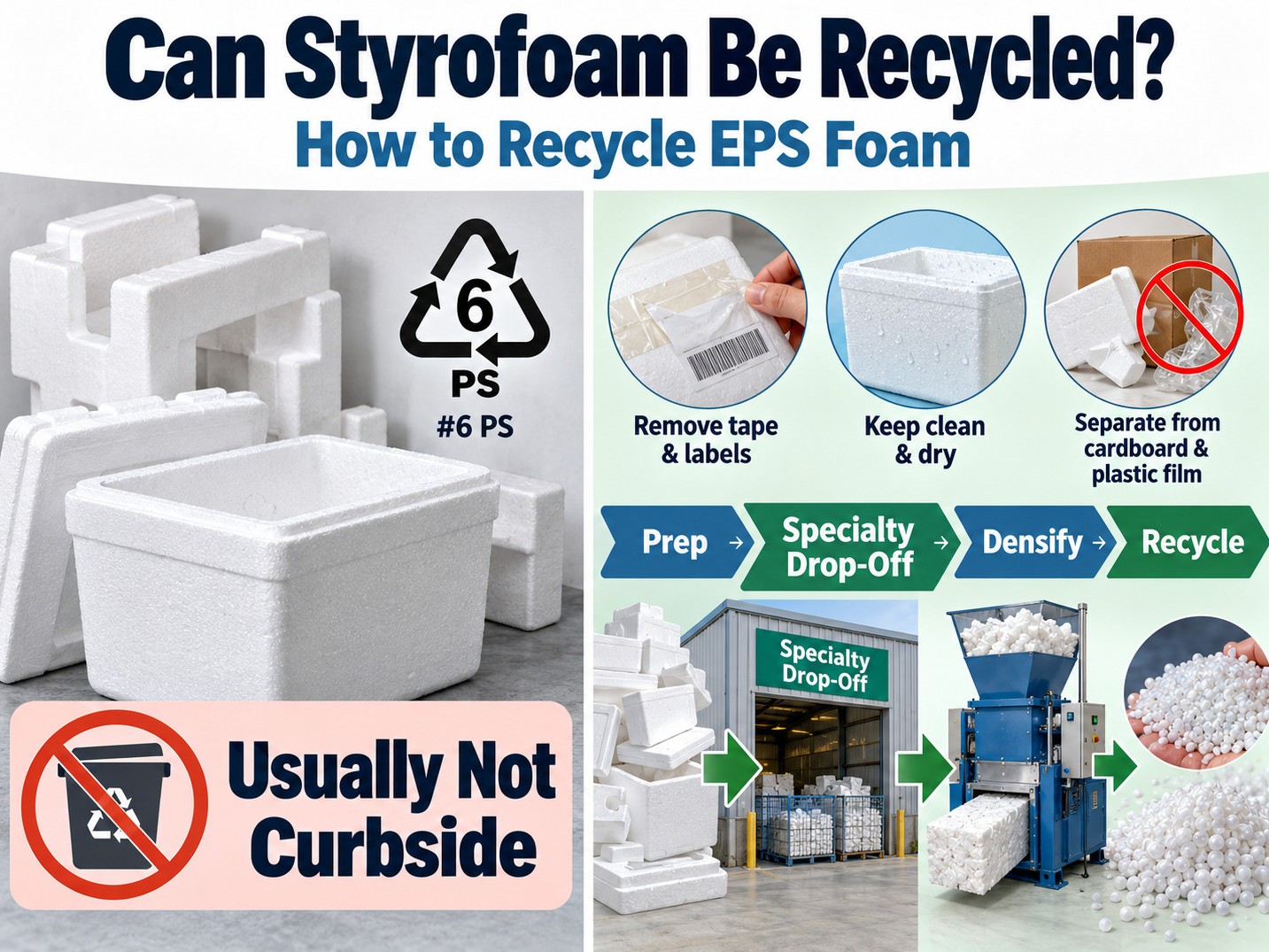
Foam cups, coolers and the molded white packaging that protects televisions and appliances are often called Styrofoam, but recycling them is not as simple as looking for a recycling symbol. Some expanded polystyrene foam can be recycled through specialty programs, while most curbside recycling systems do not accept it.
The number identifies polystyrene resin. It does not guarantee that your local recycling program can collect, sort or market the particular foam product.
- Expanded polystyrene (EPS) foam can be recycled, but very few U.S. communities accept it through normal curbside recycling.
- The white foam commonly called “Styrofoam” is usually EPS; Styrofoam™ is actually a trademark for a different polystyrene product known as XPS insulation.
- Clean molded packaging and some EPS coolers are among the foam products most likely to qualify for specialty recycling.
- Food-service foam, packing peanuts, construction insulation and flexible foams may follow different rules and should never be assumed acceptable.
- Before drop-off, remove tape, labels, film, cardboard, food and other contaminants and confirm the recycler's exact requirements.
Can Styrofoam Be Recycled?
If by “Styrofoam” you mean the white rigid foam commonly used for shipping protection, coolers and some food-service products, the material is usually expanded polystyrene, or EPS.
EPS can technically be recycled and dedicated recycling programs do exist. The problem is access.
The U.S. Environmental Protection Agency says very few localities accept polystyrene foam through curbside recycling. That means putting EPS into a household recycling cart simply because it carries a #6 symbol can create a rejected item rather than a recycled one.
Specialty drop-off programs, dedicated foam recyclers and certain community collection events can provide another route.
The practical question is therefore not simply, “Is EPS recyclable?” It is:
“Is this exact type of EPS accepted by a recycling program available to me?”
Styrofoam vs. EPS: They Are Not Technically the Same Thing
Styrofoam™ is a DuPont trademark for extruded polystyrene, or XPS, insulation. It is a rigid building material.
The white foam cups, takeout containers, coolers and protective packaging commonly called “Styrofoam” are generally made from expanded polystyrene, or EPS.
The distinction is useful because recyclers may accept one type of polystyrene foam while rejecting another.
This guide focuses primarily on EPS packaging foam, since that is the material most households are trying to recycle when they search for “Styrofoam recycling.”
How Can You Identify EPS Foam?
EPS is a rigid, very lightweight cellular form of polystyrene. It is frequently used to cushion products or provide thermal insulation during shipping.
Common examples include:
- Molded packaging around televisions and electronics
- Protective appliance packaging
- Foam shipping coolers
- Some food-service cups and containers
- Foam egg cartons
- Some produce, meat and food trays
- Other molded protective packaging
The material may carry a #6 PS Resin Identification Code.
But #6 does not exclusively identify EPS foam. Polystyrene is also manufactured into rigid plastic products, so the number alone does not tell you whether the item belongs in a foam recycling program.
For a complete explanation of all seven plastic codes, see RecyclingMonster's Plastic Recycling Numbers 1–7 Guide.
Why Is EPS Foam Hard to Recycle?
One of EPS's most useful properties as packaging creates one of its biggest recycling challenges: it is extremely light for its volume.
The EPS Industry Alliance describes EPS as approximately 98% air. That makes it effective for lightweight cushioning and insulation, but it also means loose foam takes up substantial truck and storage space while providing comparatively little plastic material by weight.
Transporting loose EPS over long distances can therefore be inefficient.
Dedicated programs address this problem by compacting or densifying the foam before longer-distance transportation.
An industry recycling manual illustrates the scale of that difference: a large trailer carrying loose EPS can hold only a fraction of the weight it can carry after the same material has been baled or densified.
Contamination creates another challenge. Tape, labels, plastic film, cardboard, dirt and food can interfere with a recycler's process and reduce the value of collected material.
Why Doesn't Most Curbside Recycling Accept Foam?
Conventional curbside programs are designed around materials their local materials recovery facilities can reliably identify, separate and market.
EPS requires a collection and processing system capable of handling a low-density foam stream and, frequently, equipment that can compact or densify it economically.
Most curbside programs do not have that system in place.
EPA therefore directs consumers to check for specialty drop-off opportunities rather than assuming foam belongs in the household recycling bin.
RecyclingMonster's guide to materials recovery facilities explains how household recyclables are sorted and why an item made from recyclable material can still be incompatible with a particular processing system.
Which Types of Foam Are Most Likely to Be Accepted?
Every foam recycler sets its own acceptance rules, but clean EPS protective packaging is generally the material most commonly targeted by dedicated recycling programs.
| Foam Item | Typical Recycling Route | What to Check |
|---|---|---|
| Molded EPS packaging | Specialty EPS drop-off or dedicated recycler | Usually needs to be clean and free of tape, labels, film and cardboard. |
| EPS shipping coolers | Specialty EPS recycling where accepted | Empty completely and check whether the recycler accepts coolers. |
| Foam cups and takeout containers | Highly program-specific | Many specialty packaging programs exclude food-service foam, even when the item is clean. |
| Foam meat and produce trays | Often excluded | Food contamination and program restrictions frequently prevent acceptance. |
| Foam egg cartons | Check local specialty program | Some programs accept them; others accept only protective packaging. |
| EPS packing peanuts | Reuse or specialty program where specifically accepted | Do not assume all packing peanuts are polystyrene or accepted with molded EPS. |
| XPS construction insulation | Construction-specific recovery program where available | Do not mix automatically with household EPS packaging. |
| Flexible or squishy foam | Material-specific specialty route | It may be polyurethane, polyethylene or another material rather than EPS. |
How to Prepare EPS Foam for Recycling
Preparation requirements vary, but clean material is central to most EPS recycling programs.
Look for product information or a #6 PS marking when available, but remember that the recycling program must still accept the specific product format.
Dedicated EPS programs commonly require packaging to be free of shipping tape, adhesive labels and attached materials.
Separate boxes, bags, shrink wrap and other packaging components before taking EPS to a specialty recycler.
Dirt, paint, food and other residues can make otherwise recyclable EPS unacceptable to a processor.
Do not mix EPS with construction foam, flexible foam or other plastic products unless the receiving program explicitly accepts them together.
Ask about accepted product types, colors, quantity limits, residential or commercial restrictions, fees and operating hours.
Does EPS Need to Be Clean and Dry?
Yes, for most specialty recycling programs.
The EPS Industry Alliance's recycling guidance calls for clean packaging without food, dirt, tape, paint, plastic film or glued-on cardboard.
This matters because contamination has to be removed before the polystyrene can be reprocessed.
Do not assume that washing a foam food tray automatically makes it acceptable, however. A recycling program may prohibit food-service EPS regardless of cleanliness.
Can Foam Food Containers Be Recycled?
Sometimes, but access is considerably more limited than for clean protective packaging.
Foam cups, plates, takeout containers, egg cartons and meat trays may be made from EPS, but dedicated packaging recyclers frequently apply stricter rules to food-service products.
For example, the EPS Industry Alliance's mail-back program accepts qualifying packaging foam but specifically excludes meat trays, cups, egg cartons and other disposable food-service items.
Local programs can be different. A 2026 Greensboro collection event covered by RecyclingMonster accepted specified clean foam food-service products while excluding other foam categories.
The correct rule is therefore:
Never assume food-service foam belongs in either curbside recycling or an EPS drop-off. Check the specific program.
Can Foam Packaging From Electronics and Appliances Be Recycled?
This is often one of the better candidates for specialty EPS recycling.
Large molded pieces used around televisions, computers, furniture and appliances are commonly made from clean EPS and have not been in contact with food.
Remove all tape, labels, film and cardboard first, then locate a program specifically accepting EPS protective packaging.
If the foam came attached or glued to another material, ask the recycler whether it must be separated before delivery.
Can EPS Coolers Be Recycled?
Some programs accept clean EPS shipping coolers, particularly those used to transport food, medicines or temperature-sensitive products.
Coolers should be completely empty and free from labels, tape, liners and other contaminants unless the recycler gives different instructions.
EPS-IA's current mail-back program specifically provides a procedure for qualifying EPS coolers, although the customer pays shipping costs.
Can Packing Peanuts Be Recycled?
Packing peanuts require separate confirmation.
Some are made from expanded polystyrene, while others are made from different materials, including starch-based products.
Even when the peanuts are EPS, a recycler that accepts molded protective blocks may not accept loose peanuts.
Reuse can be a practical first option when clean packing material is still functional, but businesses and specialty collection programs set their own acceptance policies.
Do not place loose packing peanuts into curbside recycling unless your program explicitly instructs you to do so.
Is All #6 Plastic Styrofoam?
No.
The number 6 identifies the resin family polystyrene, or PS.
Polystyrene can be manufactured as foam or as a rigid plastic. That means two products carrying #6 can behave differently in a recycling system.
The resin code identifies the material; it does not establish curbside acceptance.
RecyclingMonster's Recycling Symbols Explained guide covers why recycling arrows and resin numbers should not be treated as automatic disposal instructions.
Where Can I Recycle Styrofoam or EPS Near Me?
Start with your municipal recycling program. If EPS is not accepted curbside, check specialty recycling options.
- Search RecyclingMonster's Recycle an Item finder for Expanded Polystyrene Packaging, Plastic #6, Plastic Foam or related material names.
- Browse Plastic Recycling Centers and confirm which facilities specifically accept EPS.
- Check municipal transfer stations or special hard-to-recycle drop-off programs.
- Look for temporary community foam collection events.
- Use a dedicated EPS recycler or manufacturer collection program when available.
- For qualifying U.S. packaging foam, consider an EPS mail-back option when local recycling is unavailable.
The EPS Industry Alliance currently says its North American map includes more than 700 EPS recycling opportunities across the United States and Canada. That does not mean every resident has convenient access or that every site accepts every foam product.
Always contact the location before traveling.
Can EPS Be Mailed to a Recycler?
For some U.S. consumers, yes.
The EPS Industry Alliance maintains a mail-back program for qualifying EPS packaging when a convenient local collection route is unavailable.
The program requires EPS to be clean and free of tape, labels, film, loose parts, attached cardboard, food and other waste.
Its mail-back program does not accept disposable food-service products such as meat trays, cups and egg cartons.
Consumers are responsible for preparing and shipping the material to a participating location, so mail-back may make more sense for some quantities and circumstances than others.
What Happens to EPS After It Is Collected?
Once a recycler receives acceptable foam, the goal is to turn a bulky, low-density material into a concentrated polystyrene feedstock that can move efficiently to downstream processors.
A typical process can include:
1. Inspection & Sorting
Workers remove unacceptable foam types and contaminants such as tape, film, cardboard and dirt.
2. Size Reduction
The material may be broken or ground into smaller pieces depending on the recycling system.
3. Densification
Specialized equipment compresses or thermally densifies the lightweight foam into compact blocks or another concentrated form.
4. Transportation
The denser material can be shipped more economically than loose foam.
5. Reprocessing
The recovered polystyrene can be processed into recycled resin or other usable feedstock.
6. New Products
Depending on the processor and market, recycled EPS can be incorporated into durable plastic products or new polystyrene applications.
EPS-IA reports recycled EPS going into applications including new packaging, furniture, automotive products and other durable goods.
What Is an EPS Densifier?
A densifier solves one of the biggest logistical problems in foam recycling: volume.
Instead of transporting a trailer filled primarily with air, a recycler compresses EPS into a much denser form.
Different densification technologies operate differently. Some mechanically compact the foam; others use heat in the consolidation process.
The result occupies substantially less space, reducing the transportation burden and making it more practical to move recovered polystyrene to a downstream processor.
RecyclingMonster reported on this approach when Kent County, Michigan opened a dedicated foam recycling drop-off station. Collected material is compacted into dense blocks before being sent for manufacture into new products.
Is EPS Recycling Actually Happening?
Yes, but it remains a specialty recycling stream rather than a universally accessible curbside material.
EPA's consumer guidance makes the access problem clear: very few localities accept polystyrene foam at the curb.
At the same time, industry collection infrastructure has expanded. The EPS Industry Alliance said in 2025 that it had added 165 locations to its recycling map, bringing the listed North American total to approximately 700 locations.
Its most recent published recycling survey reports that 61.6 million pounds of post-consumer EPS were recycled in North America in 2022. The survey was conducted by Resource Recycling Systems for EPS-IA and participation was voluntary, so the figures should be understood as industry-reported recycling data rather than a federal recycling statistic.
Both facts can be true at once: EPS can be mechanically recycled at dedicated facilities, while practical household access remains limited in many areas.
Why Does How2Recycle Treat EPS Differently From Common Bottles and Jugs?
National recyclability labels consider more than whether a polymer can technically be processed.
How2Recycle evaluates collection access, sortation, technical recyclability and end markets. Its guidance has classified EPS packaging as Not Yet Recyclable at the national labeling level in the United States and Canada.
Under How2Recycle's current framework, a Not Yet Recyclable designation applies when fewer than 20% of people have access or when significant sortation, reprocessing or end-market obstacles exist.
This does not mean an EPS item can never be recycled.
It means a national packaging label cannot tell the average consumer to place it into conventional recycling when access remains too limited.
Can Black Foam Be Recycled?
Do not assume it can.
Color restrictions vary among specialty foam recyclers. Some programs accept only clean white EPS, while others accept additional colors.
For example, a recent Greensboro specialty event accepted certain clean EPS items but specifically excluded black foam.
That restriction belongs to that program and should not be treated as a universal rule.
Check the receiving recycler's current specifications.
Can Construction Foam Be Recycled With Packaging Foam?
Not automatically.
Building insulation can involve EPS, XPS and other foam products, with different additives, densities, colors and applications.
Styrofoam™ Brand itself is XPS building insulation, not EPS packaging.
A household packaging collection site may specifically exclude blue, pink, grey or other construction insulation even when the material is a form of polystyrene.
Construction contractors and businesses should look for a recycler that explicitly handles the relevant building-material grade rather than placing construction foam into a consumer packaging drop-off.
What If No EPS Recycling Is Available?
Do not put foam into the recycling cart in the hope that the facility will find a use for it.
If your curbside program does not accept the material and no practical specialty route is available, follow your local waste provider's disposal instructions.
Before disposal, reuse may be practical for clean protective packaging, shipping coolers or packing material that remains functional.
The important principle is the same one that applies throughout recycling:
“Recyclable somewhere” is not the same as “accepted in my recycling bin.”
Seven EPS Recycling Mistakes to Avoid
1. Putting EPS in Curbside Recycling Without Checking
EPA says very few localities accept polystyrene foam through normal curbside programs.
2. Assuming #6 Means Accepted
The resin code identifies polystyrene; it does not establish your local recycling route.
3. Leaving Tape and Labels Attached
Dedicated recyclers commonly require clean foam without attached packaging materials.
4. Mixing Food-Soiled Foam With Packaging EPS
Food contamination can make foam unacceptable, and some programs exclude food-service EPS entirely.
5. Mixing Every Foam Type Together
EPS, XPS, polyurethane and polyethylene foams are different materials and may require different recycling routes.
6. Assuming Every EPS Drop-Off Accepts Packing Peanuts
Programs often have format-specific rules. Confirm loose packing material separately.
7. Driving to a Recycler Without Confirming Acceptance
Colors, quantities, residency, business material and product types can all affect whether a facility accepts your foam.
How to Find an EPS Foam Recycler Near You
First identify the item as accurately as possible.
Then:
- Check your municipal recycling rules. Confirm whether foam is accepted curbside or through a local drop-off.
- Search RecyclingMonster. Use Recycle an Item for Expanded Polystyrene Packaging, Plastic #6 or Plastic Foam.
- Browse plastic recyclers. Search the Plastic Recycling Centers directory.
- Check dedicated EPS programs. Specialty foam recyclers may accept products that standard MRFs do not.
- Look for community collection events. Some municipalities periodically collect hard-to-recycle foam.
- Consider mail-back for qualifying packaging. This can provide an option when local EPS recycling is unavailable.
- Call before traveling. Confirm the exact type, color, cleanliness, amount and source of the foam.
The Bottom Line on Styrofoam and EPS Recycling
Expanded polystyrene provides a good example of why the word recyclable needs context.
EPS is a polystyrene material that can be collected, densified and reprocessed. Dedicated recycling programs exist, and access has expanded in parts of North America.
But that does not make EPS a conventional curbside recyclable.
EPA still says very few localities accept polystyrene foam at the curb. The correct route is usually a dedicated foam drop-off, specialty recycler, collection event or, for qualifying packaging, a mail-back program.
Before recycling EPS, identify the material, remove contaminants and check exactly what the receiving recycler accepts.
When no appropriate recycling option exists, follow local disposal rules rather than adding foam to a recycling stream that is not designed to handle it.
Frequently Asked Questions About Styrofoam and EPS Recycling
Can Styrofoam go in the recycling bin?
Usually not. EPA says very few U.S. localities accept polystyrene foam through curbside recycling. Use a specialty drop-off or foam recycling program when one is available.
What number is Styrofoam or EPS?
Expanded polystyrene is part of the #6 PS resin category. The #6 code identifies polystyrene but does not guarantee that a particular foam item is accepted for recycling.
Where can I recycle EPS packaging?
Options may include dedicated EPS recyclers, municipal specialty drop-offs, community collection events and certain mail-back programs. RecyclingMonster's Recycle an Item finder can also be used to search for nearby facilities.
Does EPS need to be clean before recycling?
Yes. Specialty recyclers commonly require EPS to be clean and free from food, dirt, tape, labels, plastic film, cardboard and other contamination.
Is Styrofoam the same as EPS?
Not technically. Styrofoam™ is DuPont's trademark for extruded polystyrene, or XPS, insulation. The white foam packaging and cups commonly called Styrofoam are generally expanded polystyrene, or EPS.
Primary Sources and Verification
This guide was reviewed against current federal, packaging-labeling and EPS recycling guidance available on October 19, 2026.
- U.S. Environmental Protection Agency — How Do I Recycle Common Recyclables?
- DuPont — Styrofoam™ Brand XPS and Styrofoam Is Not a Cup
- EPS Industry Alliance — North American EPS Recycling Map
- EPS Industry Alliance — EPS Mail-Back Program
- EPS Industry Alliance — EPS Recycling How-To Manual
- EPS Industry Alliance / Resource Recycling Systems — 2022 EPS Recycling Report
- How2Recycle — Recyclability Designations and EPS Labeling Guidance
Last verified: October 19, 2026.