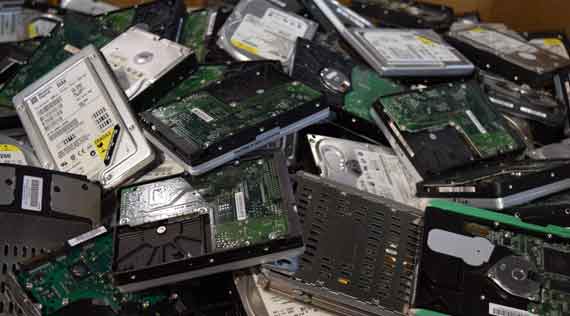
Scrap hard drives are a recoverable electronic waste stream generated by computers, servers, data centers and other electronic systems. Traditional hard disk drives (HDDs) contain aluminum, steel, copper, magnets and electronic circuit boards. Recycling these materials also requires attention to information security because discarded drives may still contain confidential data.
Hard-drive scrap prices vary according to the device's construction, condition, circuit board content, material grade and buyer requirements. Complete drives, drives with removed circuit boards and separated hard-drive boards may be purchased as different grades.
Hard Drive Scrap: Quick Facts
- Material category: Electronic scrap (e-scrap)
- Common sources: Desktop PCs, laptops, servers, storage arrays and data centers
- Common scrap grades: Complete hard drives, hard drives with boards, hard drives without boards and separated circuit boards
- Recoverable materials: Aluminum, steel, copper, magnets and electronic components containing small quantities of precious metals
- Important value factors: Drive type, circuit board content, condition, sorting and buyer specifications
- Data security: Appropriate sanitization or destruction is required before disposal or resale of drives containing sensitive data
- Potential buyers: Electronics recyclers, IT asset disposition companies, e-scrap processors and specialized scrap buyers
What Are Hard Drives?
A hard disk drive (HDD) is a non-volatile data storage device that records and retrieves digital information using magnetic technology. Unlike temporary computer memory, a hard drive can retain stored data after power is disconnected.
Traditional HDDs contain one or more rotating platters coated with magnetic recording material. Read/write heads move across the platter surfaces to access stored information. The drive also contains a spindle motor, actuator assembly, electronic control board and protective housing.
Hard-drive platters may use aluminum alloy or glass-based substrates, depending on the design. The housing is commonly made from cast aluminum, with a separate cover and other components made from various metals and materials. Hard drives should not be assumed to have platinum-plated platters or stainless steel outer housings.
Important distinction: Solid-state drives (SSDs) also store computer data, but they use semiconductor memory rather than rotating magnetic platters. SSDs have different construction, recycling characteristics and data-sanitization considerations.
What Materials Are Found Inside a Hard Drive?
The composition of a hard drive varies by manufacturer, model, size and generation. Common recoverable components include:
- Aluminum: Frequently used in the drive housing and in certain platter substrates.
- Steel: Present in covers, fasteners and structural or magnetic components.
- Copper: Found in motor windings, actuator coils, electrical connections and circuit board features.
- Magnets: Strong permanent magnets, often using rare-earth magnetic materials, may be present in the actuator assembly.
- Printed circuit boards: Contain electronic components, copper circuitry and contacts that may include small quantities of precious metals.
- Glass-based platters: Used in certain hard-drive designs instead of aluminum-based platters.
Although precious metals can contribute to the recovery value of electronic components, most of a complete HDD's physical mass is not precious metal.
Types of Hard Drive Scrap
Electronics scrap processors may classify hard drives according to their configuration and the presence of recoverable circuit boards.
1. Complete Hard Drives
Complete HDDs retain their housings, internal mechanisms and electronic circuit boards. They are typically received as whole units for reuse evaluation, secure data processing or material recycling.
Some buyers require attached circuit boards, while others maintain separate categories for drives that have undergone approved destruction.
2. Hard Drives With Circuit Boards
This grade refers to hard drives retaining their external electronic control boards. These boards can contribute to the recoverable value of the complete unit.
Buyers may distinguish these drives from units with missing or removed boards. The precise definition should be confirmed against the buyer's purchasing specifications.
3. Hard Drives Without Circuit Boards
Drives from which the circuit boards have been removed may be purchased separately, often at a different rate. Their remaining value comes largely from the housing, internal metal components and other recoverable materials.
Removing a circuit board does not reliably sanitize the data stored on an HDD's platters.
4. Hard Drive Circuit Boards
Separated hard-drive printed circuit boards may be purchased as a specialized electronic scrap grade. Their recovery value depends on construction, component population, metal content and the buyer's classification.
Some hard-drive board grades command higher prices per unit of weight than complete drives. However, they should not automatically be classified above all computer motherboards because electronic board grades and precious-metal yields vary.
5. Solid-State Drives (SSDs)
SSDs are electronic data storage devices using non-volatile semiconductor memory. They do not contain rotating platters or conventional HDD actuator assemblies.
SSDs may enter the same IT asset disposition stream as HDDs, but should be identified separately where the buyer's material specifications or data-sanitization procedures require it.
How to Identify and Grade Scrap Hard Drives
Correct identification helps distinguish complete drives from circuit-board scrap, incomplete units and other electronic storage devices.
- Check the device label: Identify the manufacturer, model and whether the unit is an HDD or SSD.
- Inspect the enclosure: Traditional HDDs generally have a rigid metal housing containing the platter and actuator assemblies.
- Check the circuit board: Determine whether the external electronic control board remains attached.
- Inspect physical condition: Note broken housings, exposed internal components and signs of previous dismantling.
- Separate device types: Keep HDDs, SSDs and loose circuit boards apart when required by the receiving buyer.
- Confirm security status: Record whether each drive is awaiting sanitization, has been sanitized, or has undergone verified physical destruction.
Grading note: Hard-drive storage capacity and age may matter when assessing reuse value, but they do not independently establish the scrap metal value of a drive.
What Affects Hard Drive Scrap Prices?
Hard-drive scrap prices reflect the buyer's grade requirements, recoverable materials, processing costs and relevant market conditions.
Important pricing factors include:
- Complete versus incomplete: Units with circuit boards may be priced differently from stripped drives.
- Circuit board content: Board size, construction and electronic component content can affect classification.
- Recoverable metals: Aluminum, copper, steel and precious-metal-bearing components contribute to material recovery economics.
- Material condition: Excess contamination, mixed material or damaged components can affect buyer acceptance.
- Sorting quality: Consistent grades make commercial lots easier to evaluate.
- Shipment quantity: Bulk lots may qualify for different transportation and purchasing terms.
- Data destruction services: Sanitization, secure transportation, documentation and physical destruction can create additional processing costs.
- Buyer location and demand: Local capacity, transportation costs and market conditions can affect the net payment.
Hard Drive Scrap Prices
Review available RecyclingMonster price records below. Check each record's reporting date, location, material description and price unit before using it as a market comparison.
The prices listed below are country averages paid by recycling centers in the United States
| Scrap Material | National Average | High Price | Low Price | Unit | Updated |
|---|---|---|---|---|---|
| Hard Drive Boards | $4.06 | 4.06 | 4.06 | USD/LB | 2024-03-20 |
| Hard Drives - Incomplete | $0.09 | 0.09 | 0.09 | USD/LB | 2024-03-20 |
| HARD DRIVES W/O BOARDS | $0.12 | 0.12 | 0.12 | USD/LB | 2024-03-20 |
| HARD DRIVES W/BOARDS | $0.36 | 0.36 | 0.36 | USD/LB | 2023-05-05 |
| Hard Drives Scrap | $0.46 | 0.47 | 0.46 | USD/LB | 2019-09-25 |
For grade-specific comparisons, explore the Hard Drives Scrap Price Guide and Hard Drives With Boards Prices.
These are distinct material categories. Historical price records should not be interpreted as guaranteed current purchasing offers.
Hard Drives vs. Hard Drive Circuit Boards: Which Are More Valuable?
Separated hard-drive circuit boards can have a higher value per pound than complete mechanical hard drives because they concentrate electronic components and metal-bearing circuitry into a smaller mass.
However, price per pound is not the same as the total recoverable value of a complete drive. Removing boards also introduces labor, handling and data security considerations. Recyclers should compare the net value of processing and selling each grade rather than assuming dismantling will always increase returns.
RecyclingMonster's Electronics Scrap Price Guide includes additional electronic material categories for comparison.
How to Prepare Hard Drives for Recycling
Preparation should begin with data protection, followed by sorting and packaging according to the recycler's requirements.
- Inventory the drives: Record quantities, device types and identifying information needed for tracking.
- Assess reuse potential: Determine whether functioning drives are eligible for approved reuse or resale.
- Protect stored information: Arrange appropriate data sanitization or destruction before uncontrolled transfer or material processing.
- Separate HDDs and SSDs: Keep different storage technologies distinguishable where their processing requirements differ.
- Confirm the purchasing grade: Ask whether the buyer accepts whole drives, destroyed drives or separated circuit boards.
- Package securely: Prevent loose drives from shifting or becoming damaged during transport.
- Maintain records: Document collection, transfer, sanitization or destruction where required.
Do not open hard-drive enclosures or remove circuit boards solely to prepare material for sale without considering the receiving buyer's security and processing requirements.
Secure Hard Drive Data Destruction
Data security is one of the most important considerations in hard-drive recycling. Deleting files, formatting a drive or removing its circuit board does not necessarily make the underlying stored information unrecoverable.
The U.S. National Institute of Standards and Technology (NIST) publishes SP 800-88 Revision 2, Guidelines for Media Sanitization, issued in September 2025. It provides a framework for selecting and managing appropriate media sanitization methods according to organizational risk and information sensitivity.
Clear, Purge and Destroy
- Clear: Uses appropriate logical techniques to protect against recovery through the normal device interface, subject to the applicable method and verification requirements.
- Purge: Uses stronger logical or physical techniques intended to make recovery infeasible even against more advanced recovery capabilities, when properly supported and implemented.
- Destroy: Physically destroys the storage media through an appropriate process when reuse is not intended and the required sanitization outcome demands destruction.
The correct method depends on the storage technology, device condition, sensitivity of the information and applicable organizational policies.
Important: Not every data-wiping method works on every drive. Damaged or nonfunctional drives may require a different treatment from functioning drives. HDDs and SSDs should not automatically be assigned identical procedures.
Certificate of Data Destruction
Some professional service providers issue certificates or other records documenting the sanitization or physical destruction of storage media.
For commercial transactions, request documentation identifying the service provider, the media or batch processed, the method used, relevant dates and the reported completion or verification status.
A certificate is supporting documentation, not independent proof that an unsuitable process was effective. Buyers and generators should assess the provider's procedures, verification practices and chain of custody.
How Are Scrap Hard Drives Recycled?
Professional hard-drive recycling operations may combine secure data handling, reuse evaluation, dismantling, mechanical processing and downstream metal recovery.
A typical recycling sequence can include:
- Collection and registration: Drives are received, identified and documented.
- Data sanitization or destruction: Storage media are treated according to the applicable security requirements.
- Reuse assessment: Suitable equipment may be directed to authorized refurbishment or reuse after appropriate data protection.
- Mechanical processing: End-of-life drives may be dismantled or processed using controlled equipment.
- Material separation: Aluminum, ferrous metals, copper-bearing components, magnets and circuit boards may enter separate recovery streams.
- Downstream recovery: Recovered fractions are transferred to suitable processors or refiners.
- Residual management: Non-recovered materials and processing residues are handled under applicable requirements.
Different facilities use different technologies. Shredding is one possible process but is not the only method of managing end-of-life drives. Data destruction and material recycling are related services with distinct performance objectives.
Where Can You Sell or Recycle Hard Drives?
Not every scrap metal yard purchases hard drives. Suitable destinations may include electronics recyclers, specialized e-scrap buyers, IT asset disposition companies and facilities providing secure media destruction.
Before selecting a buyer, confirm whether the facility accepts complete drives, drives without circuit boards, loose hard-drive boards or SSDs. Ask separately whether secure data sanitization, physical destruction and written documentation are available.
Hard Drive Scrap: Prices, Recycling & Data Destruction - Material Specifications, How to Sell & Current Price accepting recycling centers in the United States
- A-Plus Industry, Inc.415 N 15th St
Allentown,Pennsylvania - Wilenta Carting, Inc46 Henry Street
Secaucus,New Jersey - Go GarbageP.O. Box 54
Stirling,New Jersey - Perkasie PC Repair & Recycling1133 N 5th St
Perkasie,Pennsylvania - H&C Metals, Inc227 Clifford Street P.O. Box 5150
Newark,New Jersey
Use RecyclingMonster's Hard Drive Recycling Centers Directory to identify listed facilities, then verify current acceptance and service terms directly.
Bulk Hard Drive Recycling for Businesses and Data Centers
Corporate IT departments, data centers, government agencies, universities, hospitals, managed service providers and electronics refurbishers may generate substantial quantities of retired storage devices.
Bulk disposal programs need to account for information security and the commercial value of recovered equipment and materials.
Questions to Ask a Commercial Recycling Provider
- Does the facility accept both HDDs and SSDs?
- Are on-site collection and secure transportation available?
- What chain-of-custody controls are maintained?
- Which sanitization and destruction methods are offered?
- How are outcomes verified and documented?
- Can individual drives or asset identifiers be tracked?
- Are reusable devices separated from material-recovery streams?
- What material grades and purchasing terms apply?
- Are service, logistics and destruction fees charged separately?
- What certifications and downstream processing controls apply?
On-site services, collection arrangements and pricing depend on the provider and contract. Free collection, free shredding and guaranteed scrap payments should not be assumed.
Choosing a Responsible Hard Drive Recycler
In the United States, R2 and e-Stewards are recognized third-party electronics recycling certification programs. The U.S. Environmental Protection Agency encourages the use of certified electronics recyclers and identifies data security and asset management among relevant service considerations.
Certification does not mean every facility offers the same data destruction service or that all its operations have identical coverage. Verify the facility's current certification status, scope of services, data security capabilities and downstream handling practices.
For organizations managing sensitive information, the recycler's technical procedures, chain of custody and documentary controls should be evaluated alongside material recovery capabilities.
Frequently Asked Questions About Hard Drive Recycling
Do hard drives contain gold?
Hard drives may contain small amounts of gold in electronic contacts and circuit board components. The recoverable quantity depends on the design and should not be assumed from appearance alone.
Are hard drive circuit boards worth more than whole drives?
Separated hard-drive boards may command a higher price per pound than complete HDDs. However, total value depends on grade, weight, processing costs and buyer terms.
Does deleting files make a hard drive safe to recycle?
No. Ordinary file deletion does not necessarily sanitize stored information. Use an appropriate verified sanitization or destruction process before releasing drives containing sensitive data.
Can broken hard drives still contain recoverable data?
Yes. A damaged or nonfunctional HDD may retain readable information on its storage media. Physical damage alone does not establish successful data destruction.
Do electronics recyclers provide certificates of destruction?
Some providers offer certificates or detailed sanitization records, but the service is not universal. Confirm documentation and verification requirements before arranging collection or processing.
Related Electronics Scrap and Recycling Resources
Hard drives are one part of the broader electronic equipment recycling stream. Explore these related RecyclingMonster resources:
Material information notice: Scrap prices, acceptance requirements and data destruction services vary by facility and location. This guide is educational and does not guarantee a purchase price, certification status or specific sanitization outcome. Confirm service requirements and applicable regulations with qualified providers.