Short answer: What can go in your recycling bin depends on your local program. Common curbside materials include clean paper and cardboard, food and beverage cans, glass bottles and jars, and certain rigid plastic containers. Plastic bags, batteries, electronics and household hazardous waste generally require separate collection or drop-off instead.
- Cardboard, paper, food and beverage cans, glass bottles and jars, jugs and plastic bottles are among the most commonly accepted curbside materials in the United States.
- Plastic bags and wrap, electronics, most batteries and textiles generally do not belong in a standard curbside recycling bin.
- A recycling symbol or plastic resin number does not guarantee that a local program accepts the item.
- Plastic, metal and glass containers should generally be emptied and cleared of food residue; paper should be clean and dry.
- When curbside collection does not accept an item, RecyclingMonster can help locate material-specific recycling options.
The U.S. Environmental Protection Agency lists cardboard, paper, food boxes, mail, beverage cans, food cans, glass bottles, jars, jugs, and plastic bottles and caps among the most commonly recycled curbside items. The same guidance stresses that residents should still confirm acceptance with their local recycling provider before putting those materials in the bin.
That distinction matters. An item may be technically recyclable and still be unsuitable for your particular curbside program. The safest approach is to treat the local municipality or hauler’s accepted-material list as the final instruction for your address.
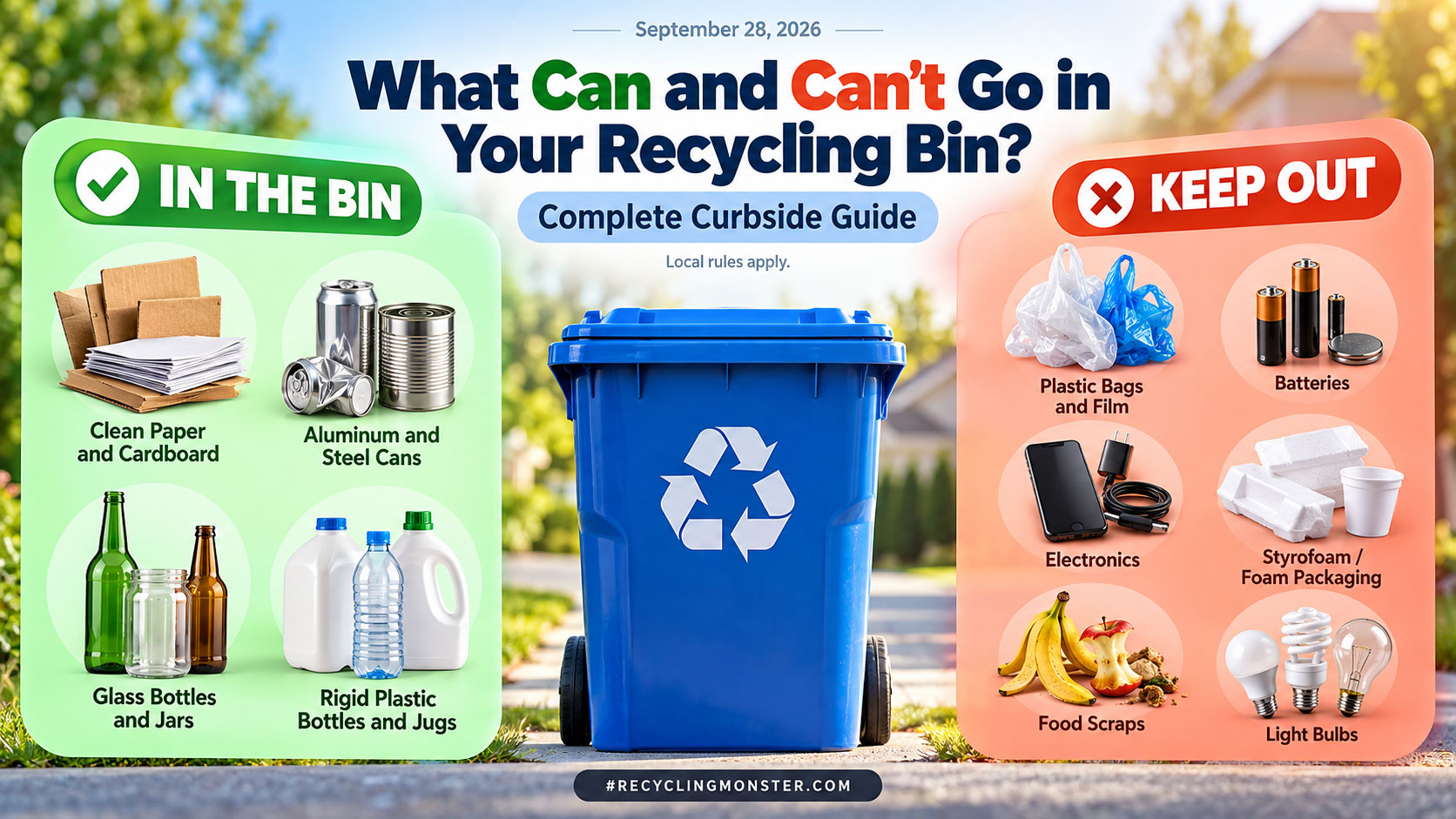
What Can Go in the Recycling Bin? Quick Yes, No and Depends Guide
The table below provides a practical U.S. baseline based on current EPA guidance. “Usually yes” means the material is commonly accepted, not universally accepted.
| Item or Material | Curbside Status | What to Do |
|---|---|---|
| Cardboard boxes | Usually yes* | Empty and flatten boxes. Keep them reasonably clean and dry. |
| Newspapers, magazines and office paper | Usually yes* | Keep paper clean and dry. |
| Mail and envelopes | Usually yes* | EPA identifies mail among commonly recycled curbside materials. |
| Paperboard food boxes | Usually yes* | Empty the box and keep the paperboard clean and dry. |
| Pizza boxes | Usually yes, but check locally | EPA says pizza boxes can be recycled even with some grease. Remove food scraps and flatten the box. |
| Shredded paper | Depends | Acceptance varies because loose shredded paper can be difficult for some programs to handle. |
| Aluminum beverage cans | Usually yes* | Empty the can. EPA advises against crushing cans in many single-stream programs because flattened cans can be harder to sort. |
| Steel or tin food cans | Usually yes* | Empty and rinse away food residue. Confirm with the local program. |
| Aluminum foil | Depends | EPA identifies aluminum foil as recyclable when food residue is removed, but local collection rules still apply. |
| Glass bottles and jars | Often yes; check locally | Many curbside programs accept container glass, but some communities do not collect glass curbside. |
| Broken glass | No | Do not place broken glass in the recycling bin. Follow local waste-authority instructions for safe disposal. |
| Plastic bottles and caps | Depends | These are commonly recycled, but acceptance depends on the local program and the type of plastic. |
| Plastic jugs and jars | Depends | Check local guidance. Empty containers and remove food residue before recycling. |
| Plastic tubs and cups | Depends | Programs differ significantly. The resin number alone does not establish local acceptance. |
| Plastic bags, wrap and film | No curbside | Keep them out of the household recycling bin. Some retailers and specialty programs collect clean film separately. |
| Polystyrene foam / Styrofoam | Usually not curbside | Very few localities accept foam in curbside programs. Look for a specialty option if available. |
| Plastic utensils | No | EPA guidance says plastic utensils cannot be recycled through standard household recycling. |
| Compostable plastic | No recycling bin | Compostable plastics are not intended for conventional recycling and can disrupt the recycling stream. |
| Batteries | No curbside | Most household battery types require separate handling. Use an approved battery or household hazardous-waste collection option. |
| Electronics | No curbside | Use an electronics collection site, retailer take-back program or appropriate recycler. |
| Clothing and textiles | Usually no curbside | Consider reuse, donation, retailer collection or a textile-recycling program where available. |
| Food and liquids | No | Keep food and liquids out of recycling bins. Food residue should be removed from recyclable containers. |
| Dirty diapers | No | Disposable diapers belong in the trash under EPA’s general guidance, not the recycling bin. |
| Light bulbs | Not standard curbside | Check local recycling, household hazardous-waste or retailer programs for the specific bulb type. |
| Paint and household hazardous waste | No | Use an appropriate household hazardous-waste or specialty collection program. |
| Propane tanks or cylinders | No | Do not put pressurized cylinders in a recycling bin. Follow local specialty-disposal instructions. |
| Unemptied aerosol cans | No | EPA identifies unemptied aerosol cans as a household hazardous-waste concern. Local rules apply to empty cans. |
| Garden hoses | No | EPA lists garden hoses among items that should never be put in a recycling bin. |
*“Usually yes” means commonly accepted according to national EPA guidance. Always confirm with your local recycling provider before placing the item in a curbside bin.
Paper and Cardboard: Keep It Clean and Dry
Paper and cardboard are among the most familiar curbside recyclables. EPA guidance identifies cardboard, paper, food boxes and mail among commonly recycled items. Newspapers and magazines are also recyclable in many community programs.
The main preparation rule is simple: paper should be empty, clean and dry. Flatten cardboard boxes before placing them in the bin. This saves space and makes the material easier to collect and process.
Pizza boxes cause more confusion than almost any other paper item. EPA currently says pizza boxes can be recycled even when some grease is present, provided food scraps are removed and the box is flattened. Local rules can still be more restrictive, so the local program remains the final authority.
Shredded paper is different. Some recycling programs accept it, while others do not because small pieces can be difficult to handle. If curbside collection does not take it, browse paper recycling centers listed by RecyclingMonster or check for a local document-destruction or paper-recovery program.
Metal Cans: Commonly Accepted, but Empty Them First
Beverage cans and food cans are among the materials EPA identifies as commonly recycled curbside. Aluminum foil can also be recycled, although acceptance may vary by local program.
Before recycling metal food packaging, remove food and liquid residue. EPA advises that plastic, metal and glass materials generally should be empty and rinsed clean of food debris before recycling.
One detail may surprise frequent recyclers: EPA recommends that aluminum cans generally not be crushed before recycling in single-stream systems because flattened cans may be more difficult for sorting equipment to identify. Multi-stream programs may operate differently.
If you have larger metal items or metal that does not belong in a household bin, use RecyclingMonster’s metal recycling directory to look for appropriate recyclers.
Glass Bottles and Jars: Often Accepted, Not Universal
Many curbside programs accept glass bottles and jars, and EPA notes that most curbside programs that collect glass can handle different container-glass colors together. Glass is still a local-rule material, however. Some communities do not include glass in curbside collection.
Broken glass should not be placed in the recycling bin. EPA warns that glass shards can injure workers and damage equipment. Follow your local waste authority’s instructions for broken glass rather than assuming it belongs with whole bottles and jars.
For container glass that is not accepted locally, check RecyclingMonster’s glass recycling directory for other options.
Rigid Plastics: The Number on the Container Is Not the Final Answer
Plastic bottles, caps, jugs and some jars are among the most commonly recycled plastic items, but plastics are also where local rules differ most noticeably.
A resin identification number on the bottom of a container identifies the type of plastic used to make the product. It does not guarantee that the item can be placed in your local recycling bin. EPA explicitly advises residents to check which plastic types their local provider accepts.
That means a container marked with a recycling-style triangle should not automatically go into the bin. First determine whether the local program accepts that specific type and form of plastic.
Plastic bags, wrap and film are a separate category. EPA says they should not go in the household recycling bin. Many retailers and specialty collection programs accept clean bags and film separately.
Polystyrene foam is another material with limited curbside acceptance. Very few localities accept it through standard household recycling. Plastic utensils should also stay out of the recycling bin, while compostable plastics belong in a composting pathway only where an appropriate program accepts them.
For plastics that are recyclable but not accepted at the curb, search RecyclingMonster’s plastic recycling centers or use the Recycle an Item finder to search by material and location.
Recycling Options to Get Rid of Shredded Paper
How to Recycle and Dispose of Different Types of Light Bulbs
What Should Never Go in a Standard Recycling Bin?
Some materials may be recyclable somewhere, but that does not make a household recycling cart the correct collection point.
Batteries
Most batteries should not go in a municipal recycling bin. This includes lithium-ion, lithium metal, lead-acid and many rechargeable batteries. These products require separate handling and should be taken to an appropriate battery collection, retailer program or household hazardous-waste location.
Lithium-ion batteries deserve particular attention because they should not be placed in household trash or municipal recycling bins. Use a dedicated collection pathway instead.
Electronics
Computers, televisions, phones and other electronics are not standard curbside recyclables. Manufacturers, retailers, municipalities and electronics recyclers may provide collection options. Before recycling a device that contains personal information, erase or otherwise secure the data it contains.
Household Hazardous Waste
Paint, solvents, pesticides, antifreeze, certain bulbs, unemptied aerosol cans and other potentially hazardous household products should not be mixed with ordinary curbside recyclables. Follow the requirements of the local household hazardous-waste program.
Plastic Bags and Other Flexible Film
Plastic bags and film can wrap around sorting equipment and are collected separately from household curbside recycling in most areas. Keep them out of the bin unless the local program explicitly instructs otherwise.
Textiles
Clothing and shoes generally do not belong in a curbside recycling cart. Items in usable condition may be candidates for reuse or donation, while some retailers and specialty textile programs accept worn materials.
Food and Liquids
Food is not a curbside recyclable. Keep food scraps and liquids out of recycling containers. Depending on the community, food scraps may have a separate composting or organics collection option.
How Clean Do Recyclables Need to Be?
Recyclables do not need to look factory-new, but they should not contain significant food or liquid residue.
EPA’s general guidance is that plastic, metal and glass materials should be empty and rinsed clean of food debris. Paper should be empty, clean and dry. For containers, scraping or rinsing away remaining food is normally the practical goal.
Do not use large amounts of water trying to make packaging spotless. The objective is to remove the material that can contaminate the recycling stream, not to turn used packaging into something that looks unused.
Why “Wishcycling” Creates Problems
Putting an item in the recycling bin because it looks recyclable does not make it recyclable within that collection system.
EPA warns that non-accepted materials can contaminate the recycling stream, damage equipment and create additional sorting and disposal costs for recycling facilities. Some collection systems also require materials to be separated, while others use single-stream collection.
The better rule is straightforward: recycle what your program accepts and find a separate pathway for everything else.
How to Check Your Local Recycling Rules
When an item is not clearly covered by the basic curbside list, use this order:
- Check your municipality or recycling hauler. Look for the current accepted-material list for your exact service area.
- Identify the material precisely. A plastic bottle, plastic bag and foam container may all be “plastic,” but they are handled very differently.
- Look for a specialty recycling option. Use RecyclingMonster’s Recycle an Item search or browse recycling centers by category and location.
- Confirm before making the trip. Individual recyclers may limit materials by form, quantity, condition or customer type.
Property managers can reduce confusion by posting the actual accepted-material list supplied by their hauler next to recycling stations rather than relying on a generic recycling symbol. The same rule applies in offices, schools and other shared buildings: the instructions at the bin should match the service actually being provided.
Find a Recycling Option by Material
When an item does not belong in your curbside bin, it may still have a recycling pathway.
RecyclingMonster allows users to search by material and location through the Recycle an Item finder. You can also browse household recycling centers, paper recyclers, glass recyclers, plastic recyclers and metal recycling centers.
Always confirm that a facility accepts your specific material before bringing it in.
Frequently Asked Questions
Can plastic bags go in the recycling bin?
Generally, no. EPA advises keeping plastic bags, wrap and film out of household curbside recycling. Retail or specialty collection programs may accept them separately.
Do recyclables need to be washed before they go in the bin?
They do not need to be spotless. EPA advises that plastic, metal and glass items should be empty and rinsed free of food debris, while paper should be empty, clean and dry.
Can a greasy pizza box be recycled?
EPA says pizza boxes can be recycled even with some grease. Remove leftover food and flatten the box, then confirm that your local program accepts pizza boxes.
Does the recycling symbol or plastic number mean an item can go in my bin?
No. A plastic resin number identifies the type of plastic but does not guarantee local recyclability. Your local recycling provider’s accepted-material list controls.
Can batteries and electronics go in the recycling bin?
Generally, no. Most batteries and electronics require separate collection through appropriate retailers, municipal programs or specialty recyclers.
Primary Sources and Verification
This guide was checked against current U.S. EPA recycling guidance, including:
- U.S. EPA: How Do I Recycle Common Recyclables?
- U.S. EPA: Frequent Questions on Recycling
- U.S. EPA: What You Can Do to Improve the Recycling Rate
Verification date: September 28, 2026. Local recycling acceptance changes independently of federal guidance, so readers should always confirm current requirements with their municipality or recycling service provider.